Week 1 Understanding Different Battery Chemistry
1.
Lithium-Ion:
A lithium-ion battery or Li-ion battery is a type of rechargeable battery in which lithium ions move from the negative electrode through an electrolyte to the positive electrode during discharge, and back while charging.
Lithium-ion batteries are used in most aspects of our everyday lives. Most devices like smartphones and laptops cannot operate without these batteries. Lithium-ion batteries have also become very important in the field of electromobility as it is now the battery of choice in most electric vehicles. Its high specific energy gives it an advantage over other batteries.
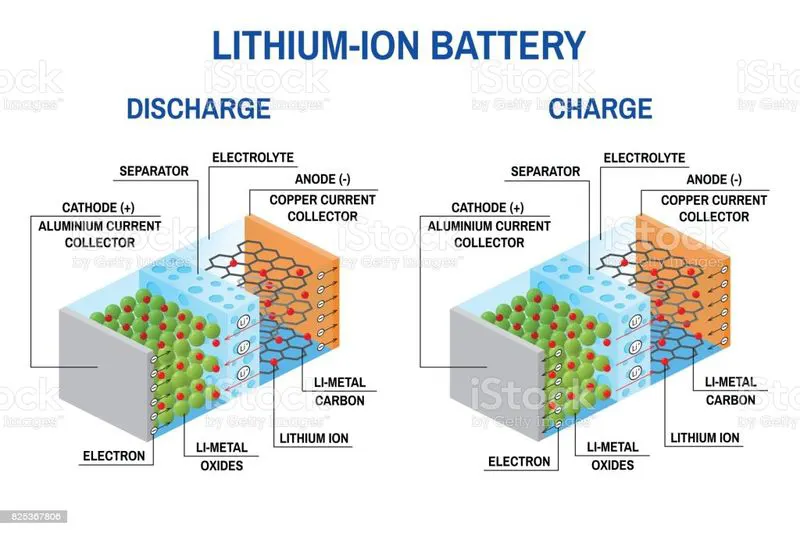
Here we have made a table to compare different type of lithium ion batteries cathode,anode,chemical reaction.
| TYPE OF LITHIUM ION CELLS | ANODE MATERIAL | CATHODE MATERIAL | SEPERATOR | REACTION at ANODE | REACTION at CATHODE | CHEMICAL REACTION (left to right discharging & right to left charging) | ELECTROLYTE |
| LITHIUM COBALT OXIDE(LCO) | Graphite Carbon (C6) |
Lithium Cobalt Oxide(LiCoO2) |
Polyolefin | LixC6→xLi++xe-+C6 | Li1-x CoO2+xLi++xe- →LiCoO2 |
LiC6 + CoO2⇄ C6 + LiCoO2 |
Lithium hexaflurophosphate (LiPF6)+ethylene carbonate |
| LITHIUM MANGANESE OXIDE(LMO) | Graphite Carbon (C6) |
Lithium Manganese Oxide(LiMn2O4) |
Polyolefin | LixC6→xLi++xe-+C6 | Li1-x Mn2O4+xLi++xe- →LiMn2O4 |
LiC6 + LiMn2O4 ⇄ C6 + LiMn2O4 |
Lithium hexaflurophosphate (LiPF6)+ethylene carbonate |
| LITHIUM NICKEL COBALT ALUMINIUM OXIDE(NCA) | Graphite Carbon (C6) | Lithium nickel cobalt aluminium oxide (LiNiCoAlO2) | Polyolefin | LixC6→xLi++xe-+C6 | Li1-x (NixCoyAlz)O2+xLi++xe- →Li(NixCoyAlz)O2 |
LiC6 + Li(NixCoyAlz)O2 ⇄ C6 + Li(NixCoyAlz)O2 |
Lithium hexaflurophosphate (LiPF6)+ethylene carbonate |
|
LITHIUM NICKEL MANGANESE COBALT OXIDE(NMC) |
Graphite Carbon (C6) | Lithium Nickel Manganese Cobalt Oxide(LiNiMnCoO2) | Polyolefin | LixC6→xLi++xe-+C6 | Li1-x (NixMnyCoz)O2+xLi++xe- →Li(NixMnyCoz)O2 | LiC6 + Li(NixMnyCoz)O2 ⇄ C6 + Li(NixMnyCoz)O2 |
Lithium hexaflurophosphate (LiPF6)+ethylene carbonate |
| LITHIUM IRON PHOSPHATE (LFP) | Graphite Carbon (C6) | Lithium Iron Phosphate (LiFePO4) | Polyolefin | LixC6→xLi++xe-+C6 | Li1-x FePO4+xLi++xe- →LiFePO4 | LiC6+FePO4 ⇄ LiFePO4+C6 |
Lithium hexaflurophosphate (LiPF6)+ethylene carbonate |
| LITHIUM TITANATE (LTO) |
Lithium Titanate (Li4Ti5O12) |
Lithium Manganese Oxide(LiMn2O4)or Lithium Nickel Manganese Cobalt Oxide(LiNiMnCoO2) |
Polyolefin | Li4Ti5O12→Ti5O12+4Li++4e- | 4Li 1-x Mn2O4+4Li++4e-→4LiMn2O4 | Li4Ti5O12+4Mn2O4 ⇄ 4LiMn2O4+Ti5O12 |
Lithium hexaflurophosphate (LiPF6)+ethylene carbonate |
2.
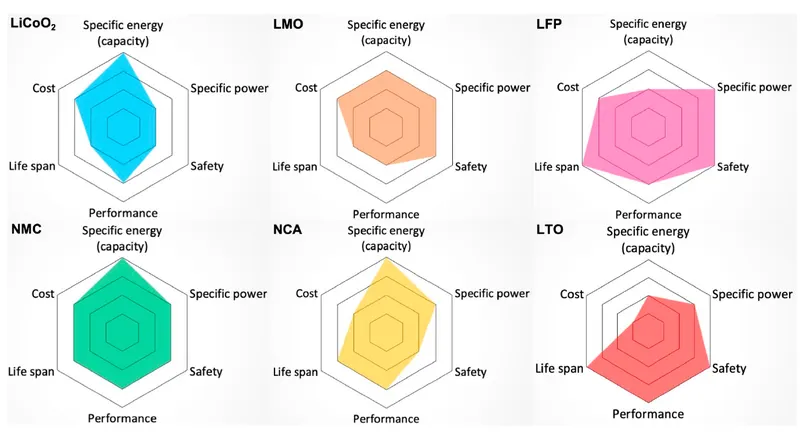
There are different types of lithium-ion batteries and the main difference between them lies in their cathode materials. Different kinds of lithium-ion batteries offer different features, with trade-offs between specific power, specific energy, safety, lifespan, cost, and performance.
The six lithium-ion battery types that we will be comparing are Lithium Cobalt Oxide, Lithium Manganese Oxide, Lithium Nickel Manganese Cobalt Oxide, Lithium Iron Phosphate, Lithium Nickel Cobalt Aluminium Oxide, and Lithium Titanate. Firstly, an understanding of the key terms below will allow for a simpler and easier comparison.
Specific energy: This defines the battery capacity in weight (Wh/kg). The capacity relates to the runtime. Products requiring long runtimes at moderate load are optimized for high specific energy.
Specific power: It's the ability to deliver a high current and indicates loading capability. Batteries for power tools are made for high specific power and come with a reduced specific energy.
A high specific power usually comes with reduced specific energy and vice versa. The pouring of bottled water in a glass is a perfect analogy of the relationship between specific power and specific energy. The water in the bottle can be thought of as specific energy. Pouring the water at a slow rate doesn’t provide enough force (low specific power) but the water lasts longer in the bottle (high specific energy). On the other hand, if we pour the water out at a faster rate it provides a greater impact (high specific power). However, the water wouldn’t last very long in the bottle (low specific energy).
Performance: These measures how well the battery works over a wide range of temperatures. Most batteries are sensitive to heat and cold and require climate control. Heat reduces life, and cold lowers performance temporarily.
Lifespan: This reflects cycle life and longevity and is related to factors such as temperature, depth of discharge, and load. Hot climates accelerate capacity loss. Cobalt blended lithium-ion batteries also usually have a graphite anode that limits the cycle life.
Safety: This relates to factors such as the thermal stability of the materials used in the batteries. The materials should have the ability to sustain high temperatures before becoming unstable. Instability can lead to thermal runaway in which flaming gases are vented. Fully charging the battery and keeping it beyond the designated age reduces safety.
Cost: Demand for electric vehicles has generally been lower than anticipated and this is mainly due to the cost of lithium-ion batteries. Hence cost is a huge factor when selecting the type of lithium-ion battery.
Now that we have an understanding of the major battery characteristics, we will use them as the basis for the comparison of our six types of lithium-ion batteries. The table below provides a simple comparison of the six lithium-ion battery types.
| TYPE OF LITHIUM ION CELLS | VOLTAGE | SPECIFIC ENERGY (Capacity) | CHARGE (C-RATE) | DISCHARGE (C-RATE) | CYCLE LIFE | THERMAL RUNAWAY | APPLICATIONS |
| LITHIUM COBALT OXIDE(LCO) |
3.60V nominal; typical operating range 3.0–4.2V/cell |
150–200Wh/kg. Speciality cells provide up to 240Wh/kg. |
0.7–1C, charges upto 4.20V (most cells); 3h charge typical. Charge current above 1C shortens battery life. |
1C; 2.50V cut off voltage. Discharge current above 1C shortens battery life. |
500–1000(related to depth of discharge, load, temperature). |
150°C (302°F). Full charge promotes thermal runaway |
Mobile phones, tablets, laptops, cameras |
| LITHIUM MANGANESE OXIDE(LMO) | Nominal voltage:3.8 V, Operating range:3-4.2V/cell | 100-150 Wh/kg | 0.7C-1C typical, 3C maximum, charges upto 4.2 V in most cells. | 1C typical; 10C possible with some cells, 30C pulse (5s), 2.50V cut-off voltage. | 300–700 (depends upon depth of discharge, temperature) | 250°C (482°F) typical. High charge promotes thermal runaway | Power tools, medical devices, electric powertrains |
| LITHIUM NICKEL COBALT ALUMINIUM OXIDE(NCA) | Nominal voltage:3.60V; typical operating range 3.0–4.2V/cell. | 200-260Wh/kg; 300Wh/kg predicted. | 0.7C, charges upto 4.20V (most cells), typical :3h charge , fast charge possible with some cells | 1C typical; 3.00V cut-off; high discharge rate shortens battery life | 500 (related to depth of discharge, temperature) | 150°C (302°F) typical, High charge promotes thermal runaway | Medical devices, industrial, electric powertrain (Tesla) |
| LITHIUM NICKEL MANGANESE COBALT OXIDE(NMC) | Nominal voltage:3.60V, 3.70V operating range 3.0–4.2V/cell. | 150–220Wh/kg | 0.7–1C, charges upto 4.20V, some goes upto 4.30V; 3h charge typical. Charge current above 1C shortens battery life. | 1C; 2C possible on some cells; 2.50V cut-off voltage | 1000–2000 (related to depth of discharge, temperature) | 210°C (410°F) typical. High charge promotes thermal runaway | E-bikes, medical devices, EVs, industrial |
| LITHIUM IRON PHOSPHATE (LFP) | Nominal voltage:3.20 V, 3.30V ; typical operating range 2.5–3.65V/cell | 90–120Wh/kg | 1C typical, charges upto 3.65V; 3h charge time typical. | 1C, 25C on some cells; 40A pulse (2s); 2.50V cut-off (lower that 2V causes damage) | 2000 and higher (related to depth of discharge, temperature) | 270°C (518°F) Very safe battery even if fully charged | Portable and stationary needing high load currents and endurance |
| LITHIUM TITANATE (LTO) | Nominal voltage:2.40V; operating range 1.8–2.85V/cell | 50–80Wh/kg | 1C typical; 5C maximum, charges upto 2.85V | 10C possible, 30C 5s pulse; 1.80V cut-off on LCO/LTO | 3,000–7,000 | One of safest Li-ion batteries | UPS, electric powertrain (Mitsubishi i-MiEV, Honda Fit EV), solar-powered street lighting |