Week 1 Understanding Different Battery Chemistry
Prepare a table which includes materials & chemical reactions occurring at the anode and cathode of LCO, LMO, NCA, NMC, LFP and LTO type of lithium ion cells.Give your detailed explanation on it
Answer:
LCO
LCO stands for Lithium cobalt battery. Lithium cobalt oxide is one of the most common Lithium-ions, it has a chemical symbol which is LiCoO2 and is abbreviated as LCO. For simplification, Li-cobalt –which is the short term- can also be used for this type battery.
Uses
Lithium cobalt oxide (LCO) batteries are used in cell phones, laptops, tablets, digital cameras, and many other consumer-facing devices. It should be of no surprise then that they are the most common type of lithium battery
LMO
LMO stands for Lithium manganese oxide batteries, which are commonly referred to as lithium-ion manganese batteries or manganese spinel. This battery was discovered in the 1980s, yet the first commercial lithium-ion battery made with a cathode material made from lithium manganese was produced in 1996.
NCA
The lithium nickel cobalt aluminium oxides (NCAs) are a group of mixed metal oxides. Some of them are important due to their application in lithium ion batteries. NCAs are used as active material on the positive pole (which is the cathode when the battery is discharged)
NMC
NMC stands for Lithium Nickel Manganese Cobalt Oxide battery. (LiNiMnCoO2)The cathode combination of NMC (nickel-manganese-cobalt) is among the most successful Li-ion systems. The NMC systems can serve as a Power Cell or an Energy Cell
LFP
A lithium iron phosphate (LFP) battery is a type of lithium-ion battery that is capable of charging and discharging at high speeds compared to other types of batteries. It is a rechargeable battery consisting of LiFePO4 as its cathode material
LTO
The lithium-titanate or lithium-titanium-oxide (LTO) battery is a type of rechargeable battery which has the advantage of being faster to charge than other lithium-ion batteries but the disadvantage of having a much lower energy density
Materials & chemical reactions occurring at the anode and cathode
The reaction at the anode is oxidation and that at the cathode is reduction. Here, the anode is positive and cathode is the negative electrode. The reaction at the anode is oxidation and that at the cathode is reduction. The electrons are supplied by the species getting oxidized.
Let us understand what cathode and anode exactly mean. They are both defined by the flow of current. Therefore, a cathode is an electrode from which the current exits a polarized electrical device. Likewise, an anode is an electrode from which a current enters into a polarized electrical device.
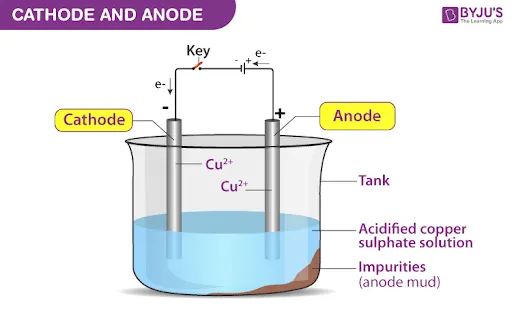
Cathode
When we talk about cathode in chemistry, it is said to be the electrode where reduction occurs. This is common in an electrochemical cell. Here, the cathode is negative as the electrical energy that is supplied to the cell results in the decomposition of chemical compounds. However, it can also be positive as in the case of a galvanic cell where a chemical reaction leads to the generation of electrical energy.
In addition, a cathode is said to be either a hot cathode or a cold cathode. A cathode which is heated in the presence of a filament to emit electrons by thermionic emission is known as a hot cathode whereas cold cathodes are not heated by any filament. A cathode is usually flagged as “cold” if it emits more electrons compared to the ones generated by thermionic emission alone.
Anode
In the most basic form, an anode in electrochemistry is the point where an oxidation reaction occurs. Generally, at an anode, negative ions or anions due to its electrical potential tend to react and give off electrons. These electrons then move up and into the driving circuit.
If we take a galvanic cell, the anode is negative in nature and the electrons mostly move towards the external part of the circuit. In an electrolytic cell, it is again positive. Additionally, an anode can be a plate or wire having an excess positive charge.
|
Anode |
Cathode |
|
The anode is the electrode where electricity moves into. |
The cathode is the electrode where electricity is given out or flows out. |
|
The anode is usually the positive side. |
A cathode is a negative side. |
|
It acts as an electron donor. |
It acts as an electron acceptor. |
|
In an electrolytic cell, oxidation reaction takes place at the anode. |
In an electrolytic cell, a reduction reaction takes place at the cathode. |
|
In galvanic cells, an anode can become a cathode. |
In galvanic cells, a cathode can become an anode. |
2.Compare the differences between each type of Li+ion batteries based on their characteristics
The six lithium-ion battery types that we will be comparing are Lithium Cobalt Oxide, Lithium Manganese Oxide, Lithium Nickel Manganese Cobalt Oxide, Lithium Iron Phosphate, Lithium Nickel Cobalt Aluminum Oxide, and Lithium Titanate
Lithium batteries are produced as either primary (disposable) or secondary (rechargeable) batteries. All batteries have positive and negative terminals, marked (+) and (-) respectively, and two corresponding electrodes. The electrodes must not touch each other, and are separated by the electrolyte, which facilitates the flow of electric charge between the electrodes. Finally, a collector conducts the charge to the battery's exterior and through the load.
When a battery is inserted into an electrical device, the device completes the circuit between the two terminals and triggers electrochemical reactions within the battery. The anode undergoes an oxidation reaction with the electrolyte, releasing electrons, while the cathode undergoes a reduction reaction and absorbs the free electrons. The product of these two reactions is electricity, which is channeled out of the battery and into the device
Battery Types
Buyers have the opportunity to select from two basic types of batteries.
Primary batteries are disposable, non-rechargeable devices. They must be replaced once their energy supply is depleted.
Secondary or rechargeable batteries contain active materials that can be regenerated. When the energy produced by these industrial batteries drops below optimum efficiency, they may be recharged according to various methods, depending on the battery construction. Secondary batteries are useful in applications where frequently replacing disposable batteries is more costly, such as in electric vehicles, handheld power tools and automobile starters.
Lithium Battery Chemistry
Lithium batteries are manufacturing using a number of different cathode materials.
Primary Batteries
Lithium manganese dioxide (Li-Mn) and lithium thionyl chloride are two types of primary lithium batteries. Li-Mn batteries make up approximately 80% of the lithium battery market. These batteries are inexpensive, feature high energy densities and can operate over a high temperature range.
Lithium thionyl chloride batteries have a liquid cathode. They are excellent for low temperature applications and can operate at 50% capacity at -55°C. Thionyl chloride batteries have very high energy densities and are expensive to manufacture. Due to their toxicity and risk of short circuit explosion, these batteries are typically handled by trained technicians and are not recommended for general purpose consumer uses.
Secondary Batteries
Secondary lithium batteries may feature carbon, iron or titanium cathodes. Lithium iron phosphate (LFP) batteries use its eponymous compound (LiFePO4) as the cathode material. They are very safe, durable, low-cost devices. LFP batteries share most characteristics of lithium-ion batteries, but feature better thermal and chemical stability due to the presence of iron in the cathode. Lithium titanium disulfide batteries have a solid titanium disulfide cathode. They feature a relatively flat discharge and high energy density.
Lithium ion (Li-ion) batteries use a carbon anode, metal oxide cathode, and a lithium salt electrolyte solution. They have excellent energy density and capacity. Lithium-ion batteries are very commonly used in portable consumer electronics, such as cell phones and laptops.
Lithium polymer (Li-poly) batteries feature a polymer electrolyte solvent instead of the lithium-ion battery's organic solvent. The polymer solvent makes lithium polymer batteries more flexible, rugged, adaptable, and cheaper to produce. They are commonly used in radio-controlled vehicles, portable consumer electronics, and electric vehicles.
The following table compares several types of lithium batteries
|
Chemistry |
Voltage |
Energy |
Power |
Durability |
|
(units) |
Volts |
Watt hour/kg |
Watts/kg |
Cycles |
|
LiMN |
3 |
280 |
||
|
LFS |
3.3 |
90-110 |
>300 |
20000 |
|
Li-ion |
3.7 |
100-250 |
250-340 |
400-1200 |
|
Li-poly |
3.7 |
130-200 |
<7000 |
>1000 |
|
Thionyl chloride |
3.5 |
500 |
(low) |
Battery Specifications
The Engineering360 Spec Search database contains information about a variety of standardized sizes and shapes pertaining to lithium batteries. These specifications can be classified by consumer sizes, which are commonly available for general purpose applications, and non-consumer sizes for specialized uses such as photography and instrumentation. Batteries manufactured for specialty use come in a variety of shapes and sizes.
When selecting industrial batteries, buyers may also specify the product's voltage, capacity and intended applications.
Consumer Sizes
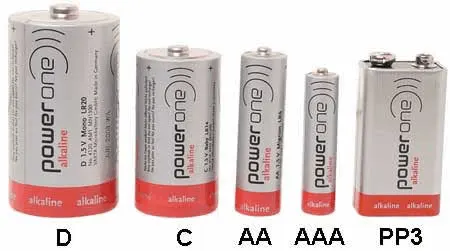
Round batteries are taller than their diameter and have terminals on each end. Depending on the active materials used, they typically produce between 1.2 and 3 volts when fresh. Round batteries are commonly available in a variety of sizes, including AAA, AA, C and D.
9-Volt or PP3 batteries consist of six individual 1.5 V cells within a can. They are typically used in smoke detectors, alarms, and other consumer products
Non-consumer Sizes
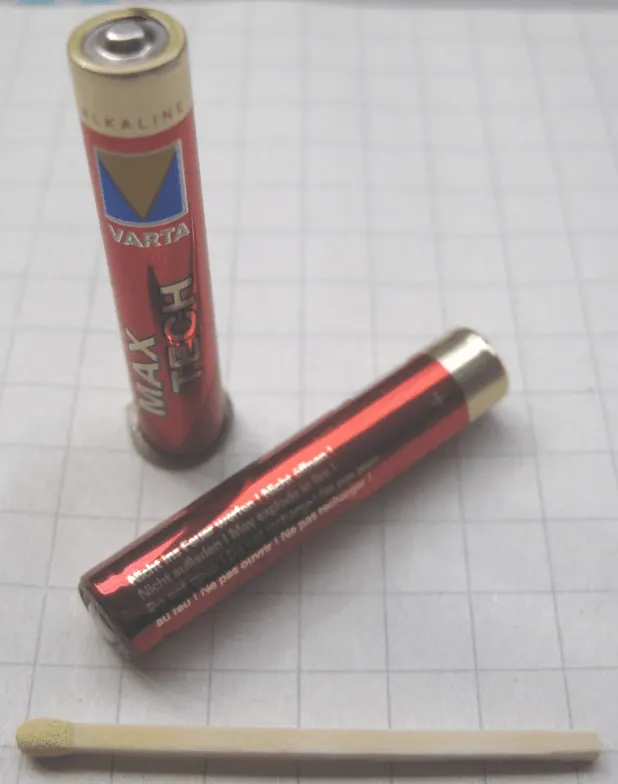
AAAA batteries are used in small devices such as laser pointers, penlights and glucose meters.
A batteries are approximately the same length as the AA size, but with a larger diameter. They are commonly used in older laptop batteries and consumer battery packs.
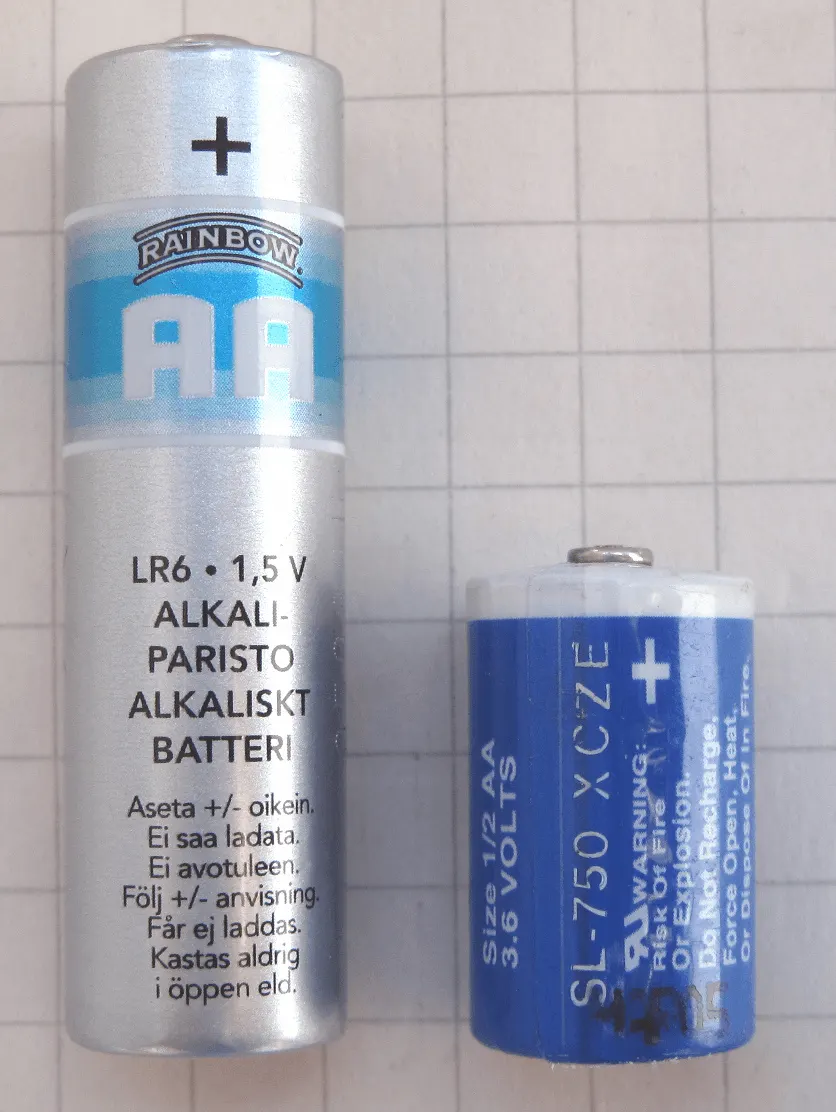
Fractional batteries are expressed as a fractional number combined with a common battery size. For example, a 1/2AA battery is half the length of an AA battery but shares the same diameter. Common fractional batteries include 1/3AA, 2/3AA, 1/2A, 2/3A, 4/5Cs and 1/2D.
Specialty Cells
- Battery packs consist of primary or secondary batteries bundled together with a connector for use in phones, radio-controlled vehicles and other consumer devices.
- Coin or button cells are available in numerous sizes and are used in watches, calculators and hearing aids.
- Prismatic cells are rectangular batteries which have slightly lower energy densities than traditional cylindrical cells. Although prismatic cells are expensive to manufacture, their unique construction offers a more efficient use of space, especially in designing battery packs.
- Sachet cells are a relatively recent battery development designed to fit in a specific space. Their electrodes are surrounded by a flexible foil packaging which replaces the hard case of traditional batteries, making sachet cells lighter.
Voltage
Battery voltage refers to the electric potential difference between the positive and negative terminal. Manufacturers typically specify the battery's nominal voltage, although its actual discharge voltage can vary depending on the battery's charge and current. For example, a battery cell with a nominal voltage of 2 V actually discharges between 1.7 and 2.0 volts at a given time. Most round consumer batteries carry a nominal voltage of 1.5 V, while a car battery is typically 12 volts. Depending on the battery materials and application, voltage can range from a fraction of a volt to several kilovolts.
Capacity
The amount of charge a battery can store is known as its capacity. Charge is typically measured in amp-hours or milliamp-hours (Ah or mAh). Most manufacturers specify capacity as the constant current that a new battery can supply for 20 hours. For example, a battery rated at 200 Ah can supply 10 A over a 20 hour period at room temperature. If the current supply to the same battery is increased, the capacity will then decrease.
Applications
Batteries are manufactured for use in numerous applications.
- Consumer batteries are used for general purpose consumer applications, such as cameras, radio-controlled cars, toys, and laptops.
- Energy batteries are manufactured for use in oil, natural gas and solar applications.
- Industrial batteries are deep cycle batteries used in forklifts and other industrial applications.
- Medical batteries are used for life support systems, hearing aids and wheelchairs.
- Military batteries are often manufactured to MIL-SPEC requirements.
- Transportation batteries are designed for use in aircraft, boats, automobiles and electric vehicles.
- Stand-by/UPS batteries are used in uninterruptible power supplies (UPS) for emergency lighting and alarms.