Week 1 Understanding Different Battery Chemistry
1,
Lithium-ion batteries are incredibly popular these days. You can find them in laptops, cell phones, electric vehicles etc. They're so common because, pound for pound, they're some of the most energetic rechargeable batteries available. A lithium-ion battery or Li-ion battery is a type of rechargable battery composed of cells in which lithium ions move from the negative electrode through an electrolyte to the positive electrode during discharge and back when charging. Li-ion cells use an intercalated lithium compound as the material at the positive electrode and typically graphite at the negative electrode. Li-ion batteries have a high energy density, no memory effect (other than LFP cells) and low self discharge. Cells can be manufactured to prioritize either energy or power density. They can however be a safety hazard since they contain flammable electrolytes and if damaged or incorrectly charged can lead to explosions and fires. M. Stanley Wittingham discovered the concept of intercalation electrodes in the 1970s, and invented the first rechargeable lithium-ion battery, which was based on a titanium disulfide cathode and a lithium-aluminum anode, patented in 1977. Jhon Goodenough expanded on this work in 1980 by using lithium cobalt oxide as a cathode. A prototype Li-ion battery was developed by Akira yoshino in 1985, based on the earlier researchs during the 1970s–1980s and then a commercial Li-ion battery was developed by Sony and Asahi kasei team led by Yoshio Nishi in 1991. Lithium-ion batteries are commonly used for Portable electronics and Electric vehicles and are growing in popularity for military and aerospace applications.
| Lithium ion cells | LCO | LMO | NCA | NMC | LFP | LTO |
| Anode | Graphite carbon | Graphite carbon | Graphite carbon | Graphite carbon | Graphite carbon | Lithium titanium oxide |
| Cathode | Lithium cobalt oxide | Lithium manganese oxide | Lithium nickel cobalt aluminium oxide | Lithium nickel manganese cobalt oxide | Lithium iron phosphate | Lithium manganese oxide |
| Electrolyte | Lithium salt in organic solvent |
Lithium halide dissolved in an organic solvent |
Lithium salt in organic solvent | Lithium salt in organic solvent | Lithium salt in organic solvent | Lithium salt in organic solvent |
| Anode reaction | LiC6→xLi++xe−+C6 | xLi+ + xe- +6C ⟷ LixC6 | xLi+ + xe- + 6C ⟷ LixC6 | xLi+ + xe- + nC ⟷ LixCn | LiC6→Li++e−+C6 | Ti5O12 + 4Li+ + 4e- ⟷ Li4Ti5O12 |
| Cathode reaction |
Li1−xCoO2+xLi+ +xe−→LiCoO2 |
LiMnO2 ⟷ Li1−xMn2O4 + xLi+ + xe- |
LiNiCoAlO2 ⟷ Li1-xNiCoAlO2 + xLi+ + Xe- | LiMO2 ⟷ Li1-xMO2 + xLi+ + xe- | FePO4+Li++e−→LiFePO4 | 4LiMn2O4 ⟷ 4Mn2O4 + 4Li+ + 4e- |
| Over all reaction |
C6+LiCoO2⟷LixC6 + Li1−xCoO2 |
LiMn2O4 +6C ⟷ LiC6 + Mn2O4 | 6C + LiNiCoAlO2 ⟷ LiC6 + NiCoAlO2 | Li1-xMO2 + LIxCn ⟷ LIMO2 + nC | LiFePO4+6C→LiC6+FePO4 | Li4Ti5O12 + 4MN2O4 ⟷ 4LiMn2O4 + Ti5O12 |
2,
- Lithium Cobalt oxide;
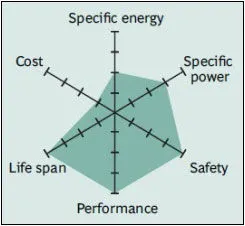
Its high specific energy makes Li-cobalt the popular choice for mobile phones, laptops and digital cameras. The battery consists of a cobalt oxide cathode and a graphite carbon anode. The cathode has a layered structure and during discharge, lithium ions move from the anode to the cathode. The flow reverses on charge. The drawback of Li-cobalt is a relatively short life span, low thermal stability and limited load capabilities (specific power).
- Lithium Manganese oxide;
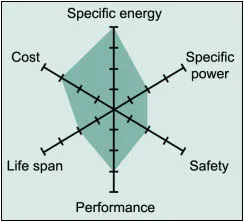
Li-ion with manganese spinel was first published in the Materials Research Bulletin in 1983. In 1996, Moli Energy commercialized a Li-ion cell with lithium manganese oxide as cathode material. The architecture forms a three-dimensional spinel structure that improves ion flow on the electrode, which results in lower internal resistance and improved current handling. A further advantage of spinel is high thermal stability and enhanced safety, but the cycle and calendar life are limited.
Low internal cell resistance enables fast charging and high-current discharging. In an 18650 package, Li-manganese can be discharged at currents of 20–30A with moderate heat buildup. It is also possible to apply one-second load pulses of up to 50A. A continuous high load at this current would cause heat buildup and the cell temperature cannot exceed 80°C (176°F). Li-manganese is used for power tools, medical instruments, as well as hybrid and electric vehicles.
- Lithium nickel cobalt aluminium oxide;
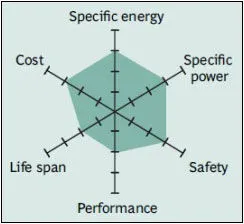
Lithium nickel cobalt aluminum oxide battery, or NCA, has been around since 1999 for special applications. It shares similarities with NMC by offering high specific energy, reasonably good specific power and a long life span. Less flattering are safety and cost.
- Lithium nickel manganese cobalt oxide;
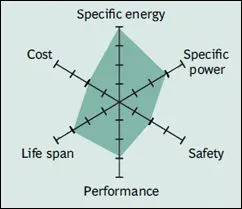
One of the most successful Li-ion systems is a cathode combination of nickel-manganese-cobalt (NMC). Similar to Li-manganese, these systems can be tailored to serve as Energy cells or Power cells. For example, NMC in an 18650 cell for moderate load condition has a capacity of about 2,800mAh and can deliver 4A to 5A; NMC in the same cell optimized for specific power has a capacity of only about 2,000mAh but delivers a continuous discharge current of 20A. A silicon-based anode will go to 4,000mAh and higher but at reduced loading capability and shorter cycle life. Silicon added to graphite has the drawback that the anode grows and shrinks with charge and discharge, making the cell mechanically unstable.
The secret of NMC lies in combining nickel and manganese. An analogy of this is table salt in which the main ingredients, sodium and chloride, are toxic on their own but mixing them serves as seasoning salt and food preserver. Nickel is known for its high specific energy but poor stability; manganese has the benefit of forming a spinel structure to achieve low internal resistance but offers a low specific energy. Combining the metals enhances each other strengths.
NMC is the battery of choice for power tools, e-bikes and other electric powertrains. The cathode combination is typically one-third nickel, one-third manganese and one-third cobalt, also known as 1-1-1. This offers a unique blend that also lowers the raw material cost due to reduced cobalt content. Another successful combination is NCM with 5 parts nickel, 3 parts cobalt and 2 parts manganese (5-3-2). Other combinations using various amounts of cathode materials are possible.
Battery manufacturers move away from cobalt systems toward nickel cathodes because of the high cost of cobalt. Nickel-based systems have higher energy density, lower cost, and longer cycle life than the cobalt-based cells but they have a slightly lower voltage.
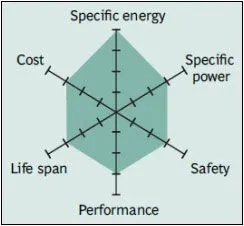
- Lithium iron phosphate;
In 1996, the University of Texas (and other contributors) discovered phosphate as cathode material for rechargeable lithium batteries. Li-phosphate offers good electrochemical performance with low resistance. This is made possible with nano-scale phosphate cathode material. The key benefits are high current rating and long cycle life, besides good thermal stability, enhanced safety and tolerance if abused.
Li-phosphate is more tolerant to full charge conditions and is less stressed than other lithium-ion systems if kept at high voltage for a prolonged time. As a trade-off, its lower nominal voltage of 3.2V/cell reduces the specific energy below that of cobalt-blended lithium-ion. With most batteries, cold temperature reduces performance and elevated storage temperature shortens the service life, and Li-phosphate is no exception. Li-phosphate has a higher self-discharge than other Li-ion batteries, which can cause balancing issues with aging. This can be mitigated by buying high quality cells and/or using sophisticated control electronics, both of which increase the cost of the pack. Cleanliness in manufacturing is of importance for longevity. There is no tolerance for moisture, lest the battery will only deliver 50 cycles.
Li-phosphate is often used to replace the lead acid starter battery. Four cells in series produce 12.80V, a similar voltage to six 2V lead acid cells in series. Vehicles charge lead acid to 14.40V (2.40V/cell) and maintain a topping charge. Topping charge is applied to maintain full charge level and prevent sulfation on lead acid batteries.
With four Li-phosphate cells in series, each cell tops at 3.60V, which is the correct full-charge voltage. At this point, the charge should be disconnected but the topping charge continues while driving. Li-phosphate is tolerant to some overcharge; however, keeping the voltage at 14.40V for a prolonged time, as most vehicles do on a long road trip, could stress Li-phosphate. Time will tell how durable Li-Phosphate will be as a lead acid replacement with a regular vehicle charging system. Cold temperature also reduces performance of Li-ion and this could affect the cranking ability in extreme cases.
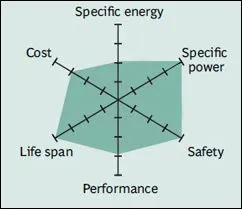
- Lithium titanium oxide;
Batteries with lithium titanate anodes have been known since the 1980s. Li-titanate replaces the graphite in the anode of a typical lithium-ion battery and the material forms into a spinel structure. The cathode can be lithium manganese oxide or NMC. Li-titanate has a nominal cell voltage of 2.40V, can be fast charged and delivers a high discharge current of 10C, or 10 times the rated capacity. The cycle count is said to be higher than that of a regular Li-ion. Li-titanate is safe, has excellent low-temperature discharge characteristics and obtains a capacity of 80 percent at –30°C (–22°F).
LTO (commonly Li4Ti5O12) has advantages over the conventional cobalt-blended Li-ion with graphite anode by attaining zero-strain property, no SEI film formation and no lithium plating when fast charging and charging at low temperature. Thermal stability under high temperature is also better than other Li-ion systems; however, the battery is expensive. At only 65Wh/kg, the specific energy is low, rivalling that of NiCd. Li-titanate charges to 2.80V/cell, and the end of discharge is 1.80V/cell.