Week 1 Understanding Different Battery Chemistry
Lithium Ion Battery
A lithium-ion (Li-ion) battery is a high-performance battery that employs lithium ions as a key component of its electrochemistry. Lithium atoms in the anode are ionised and separated from their electrons during a discharge cycle. The lithium ions go from the anode via the electrolyte to the cathode, where they recombine with their electrons and become electrically neutral. Between the anode and the cathode, the lithium ions are tiny enough to pass through a micro-permeable separator. Li-ion batteries are capable of having a very high voltage and charge storage, in part due to lithium's small size (third only to hydrogen and helium).
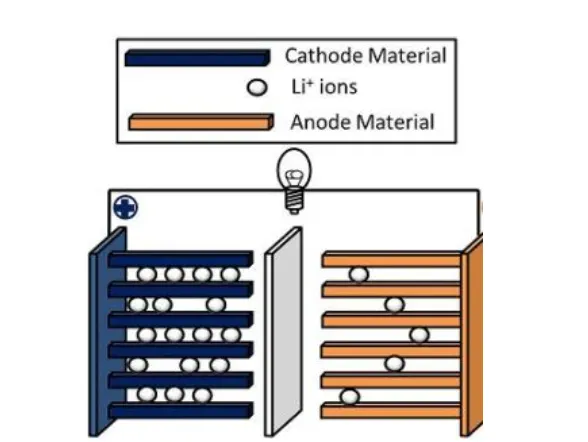
The electrodes of Li-ion batteries can be made of a variety of materials. The most popular combination is lithium cobalt oxide (cathode) and graphite (anode), which can be found in cellphones and computers. Lithium manganese oxide (used in hybrid and electric vehicles) and lithium iron phosphate are two other cathode materials. Ether (a class of organic chemicals) is commonly used as an electrolyte in Li-ion batteries.
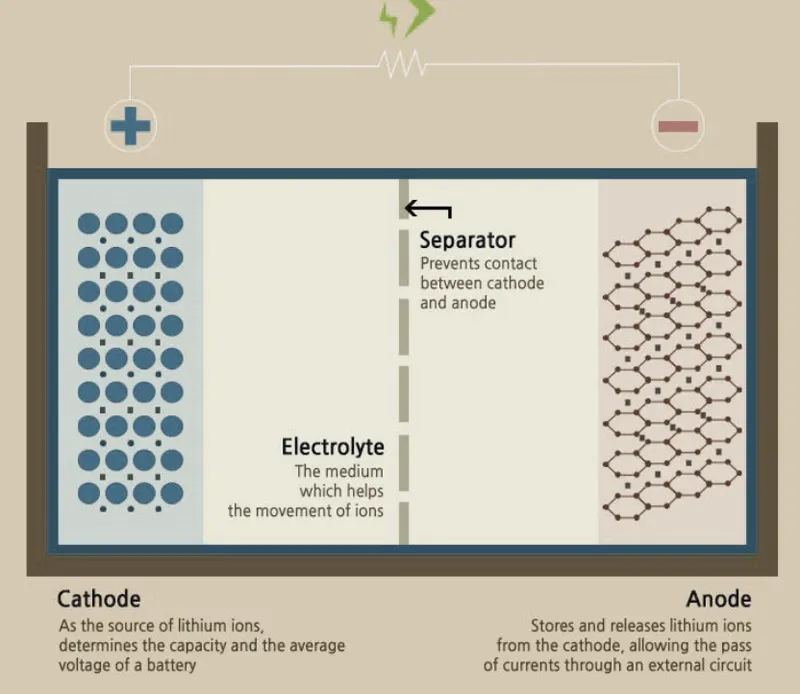
CATHODE:
The capacity and voltage of a Li-ion battery are determined by the cathode material employed. This substance is referred to as the active material. The active material is critical in the chemical reaction that causes current to flow in the battery. The capacity of a cell is determined by the size of the active material at the cathode, hence larger cathodes are required for higher cell capacity. Meanwhile, the voltage of the cathode is determined by the cathode element.The cathode determines the battery's nomenclature; for example, a Lithium-ion battery has a Lithium cathode. However, because lithium is very reactive and unstable, making it impossible to store and use directly, a cathode composed of lithium and oxygen is employed.
ANODE:
An anode, like the cathode, is the other electrode that is coated with an active substance. It is the negative electrode, and its properties determine the battery's rate of charge and discharge. We strive to increase the anode's surface area, which impacts the pace of electric current flow through the external circuit, resulting in a faster absorption or emission of lithium ions produced from the cathode. During the charge cycle of the battery, the lithium ions are stored in the anode. The discharging and charging states of the battery are depicted in the graphic below, along with the flow of electrons and ions during the operation.
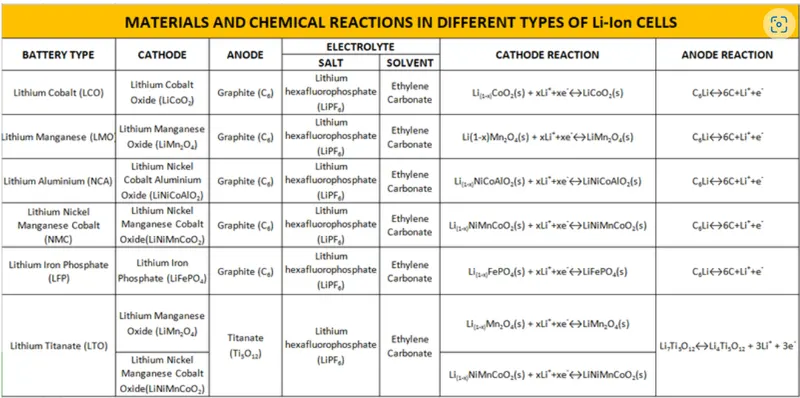
2) COMPARISION THE DIFFERENCES BETWEEN EACH TYPE OF Li-on BATTERY ON THEIR CHARACTERISTICS
Lithium-ion batteries come in a variety of shapes and sizes, with the main distinction being the cathode materials. Lithium-ion batteries come in a variety of shapes and sizes, with trade-offs between specific power, specific energy, safety, longevity, cost, and performance. Lithium Cobalt Oxide, Lithium Manganese Oxide, Lithium Nickel Manganese Cobalt Oxide, Lithium Iron Phosphate, Lithium Nickel Cobalt Aluminum Oxide, and Lithium Titanate are the six lithium-ion battery types we'll be comparing. To begin, understanding the main words listed below will make comparisons much simpler and easier.
1) SPECIFIC ENERGY: This is the weighted capacity of the battery (Wh/kg). The capacity has to do with the amount of time it takes to complete a task. High specific energy is optimised for products that require lengthy runtimes at moderate load.When particular power is high, specific energy is usually low, and vice versa. A wonderful analogy of the relationship between specific power and specific energy is pouring bottled water into a glass. The water in the bottle can be viewed as a form of concentrated energy. Slowly pouring water does not create enough force (low specific power), but the water lasts longer in the bottle. However, if we pour the water out at a faster rate, the impact will be greater (high specific power). However, due to the low specific energy of the water, it would not stay long in the bottle.
2) Performance: This metric assesses how well the battery performs over a wide temperature range. Most batteries are heat and cold sensitive and require temperature management. Heat shortens life, while cold momentarily diminishes performance.
3)Lifespan: The lifespan of a cycle is determined by elements like as temperature, discharge depth, and load. The loss of capacity is accelerated in hot temperatures. A graphite anode is commonly used in cobalt mixed lithium-ion batteries, which reduces cycle life.
4)Safety: The thermal stability of the materials used in the batteries is one example of safety. The ability of the material to withstand high temperatures without becoming unstable. Instability can lead to a thermal runaway, which releases burning gases. Fully charging the battery and storing it for longer than the specified time affects the battery's safety.
5)Cost: Electric car demand has been lower than expected, owing primarily to the high cost of lithium-ion batteries. As a result, cost is a major consideration when choosing a lithium-ion battery.
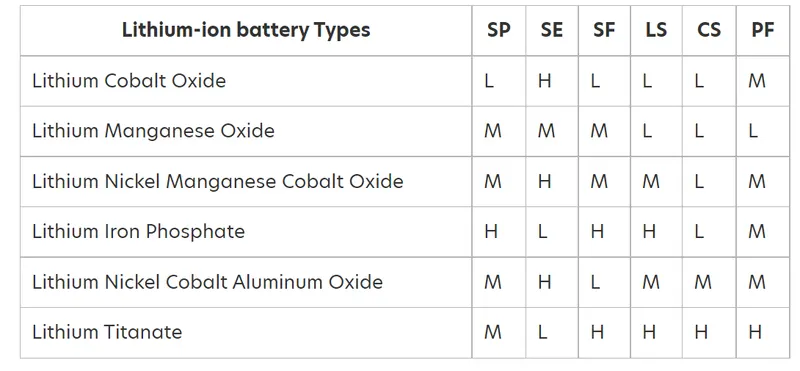
- SP stands for specific power
- SE stands for specific energy
- SF stands for safety
- LS stands for lifespan
- CS stands for cost
- PF stands for performance
- L stands for low
- M stands for moderate
- H stands for high
Difference between six types of lithum ions
Lithium Cobalt Oxide : In comparison to other batteries, it offers a high specific energy, making it the favoured choice for computers and mobile phones. It also has a reasonable performance and a low cost. When compared to other lithium-ion batteries, it is, however, extremely unfavourable in all other aspects. It has a short lifespan, low specific power, and low safety.
Lithium Manganese Oxide: It has moderate specific power, moderate specific energy, and a moderate level of safety when compared to the other types of lithium-ion batteries. It has the added advantage of a low cost. The downsides are its low performance and low lifespan. It is usually used in medical devices and power tools.
Lithium Nickel Manganese Cobalt Oxide :When compared to other types of lithium-ion batteries, it has a moderate specific power, moderate specific energy, and a moderate level of safety. It also has the benefit of being inexpensive. Its limited performance and short lifespan are disadvantages. It's commonly found in medical equipment and power tools.
Lithium Iron Phosphate : When compared to other forms of lithium-ion batteries, it only has one main disadvantage: low specific energy. Apart from that, it receives moderate to good scores in all other areas. It has a high specific power, a high level of safety, a long lifespan, and is inexpensive. This battery's performance is similarly average. It's commonly used in electric motorcycles and other applications where a long lifespan and high level of safety are required.
Lithium Nickel Cobalt Aluminum Oxide : In comparison to the other five batteries, it has a significant advantage in terms of specific energy. The rest of the attributes, such as performance, cost, specific power, and lifespan, are moderate. The sole disadvantage of this battery is its lack of safety. It's a strong contender for electric powertrains because of its high specific energy and long lifespan.
Lithium Titanate: It provides excellent levels of safety, performance, and longevity, all of which are critical characteristics for any battery. It has a lower specific energy than the other five lithium-ion batteries, but it makes up for it with a moderate specific power. The sole significant disadvantage of lithium titanate over conventional lithium-ion batteries is its exorbitant price. Another noteworthy aspect of this battery is its astonishingly quick recharging time. It may be used to store solar energy as well as to build smart grids.