Week 1 Understanding Different Battery Chemistry
Objective:
Preparing the table which includes materials ,chemical reactions occurring at the anode and cathode of LCO, LMO, NCA, NMC, LFP and LTO type of lithium ion cells and Compare the differences between each type of Li+ion batteries.
Battery:
> All batteries are made up of the same three basic components; the anode (negative - side), the cathode (positive + side), and some sort of electrolyte. When the cathode and anode of a battery are connected to an electrical circuit, a chemical reaction occurs between the anode and electrolyte.
>Electrons flow through the circuit from the anode, and then enter back through the cathode and prompt another chemical reaction. These reactions continue until the materials are consumed, at which point no more electricity is produced by the battery.
>Both Lithium and Lithium-ion batteries produce portable electricity in this manner and can be used to power all sorts of different devices and electrical circuits. Batteries are incredibly useful components that allow us all sorts of luxuries, without them we would have to start cars by hand, and phones would still all be attached to the wall.
Lithium-ion batteries: are secondary cells, meaning that they can be recharged and reused. These batteries are incredibly popular today, and our everyday lives would be quite different without them. Your laptop, cell phone, tablet, and camera all depend on Lithium-ion batteries to keep them working, as these rechargeable batteries are highly effective.
>The electrodes of Lithium-ion batteries are made from lithium and carbon, making them much lighter in weight than other rechargeable batteries.
>Lithium-ion batteries are also great at holding their charge, losing only around 5% of their power every month they aren’t used. Another benefit of Lithium-ion batteries is that they have no memory effect. Ever remember being told that you need to completely discharge your batteries before plugging them in to recharge.
>That doesn’t apply to Lithium-ion batteries. These excellent rechargeable batteries can handle being charged and emptied hundreds of times before deteriorating.
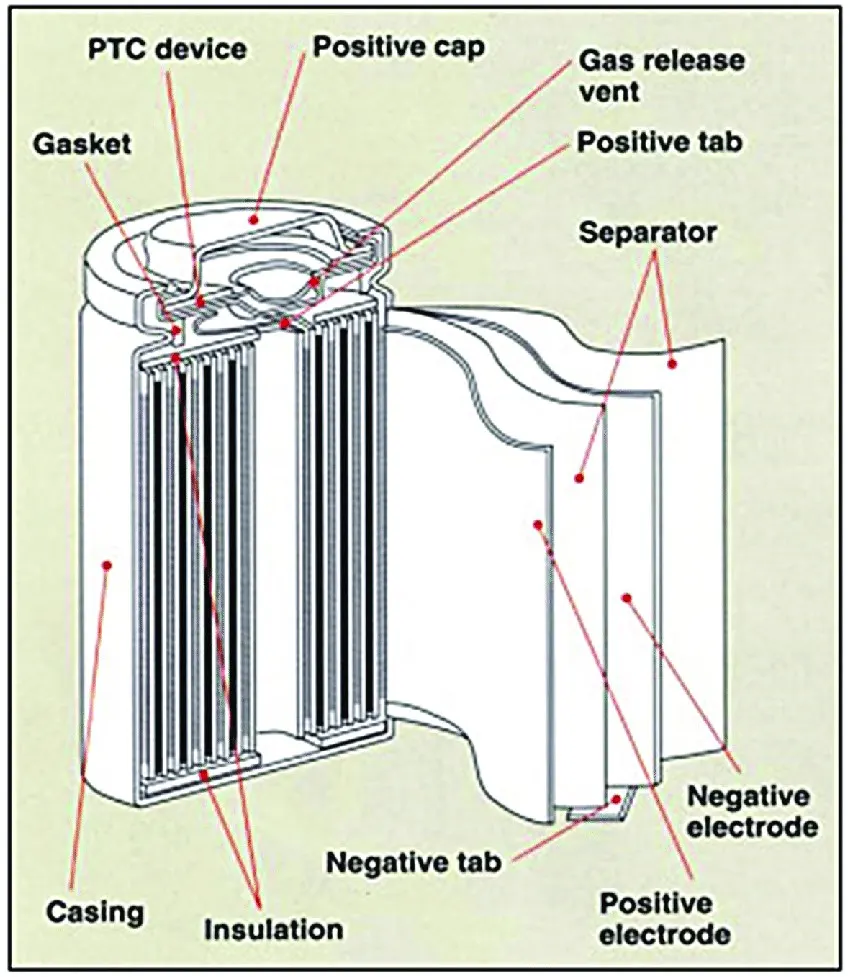
>Lithium-ion batteries are quite complex in nature, unlike the simplicity of a plain old Lithium battery. Within a lithium-ion battery, you would find multiple lithium-ion cells which store and provide the power. However, Li-ion batteries have other components too. A small computer within the battery monitors and regulates the temperature, voltage, and the state of battery charge, all from within the unit.
Table:
| S.No | Lithium ion Cells | Material | Chemical Reaction |
| 1 | Lithium Cobalt Oxide (LCO) | Cathode - Metal oxides | Cathode - Li2CoO2 |
| 2 | Lithium Manganese Spinel (LMO) | Cathode - manganese dioxide | Cathode - LiMn2O4 |
| 3 | Lithium Nickle Cobalt Aluminium (NCA) | Cathode - Lithium,Nickle ,Cobalt and Aluminium | Cathode - LiNixCoyAlzO2 |
| 4 | Nickle Manganese Cobalt (NMC) | Cathode - Lithium,Nickel,Manganese and cobalt | Cathode - LiNixMnyCozO2 |
| 5 | Lithium Ion Phosphate (LFP) | Anode-Manganese,Phosphate and iron | Anode- LiFePO4 |
| 6 | Lithium Titanium Oxide (LTO) | Anode- lithium–titanium oxide | Anode- Li4Ti5O12 |
1. Lithium Cobalt Oxide (LCO):LCO is a type of rechargeable battery, combined with a microporous separator with electrolyte, it mainly relies on the movement of lithium ions between positive electrode and negative electrode. Lithium batteries use an intercalated lithium compound as an electrode material.
>Lithium ion batteries have higher specific energies than batteries made from other materials such as zinc and lead due to the relatively light weight and low density of lithium. Lithium batteries are also more stable over charge/recharge cycles due to the small radii of lithium ions, which causes fewer disruptions of the electrode structure during ion transfer.
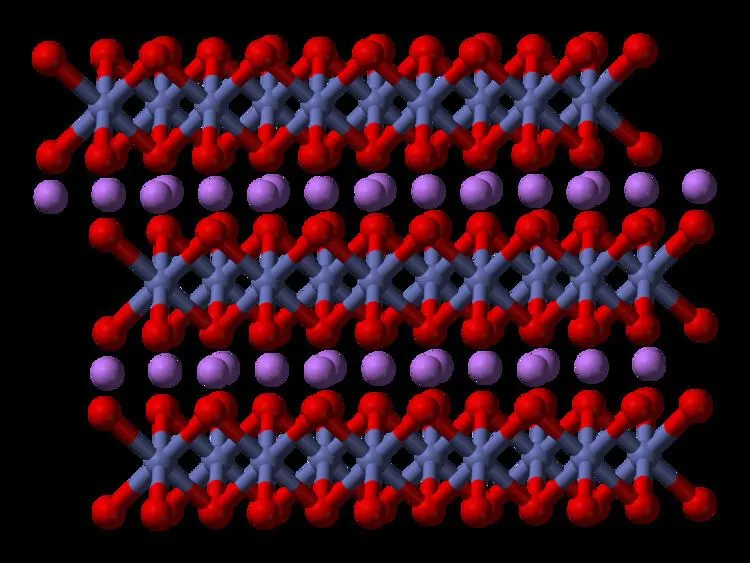
>Lithium ion batteries commonly use graphite and cobalt oxide as additional electrode materials. Lithium ion batteries work by using the transfer of lithium ions and electrons from the anode to the cathode. At the anode, neutral lithium is oxidized and converted to Li+.These Li+ ions then migrate to the cathode, where they are incorporated into LiCoO2.
>This results in the reduction of Co(IV) to Co(III) when the electrons from the anode reaction are received at the cathode. Because lithium is involved in the reactions at both electrodes, the battery can be recharged by running the reactions in reverse.
Cathode
>The cathode is most commonly a lithiated metal oxide.
>There are main 3 types:
1.Layered oxide like LixCoO2
2.Polyanion materials such as LiFePO4 and Li2FeSiO4
3.Spinel oxides like LiMn2O4.
LiCoO2- Structure
Anode
One of the most common anode materials used today is lithiated graphite, LixC6 , which is composed of graphene sheets intercalated with lithium. New materials such as those based on Silicon and other elemental blends are being researched. Lithiated graphite has a unit cell with a HCP structure.
2.Lithium Manganese Spinel (LMO):
>A lithium ion manganese oxide battery (LMO) is a Lithium ion-cell that uses manganese dioxide, Mno as the cathode material. They function through the same intercalation/de-intercalation mechanism as other commercialized secondary battery technologies, such as LiCoO Cathodes based on manganese-oxide components are earth-abundant, inexpensive, non-toxic, and provide better thermal stability.
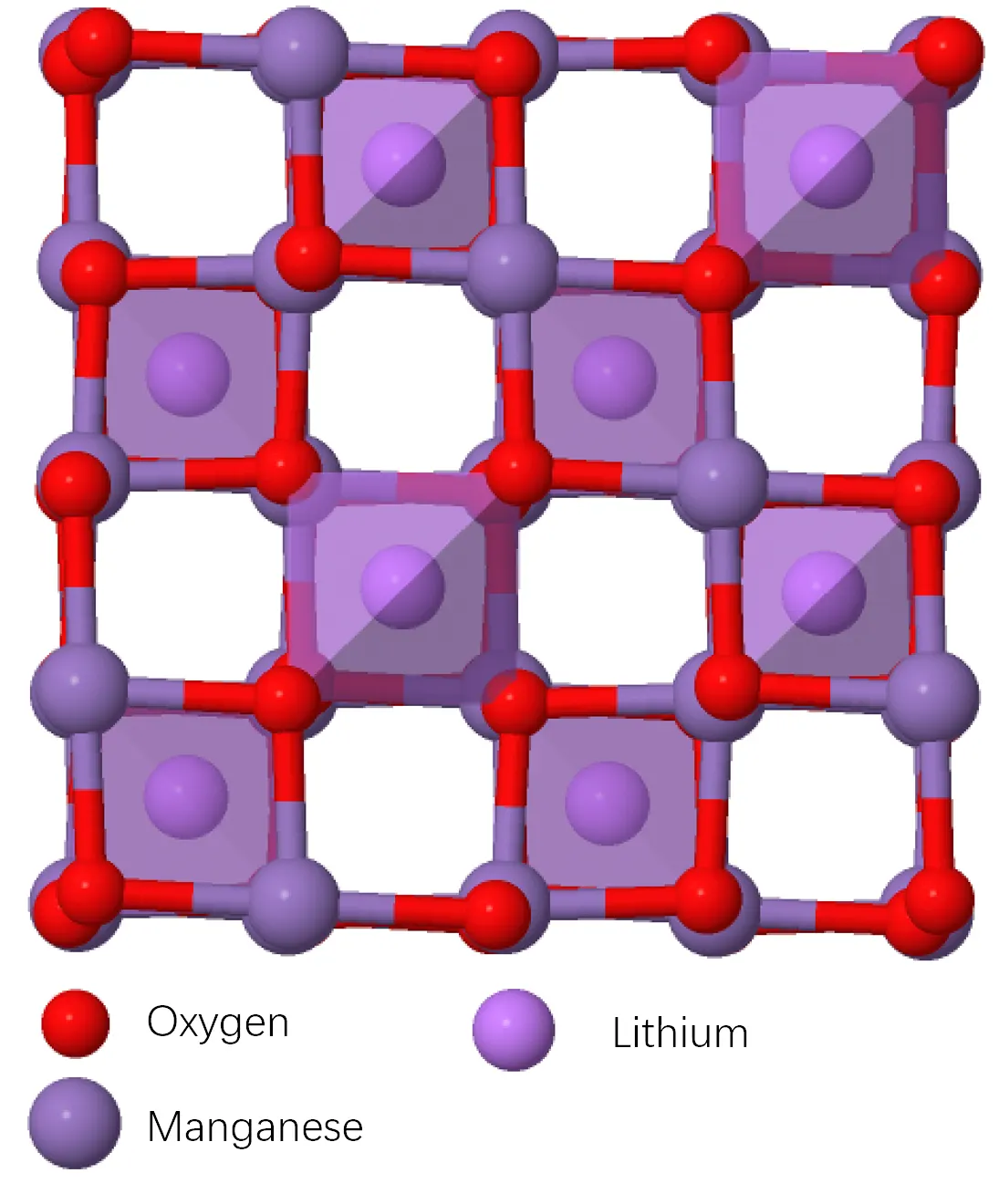
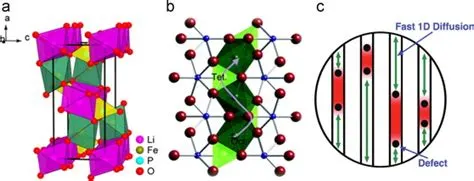
>The three-dimensional structure of LiMn2O4 lends itself to high rate capability by providing a well connected framework for the insertion and de-insertion of Li+ ions during discharge and charge of the battery. In particular, the Li+ ions occupy the tetrahedral sites within the Mn2O4 polyhedral frameworks adjacent to empty octahedral sites.
>As a consequence of this structural arrangement, batteries based on LiMn2O4 cathodes have demonstrated a higher rate-capability compared to materials with two-dimensional frameworks for Li+diffusion.
3. Lithium Nickle Cobalt Aluminium (NCA):
>The lithium nickel cobalt aluminium oxides (NCAs) are a group of mixed metal oxides. Some of them are important due to their application in lithium ion batteries. NCAs are used as active material on the positive pole (which is the cathode when the battery is discharged).
>NCAs are composed of the cations of the chemical elements lithium, nickel, cobalt and aluminium.
>The most important formula LiNixCoyAlzO2 with x + y + z = 1.
>In case of the NCA comprising batteries currently available on the market, which are also used in electric cars x ≈ 0,8, and the voltage of those batteries is between 3.6 V and 4.0 V, at a nominal voltage of 3.6 V or 3.7 V. A version of the oxides currently in use in 2019 is LiNi0,84Co0,12Al0,04O2.
4. Nickle Manganese Cobalt (NMC):
>These mixed metal oxides of lithium, nickel, manganese and cobalt.
>They have the general formula LiNixMnyCozO2.
>The most important representatives have a composition with x + y + z that is near 1, with a small amount of lithium on the transition metal site.
> NMCs are among the most important storage materials for lithium ions in lithium ion batteries. They are used on the positive side, which acts as the cathode during discharge.
>The general formula is LiNixMnyCozO2
- LiNi 0.333Mn0.333Co 0.333O2 is abbreviated to NMC111 or NMC33
- LiNi0.8Mn0.1Co0.1O2 is abbreviated to NMC811
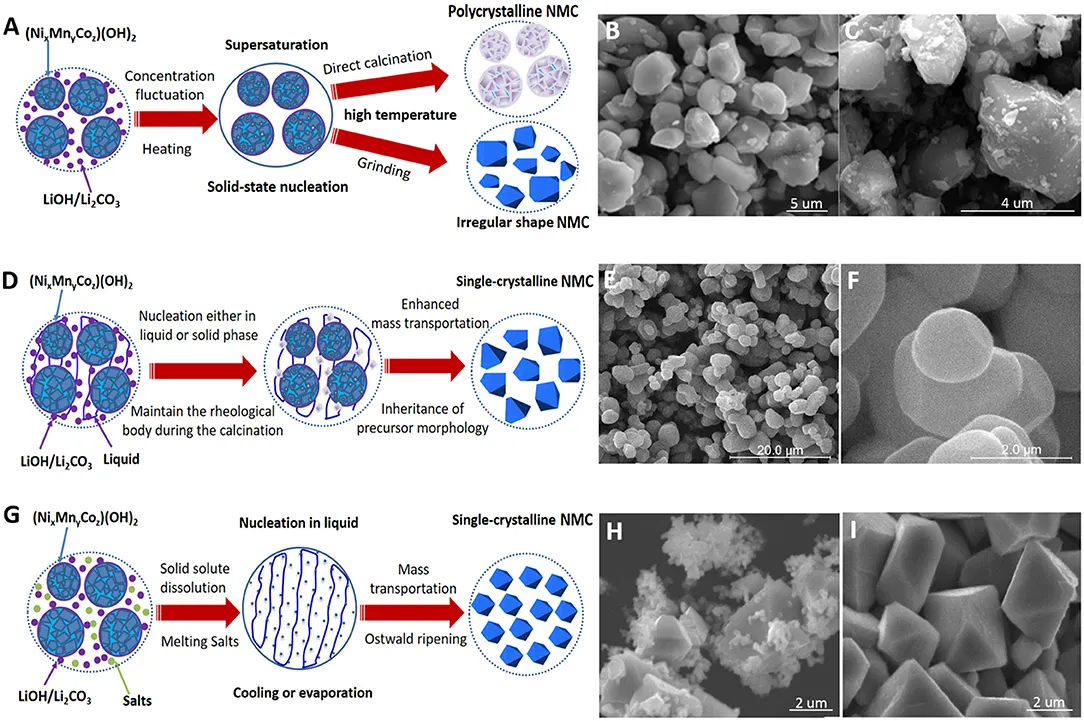
>Lithium Nickel Manganese Cobalt Oxide Structure The cambium-like structure of nickel-cobalt-manganese ternary material is composed of hexagonal dense stacking. Its structure and charge - discharge chemical equation are as follows: Crystal Structure of Nickel Cobalt Manganese Ternary Anode Material.
5.Lithium Ion Phosphate (LFP):is an inorganic compound with the formula LiFePO
>It is a gray, red-grey, brown or black solid that is insoluble in water. The material has attracted attention as a component of lithium iron phosphate batteries, a type of Li-ion battery. This battery chemistry is targeted for use in power tools, electric vehicles, solar energy installations and more recently large grid-scale energy storage.
>Most lithium batteries (Li-ion) used in consumer electronics products use cathodes made of other lithium compounds, such as lithium cobalt oxide (LiCoO2), lithium manganese oxide (LiMn2O4), and lithium nickel oxide (LiNiO2).
>The anodes aregenerally made of graphite.
> During charge/discharge, the lithium ions are extracted concomitant with oxidation of Fe:

6.Lithium Titanium Oxide (LTO): is a type of rechargeble battery which has the advantage of being faster to charge than other lithium ion battries but the disadvantage of having a much lower energy density.
Li2TiO3 chemistry
With applications in many sectors, with a primary focus on high speed charging and energy storage, Lithium Titanate Oxide (lithium titanium oxide) technology is the battery-powered technology in the future. Let's see the key benefits and advantages of the LTO battery technology.
>A variety of lithium-ion batteries are lithium titanate batteries, in which lithium titanate, the chemical formula of which is Li4Ti5O12, is used as an electrode connected to a positive power source (anode). The development of such devices began to be engaged in the distant 80s.
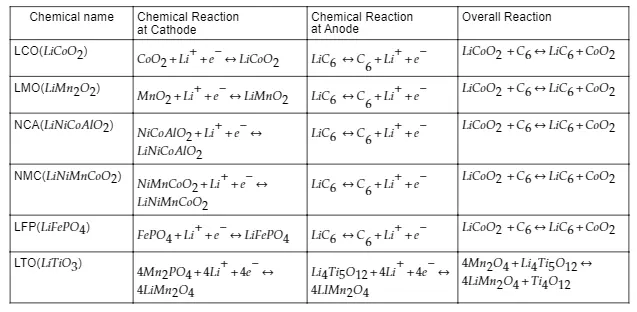
Chemical Reaction:
Differences between each type of Li+ion batteries:
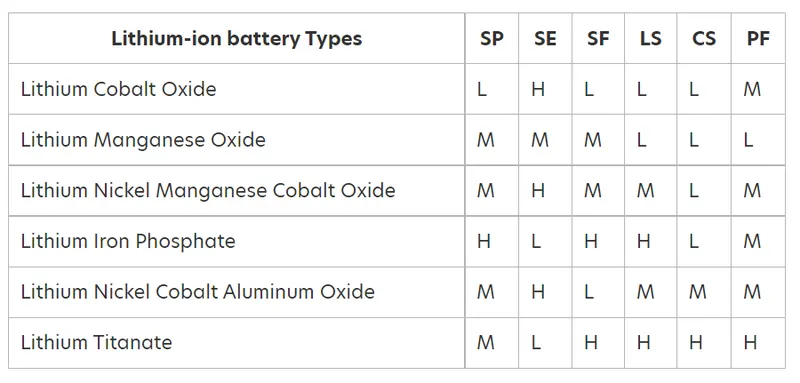
- SP stands for specific power
- SE stands for specific energy
- SF stands for safety
- LS stands for lifespan
- CS stands for cost
- PF stands for performance
- L stands for low
- M stands for moderate
- H stands for high
Pictorial Representation:
1.Lithium Cobalt Oxide has high specific energy as compared to the other batteries which make it the preferred choice for laptops and mobile phones. It also has a low cost and a moderate performance.
>However, it is highly unfavorable in all the other aspects when compared to the other lithium-ion batteries. It has low specific power, low safety, and a low lifespan.
2.Lithium Manganese Oxide has moderate specific power, moderate specific energy, and a moderate level of safety when compared to the other types of lithium-ion batteries.
>It has the added advantage of a low cost. The downsides are its low performance and low lifespan. It is usually used in medical devices and power tools.
3.Lithium Nickel Manganese Cobalt Oxide has two major advantages as compared to the other batteries. The first one is its high specific energy which makes it desirable in electric powertrains, electric vehicles, and electric bikes.
>The other is its low cost. It is moderate in terms of specific power, safety, lifespan, and performance when compared to the other lithium-ion batteries. It can be optimized to either have high specific power or high specific energy.
4.Lithium Iron Phosphate only has one major disadvantage when compared to other types of lithium-ion batteries and that is its low specific energy. Other than that, it has moderate to high ratings in all the other characteristics. It has high specific power, offers a high level of safety, has a high lifespan, and comes at a low cost.
>The performance of this battery is also moderate. It is often employed in electric motorcycles and other applications that require a long lifespan and a high level of safety.
5.Lithium Nickel Cobalt Aluminum Oxide offers one strong advantage as compared to the five other batteries and that is high specific energy. It is pretty moderate in the rest of the characteristics like performance, cost, specific power, and lifespan.
>The only downside to this battery type is its low level of safety. Its high specific energy and moderate lifespan make it a good candidate for electric powertrains.
6.Lithium Titanium oxide offers high safety, high performance, and a high lifespan which are very important features every battery should have. Its specific energy is low compared to the five other lithium-ion batteries but it compensates for this with moderate specific power.
>The only major disadvantage of lithium titanate as compared to the other lithium-ion batteries is its extremely high cost. Another important feature of this battery worthy of mention is its remarkably fast recharge time. It can be used for storing solar energy and creating smart grids.