Week 4.1 - Genetic Algorithm
%% GLOBAL OPTIMIZATION ::
>> is an area of study which deals with how to minimize and maximize an function by using various inputs..
>> The genetic algorithm is a technique for solving both constrained and unconstrained optimization problems
that are based on natural selection, the process that drives biological evolution..
%% STALAGMITE FUNCTION ::
>> is a mathematical function,that helps to generate local maximas and global maximas of an function..
>> to generate the maximas we are using the GENETIC ALGORITHAM ..
% STALAGMITE FUNCTION AND THE GLOBAL MAXIMA FUNCTION;;;
close all
clear all
%% Defining our search space-1 dimensional array;;
x=linspace(0,0.6,150);
y=linspace(0,0.6,150);
%% creating 2dimensional mesh;;
>> meshgrid transforms the domain specified by vectors x and y into arrays X and Y
[xx yy]= meshgrid(x,y);
%% evaluating the stalagmite function;;
>> Before evaluating we have to fing the stalagmite function based on the formula;;
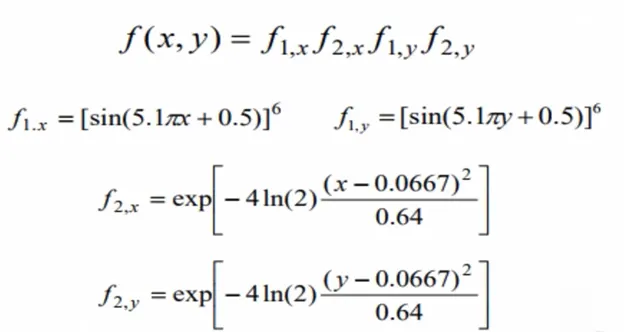
>> stalagmite_code is an function name and carries by 'input_vector' as input to the function,
>> 'f' is an output of the function,
function [f] = stalagmite_code(input_vector)
x = input_vector(1);
y = input_vector(2);
f1_x = (sin(5.1*pi*x + 0.5)).^6;
f1_y = (sin(5.1*pi*y + 0.5)).^6;
>> dividing the equation into parts for easy multiplication
t1 = ((x-0.0667).^2)/(0.64);
t2 = ((y-0.0667).^2)/(0.64);
f2_x = exp(-4.*log(2)*t1);
f2_y = exp(-4.*log(2)*t2);
>>By using '-' (-ve) sign the plot will be reversed so that we can find the maxima of the given function easly by using ga.
f = -(f1_x.*f2_x.*f1_y.*f2_y);
end
>> INSERTING the stalagmite function into the main function
for i=1:length(xx)
for k=1:length(yy)
input_vector(1)=xx(i,k);
input_vector(2)=yy(i,k);
f(i,k)=stalagmite_code(input_vector);
end
end
%%creating its surface through ‘surfc’ command
>>‘surfc’ command provide the contour of the generated surface.
>> applying 'surf' command by using'-ve' sign whcih shows the surface upside down,gets an better global maxima of the function;;
>>'-f' for global maxima of the function;;
surfc(x,y,-f)
shading interp ;;; To remove the lines produced by the mesh grid
xlabel('x')
ylabel('y')
[inputs,fval]=ga(@stalagmite_code,2)
>>[inuts,fval] is an optimum value of the function
>> 'fval' is the value of the objective function at the current value of 'x'
>> 'ga' is an matlab in bulit function ,,used here for only maxima of the function
>>'stalagmite_code is the function handle with an order of '2'
>> error by entering an 'f' +ve sign value the plot get into the minima of the function
%%STATISTICAL STUDY UNBOUNDED::
>>calculating the study time through tic and toc command;;
% study 1st-statistical behaviour
>> 'opt' optimum value of ga
>> using Number of itreation for which the function will evaluate the fitness
num_cases=50;
tic
for i=1:num_cases
[inputs,fopt(i)]=ga(@stalagmite_code,2);
xopt(i)=inputs(1);
yopt(i)=inputs(2);
end
study1_time=toc
%ploting the graph 1
figure(1)
subplot(2,1,1)
hold on
surfc(x,y,-f)
shading interp
>>'plot3' creats an plot of x,y, and the optimum function value that 'ga' preditcs;
>> 'marker' used for highlight the patricular data points;
plot3(xopt,yopt,-fopt,'marker','o','markersize',4,'markerfacecolor','r');
title('unbounded inputs')
subplot(2,1,2)
plot(-fopt)
xlabel('iterations')
ylabel('function maximam value')
%% STATISTICAL BEHAVIOUR (BOUNDED)::
tic
>> study 2-statistical bhevaiour-with upper end and lower bounds
>> GA SYNTAX:: syntax x=ga(fun,nravs,A,b,Aeq,beq,lb,ub,nonlcon,intcon)
for j=1:num_cases
[inputs,fopt(j)]=ga(@stalagmite_code,2,[],[],[],[],[0;0],[1;1]);
xopt(j)=inputs(1);
yopt(j)=inputs(2);
end
study2_time=toc;
%ploting the graph 2
figure(2)
subplot(2,1,1)
surfc(x,y,-f)
hold on
shading interp
plot3(xopt,yopt,-fopt,'marker','o','markersize',4,'markerfacecolor','r');
subplot(2,1,2)
plot(-fopt)
title('bounded inputs')
xlabel('iterations')
ylabel('function maximam value')
%%STATISTICAL STUDY WITH INCREASE IN SIZE OF POPULATION::
>>The drawback is that the time for evaluation will increase.
>> increasing the population size by using
options=optimoptions('ga','populationsize',170);
%optimoptions function;;
>> GA SYNTAX:: syntax x =ga(fun,nvars,A,b,Aeq,beq,lb,ub,nonlcon,IntCon,options);
tic
for k=1:num_cases
[inputs,fopt(k)]=ga(@stalagmite_code,2,[],[],[],[],[0;0],[1;1],[],[],options);
xopt(k)=inputs(1);
yopt(k)=inputs(2);
end
study3_time=toc;
%ploting the graph 3
figure(3)
subplot(2,1,1)
hold on
surfc(x,y,-f)
shading interp
plot3(xopt,yopt,-fopt,'marker','o','markersize',4,'markerfacecolor','r');
subplot(2,1,2)
plot(-fopt)
title('bounded inputs with modified population data')
xlabel('iterations')
ylabel('function maximum value')
%% output are 3 different statistical plots
>>> GA SYNTAX ;;;
>> syntax x=ga(fun,nravs,A,b,Aeq,beq,lb,ub,nonlcon,intcon) or
syntax x = ga(fun,nvars,A,b,Aeq,beq,lb,ub,nonlcon,intcon,options),intcon take integer values.
- fun:: function handle/objective function
Is to Write the functionobjective to accept a row vector of length nvars and return a scalar value.
- nvars:: number of variable
is an +ve integer which passes row vector of length nvars to fun
- A:: linear inequality constrains
is specified as real matrix,,A is M-by-nvars matrix,,'M' is number of inequalities
- b :: linear inequality constrain
is specified as real matrix, b is M-element vector related to the A matrix
- Aeq :: linear equality constrains
is specified as real matrix, Aeq is Me-by-nvars matrix,where 'Me' is number of equalities
- beq :: linear equality constrain
is specified as real matrix,beq is Me-element vectorvto the Aeq matrix
- lb :: lower bounds
specified as real vector or array of doubles, 'lb' represents the lower bound elements - wise lb<x<ub
- ub :: upper bounds
specified as real vector or array of doubles, 'ub' represents the upper bound elements - wise lb<x<ub
- nonlcon :: nonlinear constrains
specified as function handle that accepts a array or vector 'x' and returns two arrays are c(x) and ceq(x)
c(x) ,ceq(x) is the array of nonlinear equality constrains at x.ga attempt to satisfy
- intcon :: integer variable
specified as a vector of +ve integers taking value from 1 to 10 nvras,, each value of intcon represents the x- component that integer-valued
- options :: optimization options
specified as output of optimoptions or structure
for size of population : Positive integer ; {50} when numberofvariables=<5 , {100} otherwise {min(max(10* nvras,40)100)} for mixed-integer problems