Week 1 Understanding Different Battery Chemistry
Fundamental chemical process: Lithium-ion cell:
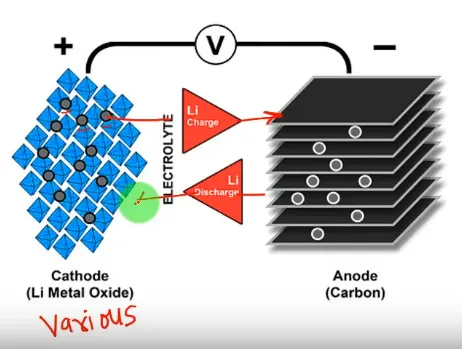
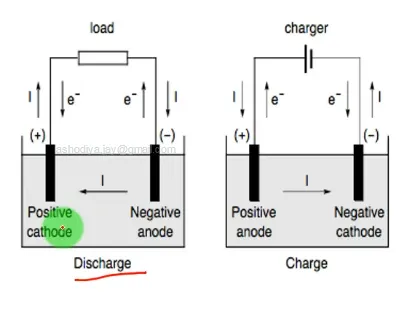
- While discharging, negative electrode (Anode) gives up electrons and gets oxidized.
- While charging, negative electrode accepts electrons & gets reduced.
- It is also known as reduction – oxidation reactions / redox reaction.
- Li ion has 1 unbalanced electron and it is very reactive or an aggressive donor of electron outside its periphery.
- Li+ ion gives up the charged ion.
- The Li+ ions keep shuttling between electrodes.
- Li+ transfer from anode (negative terminal) to cathode (positive terminal) while discharging and from Cathode (positive terminal) to Anode (negative terminal) when charging
- A discharged Li Ion Battery will have Li ions placed in the negative electrode.
- A charged Li ion Battery will have Li ions placed in the positive electrode.
- Positively charged ions are called cations and negatively charged ions are called anions.
- Cations move through the electrolyte from one electrode to another.
- Separator does not allow electrons to pass through it, hence the electrons move through the external electric circuit.
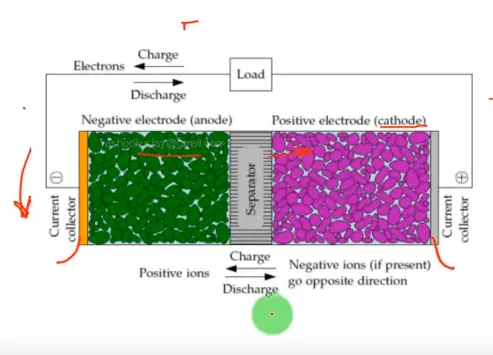
Lithium-ion cathode (positive) Materials:
- Li ion cells are classified based on material used at the Cathode
- Layered transition-metal oxides: Highest capacity but cost and safety are a concern. (NCA, NMC, LCO)
LCO is not preferred for EV applications because of safety concerns, but for low voltage requirements such as consumer products such as remotes, etc. - Spinels: High power density, but poor electronic conductivity and structural stability (LMO, LTO)
- Olivines: Better safety and longer life but low capacity and voltage (LiFePO4)
- LiPo – Li polymer
Lithium-Ion anode material:
- Carbon Based anode: Graphite or hard Carbon
- Low cost, stable and high specific capacity.
- Issue: Lithium plating – When the potential of the anode becomes excessively low, Li-ions can plate out as metallic lithium on the surface of the anode.
- Dendrite formation may result into short circuiting and may result into thermal run away, capacity loss
Lithium-Ion electrolyte material:
- A mixture of organic solvents which contain lithium salt. Such as:
- Ethylene carbonate
- Dimethyl carbonate
- Propylene carbonate
- For carbon anodes operating at a potential close to the plating of lithium, this causes the reduction of the electrolyte at the anode, building a protective coating known as SEI layer (Solid electrolyte interface)
- Typically formed during the first few charges cycles
- Below 0 C, the ionic transport properties suffer, which can drastically lower cell performance and efficiency. Difficult to use li ion cells at low temperatures.
Trade offs among 5 main lithium battery technologies:
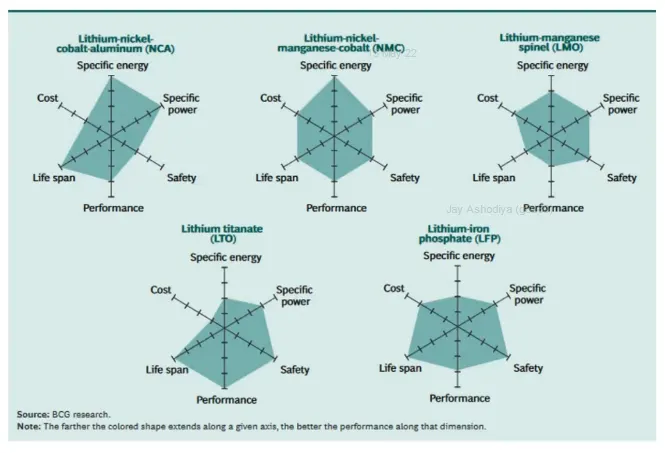
- Lithium-Nickel manganese Cobalt (NMC): Most commonly used and covers the most chart area among all different chemistries. Used in power tools and powertrains of EV.
- High specific energy.
- Moderate on Cost Effectiveness, Life Span, Performance Safety and Specific Power.
- They can either have high specific energy density or high specific power. They cannot have both properties.
- May come down in price as some manufacturers are planning on having higher% of nickel and save cost by reducing % of Cobalt.
- Preferable for EVs because of their low self heating rate.
- Lithium Nickel Cobalt aluminium (NCA): Preferrable on all aspects except that it is high on cost and has safety related concerns.
- High Specific energy, Specific power, Life span
- Moderate on performance
- Poor in terms of safety and Cost effectiveness
- Most commonly used in consumer industries, But are promising for EV. Currently not in use for EV because of safety concerns.
- Lithium Manganese Spinel (LMO):
- Poor in terms of lifespan and performance
- Moderate in terms of Safety, Specific power, Specific energy and Cost.
- They are notable for high temperature stability and are also safer than other li ion battery types.
- Often used in medical devices.
- Lithium Titanate (LTO): Most expensive among all other chemistries. But best for performance, Lifespan and safety.
- Poor in terms of specific energy and specific power.
- Excellent in terms of Safety, Performance and Life span
- But most expensive in the category
- Allows ever increasing applications, remarkably fast charging time.
- Manufacturers of EV and E bikes use Lithium Titanate, and there is a potential of its use in similar application on a large scale.
- However, they have lower inherent voltage, or low energy density than others.
- Lithium Iron phosphate (LFP): Another widely used form of chemistry. Also referred as LiFePo4
- Excellent in terms of lifespan and safety
- Moderate on Performance, specific power and Cost effectiveness
- Poor specific energy
- They have low resistance properties which enhance their safety and thermal stability.
- Durability and long-life cycles are another advantage, fully charged batteries can be stored with little change in total lifespan of battery’s charge
- Also cost effective when battery life is taken into account.
- Used in applications which need long charging time and safety, such as e bikes.
- LCO Lithium cobalt oxide:
- High specific energy, making it suitable for mobile phones, Laptops, etc
- Low lifespan and low thermal stability
|
Li-Ion Cell Type |
Cathode |
Anode |
Electrolyte |
Separator |
Overall reaction at Cathode and Anode |
Applications |
|
LCO |
Lithium Cobalt Oxide (LiCoO2) |
Graphite Carbon |
Ethylene Carbonate + Li salt |
Polyolefin |
Li(1-x) CoO2(s) + x Li+ + x e- → LiCoO2 (s) |
Mobile phones, Laptop, Cameras |
|
LMO |
Lithium Manganese Oxide (LiMn2O4) |
Graphite Carbon |
Methyl Carbonate + Li salt |
Polyolefin |
Mn2+ + 2LiC6 → Mn + 2Li+ + graphite |
Power Tools, Medical Equipment |
|
NCA |
Lithium Nickel Cobalt Aluminium Oxide (LiNiCoAlO2) |
Graphite Carbon |
Propylene Carbonate + Li salt |
Polyolefin |
Li(1-x) NiO2 → (2-x) Li (1 -x)/(2-x) O + x/2O2 |
Tesla, Industrial electric powertrain |
|
NMC (NCM) |
Lithium Nickel Cobalt Manganese Oxide (LiNiCoMnO2) |
Graphite Carbon |
Methyl Carbonate + Li Salt |
Polyolefin |
Li(x)MO2 (s) → Li+(org) + Li(x-1) MO2(s) + e- |
E bikes, medical device, Ev |
|
LFP |
Lithium Iron Phosphate (LiFePO4/C) |
Graphite Carbon |
Propylene Carbonate + Li salt |
Polyolefin |
LiFeIIPO4 ↔ FEIIIPO4 Li+ +e- |
High load currents and endurance UPS |
|
LTO |
Lithium Titanium Oxide |
Graphite Carbon |
Propylene Carbonate + Li salt |
Polyolefin |
Li4Ti5O12 +3Li+ + 3e → 4Li7Ti5O12 |
Electric powertrain (Mitsubishi i-MiEV, Honda fit EV |