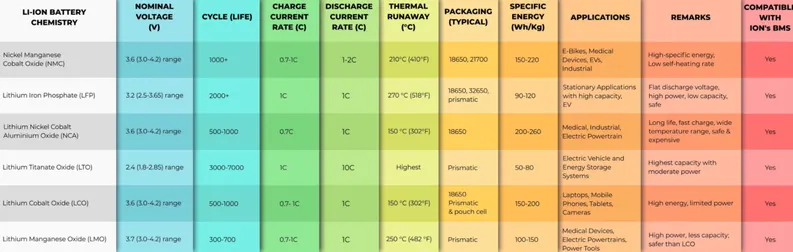
Week 1 Understanding Different Battery Chemistry
1. Prepare a table that includes materials & chemical reactions occurring at the anode and cathode of LCO, LMO, NCA, NMC, LFP, and LTO types of lithium-ion cells. Give your detailed explanation on it
ans)
Lithium-ion batteries work:
Lithium-ion batteries are batteries that function based on the transfer of lithium ions between a cathode and an anode. Lithium-ion batteries have higher specific energies than batteries made from other materials such as zinc and lead due to the relatively lightweight and low density of lithium. Lithium batteries are also more stable overcharge/recharge cycles due to
the small radii of lithium ions, which causes fewer disruptions of the electrode structure during ion transfer. Lithium-ion batteries commonly use graphite and cobalt
oxide as additional electrode materials. Lithium-ion batteries work by using the transfer of lithium ions and electrons from the anode to the cathode. At the anode, neutral lithium is oxidized and converted to Li+. These Li+ ions then migrate to the cathode, where they are incorporated into LiCoO2. This results in the reduction of Co(IV) to Co(III) when the electrons from the anode reaction are received at the cathode. Because lithium is involved in the reactions at both electrodes, the battery can be recharged by running the reactions in reverse.
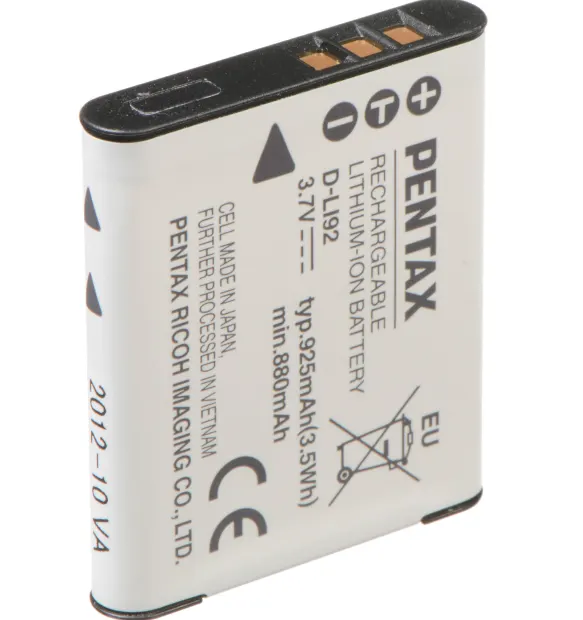
Applications:
Used in portable devices such as cell phones, wristwatches and laptop computers due to their relatively lightweight Another benefit of their lightweight is that they can be used in aerospace technologies such as satellites and space probes. Higher energy density makes them suitable for use in all-electric vehicles as well as in power tools and implanted medical devices. Lithium-ion batteries are also used for solar and wind power storage. In all of these cases, secondary batteries are generally used.
Cathode:
The cathode is most commonly a lithiated metal oxide. There are main 3 types:
1. Layered oxide like LixCoO2
2. Polyanion materials such as LiFePO4 and Li2FeSiO4
3. Spinel oxides like LiMn2O4 Li2CoO2 (HCP structure)
Electrolyte:
There are many different kinds of materials that are used as electrolytes. All of them are based on a lithium-containing material that allows for the easy diffusion of lithium. LiPF6 Ethylene
Carbonate Liquid:
Most commonly used today. Often use LiPF6 or similar lithium salt and Ethylene Carbonate as a solvent.
Solid-State and polymer:
Are being researched, but are rarely used due to the low diffusivity of lithium.
Solid Electrolyte:
Li10Zn3 (GeO4)4
Anode:
One of the most common anode materials used today is lithiated graphite, LixC6 which is composed of graphene sheets intercalated with lithium.
New materials such as those based on Silicon and other elemental blends are being researched. Lithiated graphite has a unit cell with an HCP structure.
Lithiated
Graphite
Graphene
LCO():
Cathode: Lithium Cobalt Oxide (LiCoO2(s))
Anode: Graphite
Chemical reaction at cathode: Li+ + CoO2(s) + e- -----> LiCoO2(s)
Chemical reaction at Anode: LiC6 ----> 6 C(graphite) + Li+ + e-
Complete reaction: CoO2(s) + LiC6 -----> 6 C(graphite) + LiCoO2(s)
LMO():
Cathode: lithium ion manganese oxide (LiMn2O4)
Anode: Graphite
Chemical reaction at cathode: Mn2O4 + Li+ + e- ------> LiMn2O4
Chemical reaction at Anode: LiC6 ----> 6 C(graphite) + Li+ + e-
Complete reaction: Mn2O4 + LiC6 ------> LiMn2O4 + 6 C(graphite)
NCA():
Cathode: lithium Nickel Cobalt Aluminium oxide(LiNiCoAlO2)
Anode: Graphite
Chemical reaction at cathode: NiCoAlO2 + Li+ + e- -------> LiNiCoAlO2
Chemical reaction at Anode: LiC6 ----> 6 C(graphite) + Li+ + e-
Complete reaction: NiCoAlO2 + LiC6 ------> LiNiCoAlO2 + 6 C(graphite)
NMC():
Cathode:lithium Nickel manganese Cobalt Aluminium oxide
Anode: Graphite
Chemical reaction at cathode: NiMnCoO2 + Li+ + e- -----> LiNiMnCoO2
Chemical reaction at Anode: LiC6 ----> 6 C(graphite) + Li+ + e-
Complete reaction: NiMnCoO2 + LiC6 ----> LiNiMnCoO2 + 6 C(graphite)
LFP():
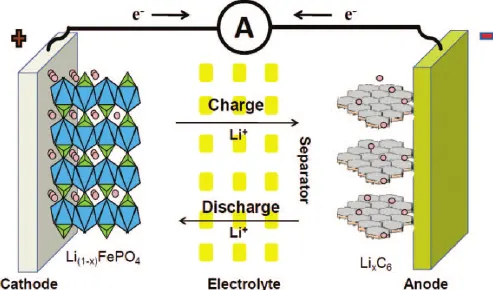
Cathode: Lithium iron phosphet
Anode: Graphite
Chemical reaction at cathode: FePO4 + Li+ + e- -----> LiFePO4
Chemical reaction at Anode: LiC6 ----> 6 C(graphite) + Li+ + e-
Complete reaction: LiC6 + FePO4 ----> 6 C(graphite) + LiFePO4
LTO():
Cathode: Lithium Manganese oxide
Anode: lithium titanate
Chemical reaction at cathode: Mn2O4 + 2Li+ + 2e- -----> 2LiMn2O4
Chemical reaction at Anode: Li2TiO3 -------> TiO3 + 2Li+ + 2e-
Complete reaction: Mn2O4 + Li2TiO3 -------> 2LiMn2O4 + TiO3
2. Compare the differences between each type of Li+ion battery based on their characteristics
ans)