Week 1 Understanding Different Battery Chemistry
1)Objective:
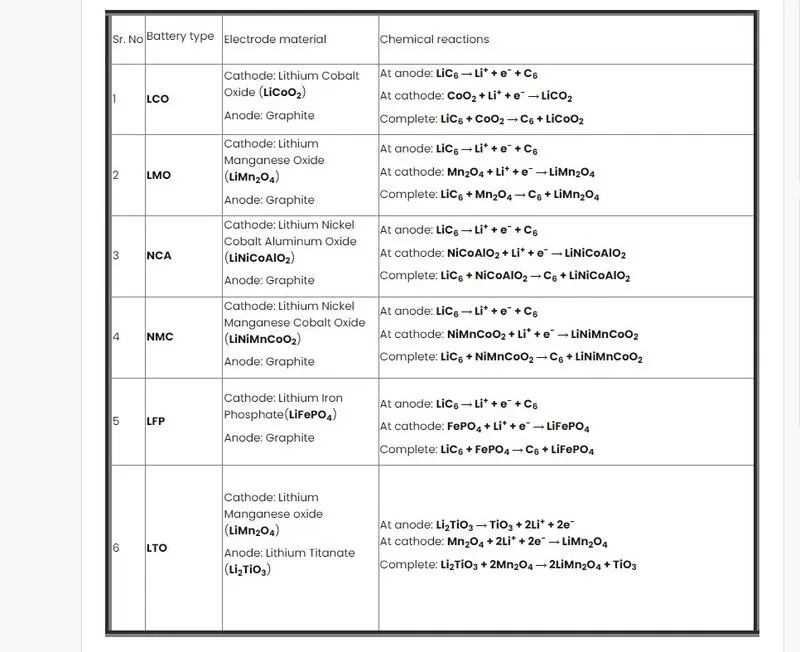
To Prepare a table which includes materials & chemical reactions occurring at the anode and cathode of LCO, LMO, NCA, NMC, LFP and LTO type of lithium ion cells.Give your detailed explanation on it
Fundamental Science in Li-ion Battery Materials
Among the rechargeable batteries, Li-ion batteries have dominated the field of advanced power sources due to their high
gravimetric and volumetric energy density. The most common Li-ion battery applications in the market are for portable electronics, power tools, and transportation.
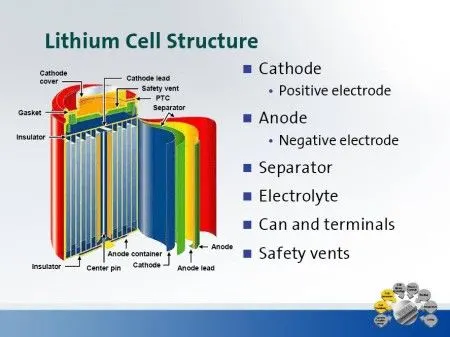
MAIN COMPONENTS OF LITHIUM ION BATTERY
Anode
The electrode at which the oxidation occurs is called the anode. The charge on the anode is negative.
Characteristics
Efficiency as a reducing agent.
High coulombic output (Ah/g)
Good conductivity
Stability
Example
graphite, Metals
Cathode
The electrode at which reduction occurs is termed as the cathode. The charge on the cathode is positive.
Characteristic
Good oxidizing agent.
Must stable when contact with electrolyte.
To achieve high performance.
Should be conductive.
Example
Metallic oxides
Electrolyte
The ionic conductor which provides the medium for transfer of charge, as ions, inside the cell between the anode and cathode
is called as an electrolyte.
Characteristics
Good ionic conductivity
Low viscosity and high dielectric constant
Non reactivity with electrode materials
Example
Sulphuric acid, LiPF , in 1:1 (Ethylene carbonate and diethylene carbonate)
Separator
An ion permeable and electronically nonconductive, spacer or material which prevents electronic contact between
electrodes of opposite polarity in the same cell.
Characteristics
Chemical stability
Low thickness
Mechanical strength
High porosity & permeability
Examples
Polypropylene, Glass, Non-Woven glass.
Current collector
An inert member of high electrical conductivity used to conduct current from or to an electrode during discharge or charge.
Characteristics
Excellent bulk electrical conductivity
Minimal thickness / weight
Excellent surface conductivity
Example - aluminium foil , nike foil , nikel mesh
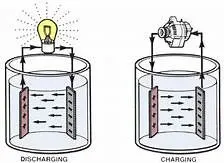
Discharge
When the cell is connected to an external load electrons flow from the anode, which is oxidized, through the external load to the cathode, where the electrons are accepted and the cathode material is reduced. The electric circuit is completed in the electrolyte by the flow of anions (negative ions) and cations (positive ions) to the anode and cathode, respectively.
charge
During the recharge of a rechargeable or storage cell, the current flow is reversed and oxidation takes place at the positive electrode and reduction at the negative electrode. As the anode is, by definition, the electrode at which oxidation occurs and the cathode is the electrode where reduction takes place. Thus, the positive electrode is the anode and the negative electrode is the cathode.
lithium iron battery
A rechargeable lithium-ion battery, like any other battery, is made up of one or more power-generating compartments known as cells. Each cell consists of three parts: a positive electrode (connected to the battery’s positive or + terminal), a negative electrode (attached to the battery’s negative or – terminal), and an electrolyte in the middle. The positive electrode is commonly composed of lithium-cobalt oxide (LiCoO2) or, in modern batteries, lithium iron phosphate (LiFePO4).The negative electrode is usually composed of carbon (graphite), and the electrolyte varies depending on the type of battery—but this isn’t critical to understanding how the battery operates.
Lithium-ion batteries all work in a similar way. When the battery is charging, the positive lithium-cobalt oxide electrode releases part of its lithium ions, which flow through the electrolyte to negative graphite electrode and stay there. During this process, the battery absorbs and stores energy.
The lithium ions migrate back across the electrolyte to the positive electrode when the battery is discharging, producing the energy that powers the battery. In both circumstances, electrons flow around the outside circuit in the opposite direction as the ions. Electrons do not flow through the electrolyte; it acts as an insulator for electrons.
The passage of ions (via the electrolyte) and electrons (in the opposite direction around the external circuit) are interrelated processes, and if one stops, the other stops as well. Because electrons can’t go through the outer circuit if ions can’t move through the electrolyte because the battery is entirely discharged, you lose power.
Similarly, if you turn off the device that the battery is powering, the flow of electrons and ions stops. The battery practically comes to a halt while it is discharging at a rapid rate (but it does keep on discharging, at a very slow rate, even with the appliance disconnected).Lithium-ion batteries, unlike simpler batteries, have built-in electronic controllers that control how they charge and discharge. They protect lithium-ion batteries against overcharging and overheating, which can cause them to explode in some cases.
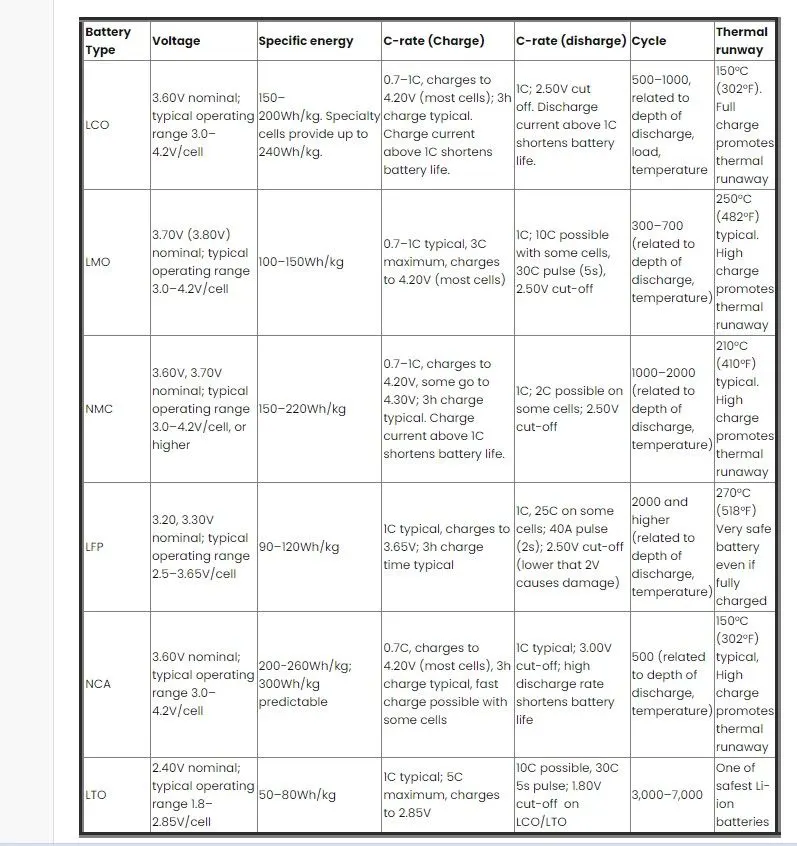
2.Compare the differences between each type of Li+ion batteries based on their characteristics
Some of the most common types of lithium batteries include:
Lithium iron phosphate (LFP)
Lithium nickel manganese cobalt oxide (NMC)
Lithium cobalt oxide (LCO)
Lithium manganese oxide (LMO)
Lithium nickel cobalt aluminum oxide (NCA)
Lithium titanate (LTO)
there are five types of lithium battery which are given below in detailed
1. Lithium Iron Phosphate (LFP)
composition: FeLiO4P
In lithium iron phosphate batteries, often known as li-phosphate batteries, phosphate is employed as a cathode. Their low resistance properties improve their thermal stability and safety.
- Nominal voltage : 3.2V
- Cycle: 2000 +
- Applications: Electric vehicles, drone, power backup.
2. Lithium Cobalt Oxide (LCO)
composition:LiCoO2 or CoLiO2
Lithium cobalt oxide batteries, commonly known as lithium cobaltate or lithium-ion cobalt batteries, are made from lithium carbonate and cobalt. Because of their high specific energy, these batteries are employed in cell phones, laptops, and electronic cameras. Lithium ions move from the anode to the cathode during discharge, with the flow reversing when the battery is charged. They have a cobalt oxide cathode and a graphite carbon anode.the cell with 2,400mAh can only be charged and discharged at 2,400mA. Forcing a fast charge or applying a load higher than 2,400mA causes overheating and undue stress. For optimal fast charge, the manufacturer recommends a C-rate of 0.8C or about 2,000mA. The mandatory battery protection circuit limits the charge and discharge rate to a safe level of about 1C for the Energy Cell.
- Nominal voltage : 3.6V
- Cycle: 1000 +
- Applications: Mobile phones, tablets, laptops, and cameras.
3. Lithium Manganese Oxide (LMO)
composition:LiMn2O4
Lithium manganese oxide batteries are also known as lithium manganese batteries, lithium-ion manganese batteries, li-manganese batteries, and manganese spinel batteries. This type of battery technology was first found in the 1980s, with the first publication in the Materials Research Bulletin in 1983. In 1996, Moli Energy produced the first commercial lithium-ion batteries with a lithium manganese oxide cathode.
- Nominal voltage : 3.6V
- Cycle: 1000 +
- Applications: Portable power tools, medical instruments, and some hybrid and electric vehicles.
4. Lithium Nickel Manganese Cobalt Oxide (NMC)
composition:LiNiMnCoO2
NMC batteries, also known as cobalt oxide batteries, are made up of a range of materials that are used in lithium-ion batteries. A cathode made of nickel, manganese, and cobalt is also provided.
Like other lithium-ion battery types, NMC batteries can have a high specific energy density or specific power. They cannot, however, have both characteristics. The most popular applications for this battery are power tools and car powertrains.Li-manganese can be
discharged at currents of 20–30A with moderate heat buildup. It is also possible to apply one-second load pulses of up to 50A. A continuous high load at this current would cause heat buildup and the cell temperature cannot exceed 80°C (176°F).
- Nominal voltage : 3.6V
- Cycle: 500- 1000
- Applications: Power tools as well as electric powertrains for e-bikes, scooters, and some electric vehicles.
5. Lithium Nickel Cobalt Aluminium Oxide (NCA)
composition:LiNi0.8Co0.15Al0.05O2
NCA batteries aren’t extensively employed in consumer electronics, they have a lot of promise in the automotive industry. NCA batteries provide a high-energy option with a long lifespan, but they are less safe and more expensive than other lithium-ion battery types. NCA batteries must be complemented by monitoring systems to assure driver safety.
- Nominal voltage : 3.6V
- Cycle: 2000 +
- Applications: In-grid storage and electrical power terrain applications, NCA is the battery of choice for Tesla.
6. Lithium Titanate (LTO)
composition:Li2TiO3
Finally, lithium titanate is a form of battery with an increasing variety of applications. The lithium-titanate battery has an extraordinarily fast recharge time due to its superior nanotechnology.
Electric vehicle and bicycle manufacturers use lithium-titanate batteries, and this type of battery has the potential to be used in public transportation electric buses.
These batteries, on the other hand, have a lower intrinsic voltage or energy density than other lithium-ion battery types, which could pose a challenge when it comes to powering autos efficiently. Regardless, lithium titanate batteries have a higher density than non-lithium-ion batteries, which is an advantage.Batteries with lithium titanate anodes have been known since the 1980s. Li-titanate replaces the graphite in the anode of a typical
lithium-ion battery and the material forms into a spinel structure. The cathode can be lithium manganese oxide or NMC. Li-titanate has a nominal cell voltage of 2.40V, can be fast charged and delivers a high discharge current of 10C, or 10 times the rated capacity.
The cycle count is said to be higher than that of a regular Li-ion. Li-titanate is safe, has excellent low-temperature discharge characteristics and obtains a capacity of 80 percent at –30°C (–22°F).
- Nominal voltage : 3.6V
- Cycle: 2000 +
- Applications: Electric vehicles and charging stations, uninterrupted power supplies, wind and solar energy storage, solar street lights, telecommunications systems, and aerospace and military equipment are just some of the use cases.