Week 1 Understanding Different Battery Chemistry
1.Prepare a table which includes materials & chemical reactions occurring at the anode and cathode of LCO, LMO, NCA, NMC, LFP and LTO type of lithium ion cells.Give your detailed explanation on it.
Introduction
Lithium-ion cells are widely used for cellular phones and note-type personal computers (PCs) because of their high voltage and high energy density. More than 1000 million such cells were sold in the year 2007. Many of the commercial lithium-ion cells have lithium cobalt oxide (LiCoO2) positive electrodes, carbon negative electrodes, and nonaqueous electrolyte solutions. These cells should be safe because the various types of electronic protection devices such as overcharge protection circuit and fuse are installed in the commercial battery pack even if the battery pack employs only one cell. However, the safety margin of these cells is still small for practical use. Many accidents involving lithium-ion cells have been reported in newspapers and via the Internet since 1995. Whatever happens to the cells, the primary reason for these accidents is thermal runway of lithium-ion cells. Abuse test results show that lithium-ion cells have two fundamental weaknesses, namely, they have insufficient tolerance to overcharging and poor thermal stability. When overcharging and heating occur simultaneously, cell safety is drastically reduced.
Studies on various new lithium-ion cells have been carried out for electric vehicles (EVs), uninterrupted power supplies (UPSs), backup power supplies (BPSs), and so on. Further trend of cell development is to make higher energy density cells and large-size cells. This trend makes cell safety a very important issue in the near future.
At present the best way to evaluate cell safety is to carry out abuse tests on bare cells without protection systems. This chapter describes the recent status of safety of practical lithium-ion cells, a theoretical approach to an understanding of cell safety, how to evaluate the safety of lithium-ion cells before practical use, and example results of safety tests of lithium-ion cells.
Lithium Cobalt Oxide (LCO)
Lithium cobalt oxide battery mainly relies on the intercalation and disintercalation of lithium ions between anode and cathode to realize the storage and release of energy.
While charging, at the external electric field, lithium elements in the LiCoO2 molecules of the anode material become lithium ion with positive charge, which moves from the anode to cathode. After chemical reaction with the carbon atoms of the cathode, LiC6 is formed, which is stably embedded into the layered graphite cathode.
When discharging, on the contrary, in the internal electric field turns, Li+ breaks away from the cathode, goes along the direction of the electric field, returns to the anode, and then becomes LiCoO2. This process called a "rocking chair battery". The more lithium ions involved in back-and-forth embedding and disembedding activities, the more energy the battery can store.
How lithium cobalt oxide battery works is shown in below figure.
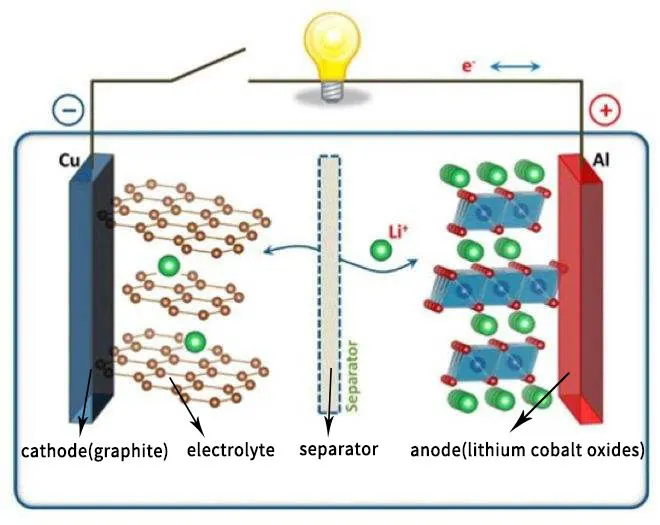
Lithium Cobalt Oxide Battery Reactions
What happens when you charge it,
Anode: LiCoO2 = Li1-xCoO2+xLi++xe-
Cathode: 6C+xLi++xe- = LixC6
What happens when you discharge
Anode: Li1-xCoO2+xLi++xe-=LiCoO2
Cathode: LixC6=6C+xLi++xe-
Applications:
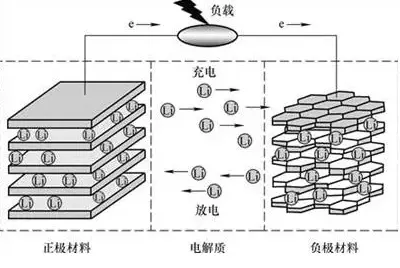
Charging Process
When the battery is charged by the power source, the electron on the anode runs to the cathode from the external circuit. The lithium ion (Li+) goes into the electrolyte from the anode, passes through the small winding hole in the separator, reaches the cathode, and combines with the electrons that have already come over.
The reaction on the anode: LiMn2O4==Li1-xMn2O4+Xli++Xe(electron)
The reaction on the cathode: 6C+XLi+Xe==LixC6
Discharging Process
When the battery discharges, the electron on the cathode runs from the external circuit to the anode, and the lithium ion goes into the electrolyte from the cathode, passes through the small winding hole in the separator runs to the anode, and combines with the electrons that have already come over.
The reaction on the anode Li1-xMn2O4+xli++xe(electron)==LiMn2O4
The reaction on the cathode LixC6==6C+xLi+xe
Applications:
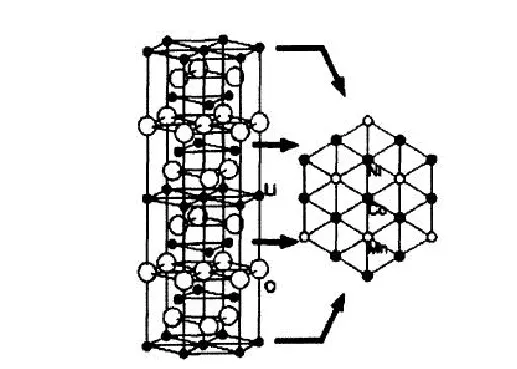
Ternary lithium battery refers to lithium battery that uses ternary materials of lithium nickel cobalt manganese oxide (LiNiMnCoO2, NMC) or lithium nickel cobalt aluminate (NCA) as anode material. Ternary means different proportions for different adjustments of nickel salt, cobalt salt and manganese salt as three different components. Lots of batteries have many different proportions of ternary materials. In terms of shape, ternary lithium batteries can be divided into soft-pack batteries, cylindrical batteries and square hard-shell batteries. Its nominal voltage can reach 3.6-3.8V. It has high energy density, high voltage platform, high tap density, long endurance range, large output power, excellent performance at low temperature, but poor stability at high temperature, and has high cost.
Chemical Equation of Charge and Discharge
Discharge: LiNixMnyCozO2→Li1-tNixMnyCozO2+tLi++te
Charge: Li1-tNixMnyCozO2+tLi++te→LiNixMnyCozO2
Application:
NMC is also used for mobile electronics such as mobile phones/smartphones, laptops in most pedelec batteries. For these applications, batteries with lithium cobalt oxide LCO were still used. Another application of NMC batteries are battery storage power stations.
Lithium Nickel Cobalt Aluminium Oxide (NCA):
The lithium nickel cobalt aluminium oxides (NCA) are a group of substances comprising metal oxides. Some of them are important due to their application in lithium ion batteries. NCAs are used as active material on the positive pole (which is the cathode when the battery is discharged).
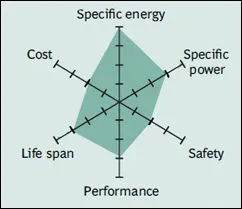
Lithium nickel cobalt aluminum oxide battery, or NCA, has been around since 1999 for special applications. It shares similarities with NMC by offering high specific energy, reasonably good specific power and a long life span. Less flattering are safety and cost. summarizes the six key characteristics. NCA is a further development of lithium nickel oxide; adding aluminum gives the chemistry greater stability.
Lithium Iron Phosphate (LFP):
The lithium iron phosphate battery or LFP battery is a type of lithium-ion battery using lithium iron phosphate as the cathode material, and a graphitic carbon electrode with a metallic backing as the anode. The energy density of an LFP battery is lower than that of other common lithium ion battery types such as Nickel Manganese Cobalt (NMC) and Nickel Cobalt Aluminum (NCA), and also has a lower operating voltages LFP batteries are currently at 125 Wh/kg, up to possibly 160 Wh/kg with improved packing technology, while BYD's LFP batteries are at 150 Wh/kg, compared to over 300 Wh/kg for the highest NMC batteries.
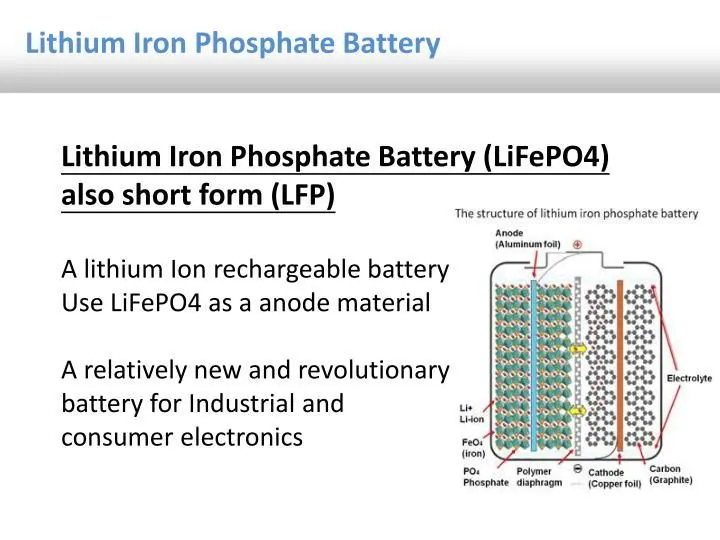
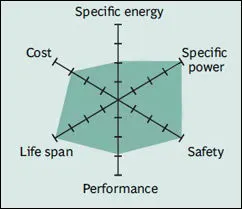
Lithium iron phosphate as cathode material for rechargeable lithium batteries. Li-phosphate offers good electrochemical performance with low resistance. This is made possible with nano-scale phosphate cathode material. The key benefits are high current rating and long cycle life, besides good thermal stability, enhanced safety and tolerance if abused. Li-phosphate is more tolerant to full charge conditions and is less stressed than other lithium-ion systems if kept at high voltage for a prolonged time. As a trade-off, its lower nominal voltage of 3.2V/cell reduces the specific energy below that of cobalt-blended lithium-ion. With most batteries, cold temperature reduces performance and elevated storage temperature shortens the service life, and Li-phosphate is no exception. Li-phosphate has a higher self-discharge than other Li-ion batteries, which can cause balancing issues with aging. Li-phosphate is often used to replace the lead acid starter battery. Four cells in series produce 12.80V, a similar voltage to six 2V lead acid cells in series. Vehicles charge lead acid to 14.40V (2.40V/cell) and maintain a topping charge. Topping charge is applied to maintain full charge level and prevent sulfation on lead acid batteries.
Lithium Titanate (LTO):
The lithium-titanate or lithium-titanium-oxide (LTO) battery is a type of rechargeable battery which has the advantage of being faster to charge than other lithium-ion battery, but the disadvantage of having a much lower energy density. Lithium titanate battery is a lithium titanate used as a negative electrode material for lithium ion batteries. It can be combined with lithium manganate, ternary materials or lithium iron phosphate to form a 2.4V or 1.9V lithium ion secondary battery.
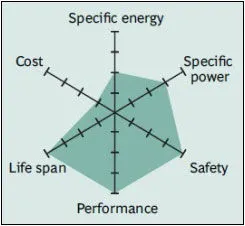
Li-titanate replaces the graphite in the anode of a typical lithium-ion battery and the material forms into a spinel structure. The cathode can be lithium manganese oxide or NMC. Li-titanate has a nominal cell voltage of 2.40V, can be fast charged and delivers a high discharge current of 10C, or 10 times the rated capacity. The cycle count is said to be higher than that of a regular Li-ion. Li-titanate is safe, has excellent low-temperature discharge characteristics and obtains a capacity of 80 percent at –30°C (–22°F). LTO (commonly Li4Ti5O12) has advantages over the conventional cobalt-blended Li-ion with graphite anode by attaining zero-strain property, no SEI film formation and no lithium plating when fast charging and charging at low temperature. Thermal stability under high temperature is also better than other Li-ion systems; however, the battery is expensive. At only 65Wh/kg, the specific energy is low, rivalling that of NiCd. Li-titanate charges to 2.80V/cell, and the end of discharge is 1.80V/cell. Illustrates the characteristics of the Li-titanate battery. Typical uses are electric powertrains, UPS and solar-powered street lighting.
Battery Abbrevation Anode Cathode Reaction at Anode Reaction at Cathode
1. LCO Lithium cobalt LiCoO2 LiC6 Li1-xCoO2+xLi++xe- 6C+xLi++xe-
oxide
2. LMO Lithium Manganese LiMn2O4 LiC6 Li1-xMn2O4+xli++xe 6C+xLi+xe
Oxide
3. NCA Lithium Nickel cobalt LiNiCoAlO2 LiC6 Li1-xNiCoAlO2+xLi++xe LiC6 xLi++xe-+C6
Aluminium oxide
4. NMC Lithium Nickel LiNiMnCoO2 LiC6 Li1-tNixMnyCozO2+tLi++te LiNixMnyCozO2
manganese cobalt
oxide
5. LFP Lithium Iron LiFePO4 LiC6 LixC6 XLi++xe-+C6 Li1-xFePO4+xLi++xe-
Phosphate
6. LTO Lithium Titanate Li2TiO3 Li4Ti5O12 Li4Ti5O12+3e-+3Li+ Li7Ti5O12
2.Compare the differences between each type of Li+ion batteries based on their characteristics.
Lithium-ion batteries are used in most aspects of our everyday lives. Most devices like smartphones and laptops cannot operate without these batteries. Lithium-ion batteries have also become very important in the field of electromobility as it is now the battery of choice in most electric vehicles. Its high specific energy gives it an advantage over other batteries.
There are different types of lithium-ion batteries and the main difference between them lies in their cathode materials. Different kinds of lithium-ion batteries offer different features, with trade-offs between specific power, specific energy, safety, lifespan, cost, and performance.
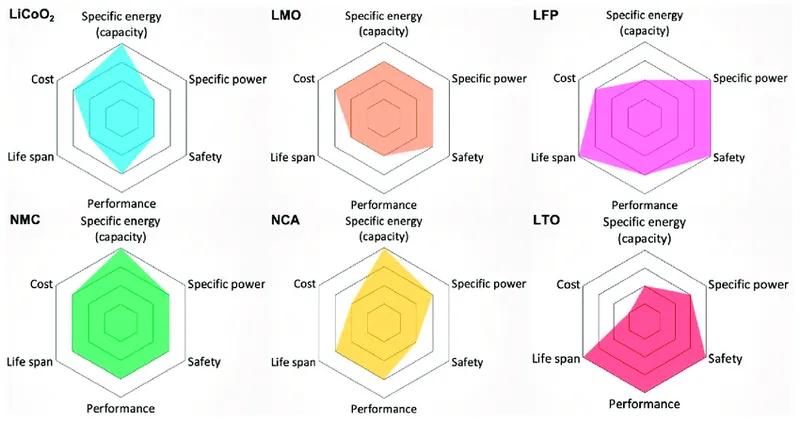
The six lithium-ion battery types that we will be comparing are Lithium Cobalt Oxide, Lithium Manganese Oxide, Lithium Nickel Manganese Cobalt Oxide, Lithium Iron Phosphate, Lithium Nickel Cobalt Aluminum Oxide, and Lithium Titanate. Firstly, an understanding of the key terms below will allow for a simpler and easier comparison.
1.Lithium Cobalt Oxide has high specific energy as compared to the other batteries which make it the preferred choice for laptops and mobile phones. It also has a low cost and a moderate performance. However, it is highly unfavorable in all the other aspects when compared to the other lithium-ion batteries. It has low specific power, low safety, and a low lifespan.
2.Lithium Manganese Oxide has moderate specific power, moderate specific energy, and a moderate level of safety when compared to the other types of lithium-ion batteries. It has the added advantage of a low cost. The downsides are its low performance and low lifespan. It is usually used in medical devices and power tools.
3.Lithium Nickel Manganese Cobalt Oxide has two major advantages as compared to the other batteries. The first one is its high specific energy which makes it desirable in electric powertrains, electric vehicles, and electric bikes. The other is its low cost. It is moderate in terms of specific power, safety, lifespan, and performance when compared to the other lithium-ion batteries. It can be optimized to either have high specific power or high specific energy.
4.Lithium Iron Phosphate only has one major disadvantage when compared to other types of lithium-ion batteries and that is its low specific energy. Other than that, it has moderate to high ratings in all the other characteristics. It has high specific power, offers a high level of safety, has a high lifespan, and comes at a low cost. The performance of this battery is also moderate. It is often employed in electric motorcycles and other applications that require a long lifespan and a high level of safety.
5.Lithium Nickel Cobalt Aluminum Oxide offers one strong advantage as compared to the five other batteries and that is high specific energy. It is pretty moderate in the rest of the characteristics like performance, cost, specific power, and lifespan. The only downside to this battery type is its low level of safety. Its high specific energy and moderate lifespan make it a good candidate for electric powertrains.
6.Lithium Titanate offers high safety, high performance, and a high lifespan which are very important features every battery should have. Its specific energy is low compared to the five other lithium-ion batteries but it compensates for this with moderate specific power. The only major disadvantage of lithium titanate as compared to the other lithium-ion batteries is its extremely high cost. Another important feature of this battery worthy of mention is its remarkably fast recharge time. It can be used for storing solar energy and creating smart grids.
Comparision of All 6 Types of Lithium ion Batteries:
| Item | LCO | LMO | NMC | NCA | LFP | LTO |
| chemical formula | LiCoO2 | LiMn2O4 | LiNiCoMnO2 | LiNiCoAlO2 | LiFePO4 | Li2TiO3 |
| theoretical capacity (mAh/g) | 274 | 148 | 275 | 275 | 170 | 175 |
| actual capacity(mAh/g) | 140 | 120 | 160~220 | 180 | 150 | 160 |
| tap density(g/cm3) | 2.8 | 2.2 | 2.6 | 2.6 | 1 | 1.68 |
| compaction density(g/cm3) | 4.2 | 3 | 3.6 | 3.6 | 2.2 | 2.43 |
| voltage platform(V) | 3.7 | 4 | 3.5 | 3.5 | 3.3 | 2.4 |
| cycling life | better | worse | ordinary | ordinary | good | better |
| transition metal | scarce | abundant | scarce | scarce | abundant | shortage |
| material costs | more expensive | cheap | expensive | expensive | cheap | expensive |
| environmental protection | contain cobalt | non-toxic | contain nickel and cobalt | contain nickel and cobalt | non-toxic | non-toxic |
| safety performance | bad | good | better | better | best | better |
Specific energy: This defines the battery capacity in weight (Wh/kg). The capacity relates to the runtime. Products requiring long runtimes at moderate load are optimized for high specific energy.
Specific power: It's the ability to deliver a high current and indicates loading capability. Batteries for power tools are made for high specific power and come with a reduced specific energy.
Performance: This measures how well the battery works over a wide range of temperatures. Most batteries are sensitive to heat and cold and require climate control. Heat reduces life, and cold lowers performance temporarily.
Lifespan: This reflects cycle life and longevity and is related to factors such as temperature, depth of discharge, and load. Hot climates accelerate capacity loss. Cobalt blended lithium-ion batteries also usually have a graphite anode that limits the cycle life.
Safety: This relates to factors such as the thermal stability of the materials used in the batteries. The materials should have the ability to sustain high temperatures before becoming unstable. Instability can lead to thermal runaway in which flaming gases are vented. Fully charging the battery and keeping it beyond the designated age reduces safety.
Cost: Demand for electric vehicles has generally been lower than anticipated and this is mainly due to the cost of lithium-ion batteries. Hence cost is a huge factor when selecting the type of lithium-ion battery.