Week 1 Understanding Different Battery Chemistry
Qn.1
Lithium Cobalt Oxide (LCO):
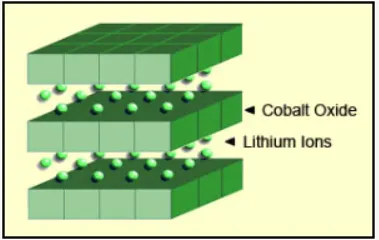
The battery consists of a cobalt oxide cathode and a graphite carbon anode. The electrolyte have the capability of passing the ions. Electrons moves over the external side.
Cathode: Cobalt oxide
Anode: Graphite carbon
Reduction operation takes place at cathode (i.e Addition of electron happens in cathode terminal)
CoO2 + Li+ + e- → LiCoO2
Oxidation takes place at anode(removal of electron).
LiC6 → C6 + Li+ + e-
Discharge:
Lithium ions move from the anode to the cathode. The electron moves from cathode to anode.
LiC6 + CoO2 --> C6 + LiCoO2
Charging:
Lithium ion moves from cathode to anode, and the electrons moves from anode to cathode.
LiC6 + CoO2 <-- C6 + LiCoO2
Drawbacks:
Li-cobalt has a graphite anode that limits the cycle life by a changing solid electrolyte interface (SEI), thickening on the anode and lithium plating while fast charging and charging at low temperature. Li-cobalt should not be charged and discharged at a current higher than its C-rating.
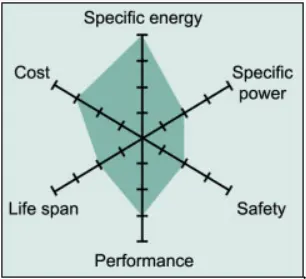
Due to its higher specific energy characteristics the battery runs for longer time but the specific power is lower so it can't withstand for larger load capacity. Safety characteristics also lower level so maintanence
Lithium Manganese Oxide(LMO):
Li-ion cell with lithium manganese oxide as cathode material, Graphite as anode material.
Chemical reaction:
At Cathode: Reduction takes place
MnO2+ Li+ + e- -->LiMnO2
At Anode: Oxidation takes place
Lithium ion moves towards cathode internally and electron comes from cathode to anode externally
Li --> Li+ + e-
Li+MnO2-->LiMnO2
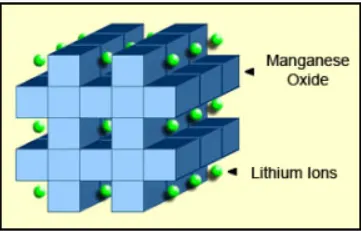
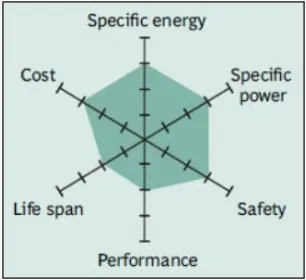
The architecture forms a three-dimensional spinel structure that improves ion flow on the electrode, which results in lower internal resistance and improved current handling. Lower internal resistance enables fast charging and high current discharging.
Drawbacks:
LMO battery have lesser performance and life span.
Nickel Cobalt Aluminium oxide:
Cathode: LiNiCoAlO2 cathode (~9% Co),
Anode: Graphite
Chemical reaction:
At Cathode: Reduction takes place
NiCoAlO2+ Li+ + e- -->LiNiCoAlO2
At Anode: Oxidation takes place
Lithium ion moves towards cathode internally and electron comes from cathode to anode externally
Li --> Li+ + e-
Li+NiCoAlO2-->LiNiCoAlO2
Drawbacks:
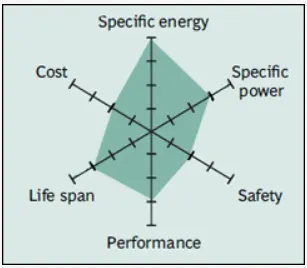
Nickel cobalt Aluminium oxide offering high specific energy, reasonably good specific power and a long life span. Less flattering are safety and cost.
Nickel Manganese Cobalt oxide:
Cathode: Combination of Nickel Manganese Cobalt
Anode: Graphite
Chemical reaction:
At Cathode: Reduction takes place
NiMnCoO2+ Li+ + e- -->LiNiMnCoO2
At Anode: Oxidation takes place
Lithium ion moves towards cathode internally and electron comes from cathode to anode externally
Li --> Li+ + e-
Li+NiMnCoO2-->LiNiMnCoO2
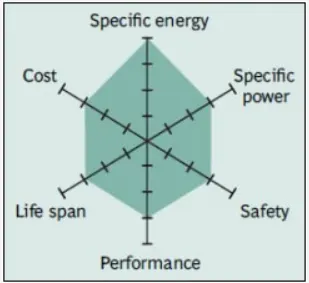
Here presence of manganese having spinal structure reduces the internal resistance but offers a low specific energy. Nickel is known for its high specific energy but poor stability. Combining the metals enhances each other strengths.
Lithium Iron phosphate:
Lithium Titanate Oxide:
Cathode: Lithium manganese oxide or NMC
Anode: Li2TiO3 (titanate) anode
Li-titanate replaces the graphite in the anode of a typical lithium-ion battery and the material forms into a spinel structure. Li-titanate has a nominal cell voltage of 2.40V, can be fast charged and delivers a high discharge current of 10C, or 10 times the rated capacity. The cycle count is said to be higher than that of a regular Li-ion. Li-titanate is safe, has excellent low-temperature discharge characteristics
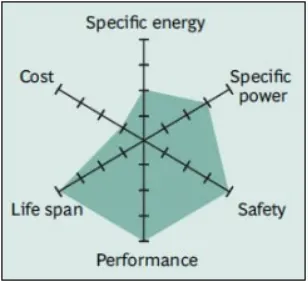
LTO has the advantages of attaining zero-strain property, no SEI film formation and no lithium plating when fast charging and charging at low temperature.
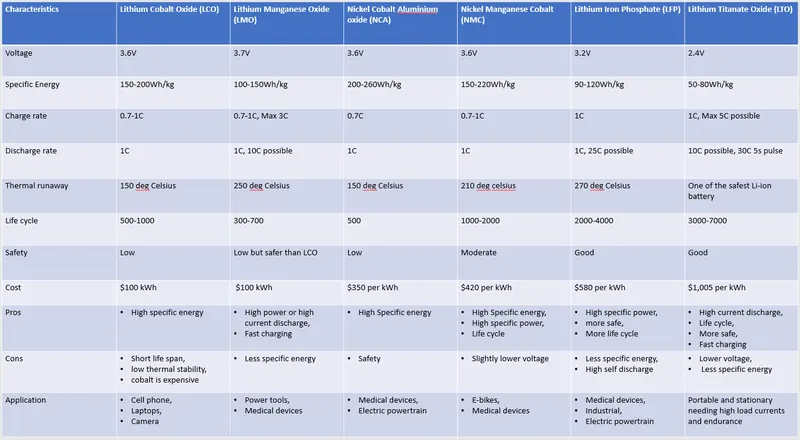
Qn. 2 Comparison of different Li+ batteries