Week 1 Understanding Different Battery Chemistry
Q1.Prepare a table which includes materials & chemical reactions occurring at the anode and cathode of LCO, LMO, NCA, NMC, LFP and LTO type of lithium ion cells.Give your detailed explanation on it
aim:- to study the characterstics of diffrent battery
Objective:-
1.Prepare a table which includes materials & chemical reactions occurring at the anode and cathode of LCO, LMO, NCA, NMC, LFP and LTO type of lithium ion cells.Give your detailed explanation on it
2.Compare the differences between each type of Li+ion batteries based on their characteristics
Introduction :-
Battery:-A battery is an electrochemical device that can store energy in the form of chemical energy. It translates to electric energy when the battery is connected in a circuit due to the flow of electrons because of the specific placement of chemicals. it is nothing but the store electrical energy in form of an the electrochemical.first battery invented by volta.
types of battery:-basically 2 types
1.Primary Batteries
The batteries made for one-time use only and unable to recharge, are called primary batteries. This type of battery is thrown away after use. It is also known as non-rechargeable batteries.
1.1 dry cell
1.2 lithium ion
2.Secondary battery:-
the battery which is made for reusable purposes by recharging are called secondary batteries. They are also called rechargeable batteries. They have the same electrochemical reaction as alkaline batteries, but the electrochemical reaction can be reversed. This type of battery is used for portable devices like mobile phones, laptops, electric vehicles.
2.1 lead acid
2.3 nickel cadmium battery
2.4 nickel metal hydride.
2.4 lithum ion
2.5 metal air
"Lithium ion battery":-
so the construction of an the lithium iron will be as same as an the ni-cd and Ni-mh battery.The lithium metal oxide is coated on aluminum foil which is the positive electrode. The graphite is coated on copper foil which is the negative electrode. Both foils are rolled in a cylindrical shape with a separator between them. The spectator is soaked with electrolyte material which generally is lithium salt as an organic solvent. The outer metal casing is negative, and the top cap is the positive terminal. Both are separated by a gasket, which is made of insulating material.
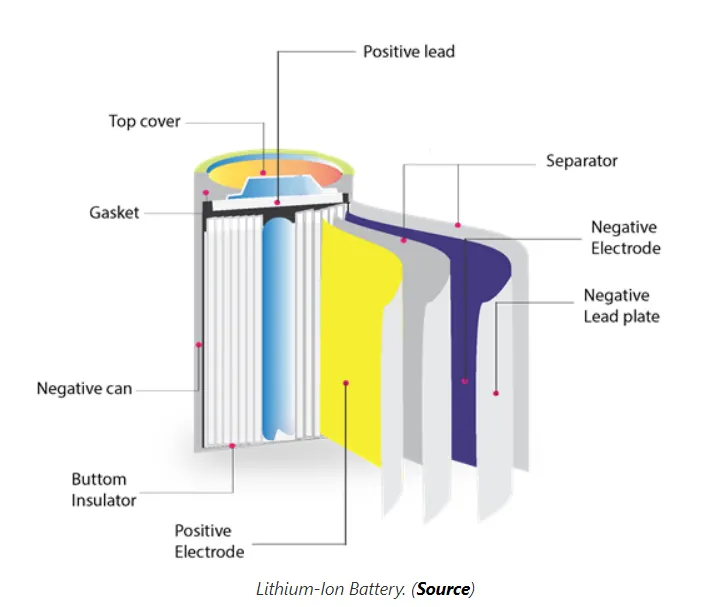
so the basically all battery has an the same parts as an the anode ,cathode,saperator and electrolyte Lithium-ion batteries are used in mobiles, laptops, and many portable devices. It is also used in the military and aerospace due to its lightweight nature. It has a higher energy density and low self-discharge compared to other types of batteries. It is also available in various sizes. Its single-cell voltage is higher. These have a significant risk of explosion when it is short-circuited or externally damaged.
So as we are considering an the lithium ion as an the anode ,cathode,electrolyte and saperator
Cathode:-so the different types of an the cathode material so we are used as the duiffrent types of an the material as metal oxide electrode , olivines electrode and spinnel electrode etc
Metal oxides:- so the metal oxides are the nothing but an the NMC-lithium nickel magnese cobalt oxide , NCA-lithium nickel cobalt aluminium ,Lithium cobalt oxide so it has an advantage as the high capacity and the safety.
Spinnel electrode:- so the other is an the spinnel electrodfe it has an the advantage as that high density as energy by volume but the low structural stability example as the Lithium magnese oxide and the lithium titanium oxide etc.
Olivines electrode:-it is the lower capacity and the lower voltge type it is an the lithium ion oxides.
Anode:- thus the anode use are the graphite or carbon basically we are used lithium plating when the anode potential is low.
Electrolyte:-electrolyte as an the lithium salt mixture of an the organic salts as the carbonate material are used which contains an the dissolve lithium salts.1]ethanyl carbonate
2]dimethanyl carbonate
3]propolane carbonate
This is the material can be used above.for an the anode operates an the close to the lithium plating so we can build an the protective coating as an the solid electrolyte interface
So the +ve material as an the cu cathode and,-ve anode as an the aluminium foil.as well as we compare alltypes of the lithium ion cells are as the according to the
1.specific power
2.specific energy
3.performance
4.life span
5.cost
6.safety
As from the above factors we can compare the different types of an the lithium ion cell mainly as the
NMC ,NCA , LCO ,LMO ,LTO,lithium phosphate ion
As well as an the form factor is an the important in the lithium ion cell as shape size of cell so the details on cell according to an the parameters on there is as below shown,
Mainly as an the cylindrical,pouch and prismatic.
Naming convetion:-
N1-cell in series
N2-diameter or trhoickness
N3-width
N4-Height
N5-parallel string
A-Shape
A1- -ve electrode
A2 +ve electrode
Notation as
ICR –lithium cobalt cylindrical
ICPlithium cobalt prismatic
Eg, ICR18650 lithium cobalt cylindrical having 18mm dia and the 65mm height.
So the below table shows the different types of lithium ion cell according to the their anode cathode and electrolyte.
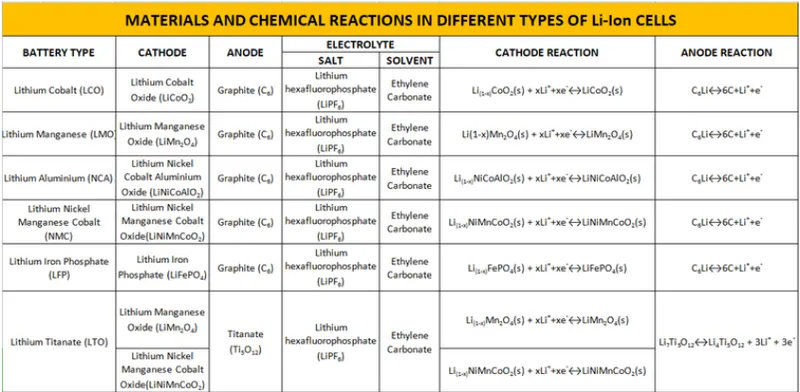
so as per above the table is an the chemical reaction
Q2.Compare the differences between each type of Li+ion batteries based on their characteristics
diffrent types of battery of lithium iron are below as
1.Lithium Nickel Manganese Cobalt Oxide (LiNiMnCoO2) — NMC
as from an the table of the anode and cathode we get an the reaction as per the charge and discharghe as well as due to the change in chemical reaction we get an diffrent characterstics as the belows
| Voltages | 3.60V, 3.70V nominal; typical operating range 3.0–4.2V/cell, or higher |
| Specific energy (capacity) | 150–220Wh/kg |
| Charge (C-rate) | 0.7–1C, charges to 4.20V, some go to 4.30V; 3h charge typical. Charge current above 1C shortens battery life. |
| Discharge (C-rate) | 1C; 2C possible on some cells; 2.50V cut-off |
| Cycle life | 1000–2000 (related to depth of discharge, temperature) |
| Thermal runaway | 210°C (410°F) typical. High charge promotes thermal runaway |
| Cost | ~$420 per kWh[1] |
| Applications | E-bikes, medical devices, EVs, industrial |
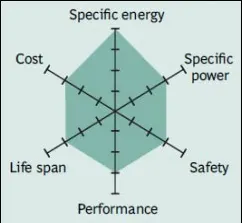
so as from an the table and the performance diagrame as the cost,performance,sp energy , sp power,safety life span etc
2. Lithium Nickel Cobalt Aluminum Oxide (LiNiCoAlO2) — NCA
| Voltages | 3.60V nominal; typical operating range 3.0–4.2V/cell |
| Specific energy (capacity) | 200-260Wh/kg; 300Wh/kg predictable |
| Charge (C-rate) | 0.7C, charges to 4.20V (most cells), 3h charge typical, fast charge possible with some cells |
| Discharge (C-rate) | 1C typical; 3.00V cut-off; high discharge rate shortens battery life |
| Cycle life | 500 (related to depth of discharge, temperature) |
| Thermal runaway | 150°C (302°F) typical, High charge promotes thermal runaway |
| Cost | ~$350 per kWh[1] |
| Applications | Medical devices, industrial, electric powertrain (Tesla) |
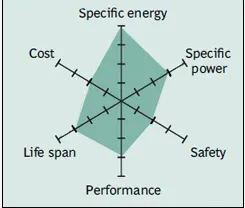
so the above we get an the all the information about an the battery cycle, charge rate discharge rate performance specific energy ,specific power etc
3]Lithium Manganese Oxide (LiMn2O4) — LMO
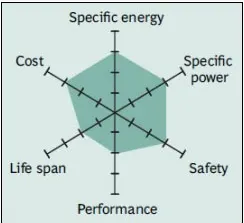
| Voltages | 3.70V (3.80V) nominal; typical operating range 3.0–4.2V/cell |
| Specific energy (capacity) | 100–150Wh/kg |
| Charge (C-rate) | 0.7–1C typical, 3C maximum, charges to 4.20V (most cells) |
| Discharge (C-rate) | 1C; 10C possible with some cells, 30C pulse (5s), 2.50V cut-off |
| Cycle life | 300–700 (related to depth of discharge, temperature) |
| Thermal runaway | 250°C (482°F) typical. High charge promotes thermal runaway |
| Applications | Power tools, medical devices, electric powertrains |
4]Lithium Titanate (Li2TiO3) — LTO
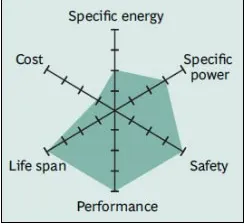
| Voltages | 2.40V nominal; typical operating range 1.8–2.85V/cell |
| Specific energy (capacity) | 50–80Wh/kg |
| Charge (C-rate) | 1C typical; 5C maximum, charges to 2.85V |
| Discharge (C-rate) | 10C possible, 30C 5s pulse; 1.80V cut-off on LCO/LTO |
| Cycle life | 3,000–7,000 |
| Thermal runaway | One of safest Li-ion batteries |
| Cost | ~$1,005 per kWh[1] |
| Applications | UPS, electric powertrain (Mitsubishi i-MiEV, Honda Fit EV), solar-powered street lighting |
| Comments |
5]Lithium Iron Phosphate(LiFePO4) — LFP
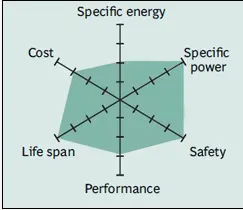
| Voltages | 3.20, 3.30V nominal; typical operating range 2.5–3.65V/cell |
| Specific energy (capacity) | 90–120Wh/kg |
| Charge (C-rate) | 1C typical, charges to 3.65V; 3h charge time typical |
| Discharge (C-rate) | 1C, 25C on some cells; 40A pulse (2s); 2.50V cut-off (lower that 2V causes damage) |
| Cycle life | 2000 and higher (related to depth of discharge, temperature) |
| Thermal runaway | 270°C (518°F) Very safe battery even if fully charged |
| Cost | ~$580 per kWh[1] |
| Applications | Portable and stationary needing high load currents and endurance |
so these are the diffrent lithium iron battery with characterstics.
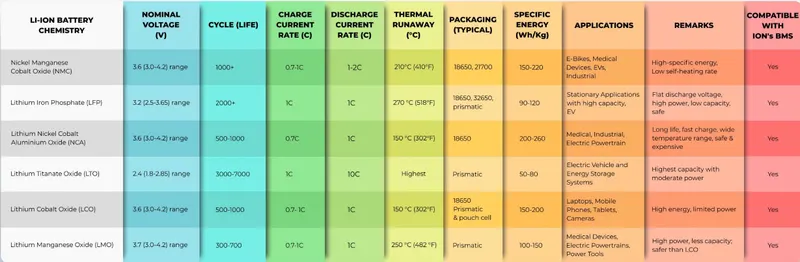
so this is the main diffrence the diffrent cell of an the lithium ion cells.