Week 1 Understanding Different Battery Chemistry
Li-ion Battery
Lithium ions cathode materials:-
Main three types by their chemistry,
- Transition metal Oxides :- Highest power capacity but cost is high and safety is less
- Spinel :- High power density but poor electric conductivity and structural stability
- Oivine :- Batter safety and long life but low capacity and voltage
Lithium ions anode materials:-
- Anode on carbon based structure which is low cost, stable and high specific voltage
- Also in some material silicon use as structure but it is poor with vibration so less feasible to use
Lithium ions anode materials:-
- Mixture of Organic solvent such as ethylene carbonate, dimethyl carbonate, propylene carbonate which contains a dissolved lithium salt
Main battery comparison:-
|
Sr. No. |
Name |
Cathode |
Anode |
Chemical Reaction Cathode |
Chemical Reaction Anode |
|
1 |
LCO |
Lithium cobalt oxide transition |
Carbon or Silicon |
Li(x)CoO2(s) → Li+(org) + Li(x-1)CoO2(s) + e- |
Li+(org) + e- → Li(gr) |
|
2 |
LMO |
Lithium manganese Oxide spinels |
Carbon or Silicon |
Li(x)Mn2O4(s) → Li+(org) + Li(x-1)Mn2O4(s) + e- |
Li+(org) + e- → Li(gr) |
|
3 |
NCA |
Lithium nickel cobalt aluminum oxide transition |
Carbon or Silicon |
Li(x)NiCoAlO2(s) → Li+(org) + Li(x-1) NiCoAlO2(s) + e- |
Li+(org) + e- → Li(gr) |
|
4 |
NMC |
Lithium nickel manganese cobalt oxide transition |
Carbon or Silicon |
Li(x)NiMgCoO2(s) → Li+(org) + Li(x-1)NiMgCoO2(s) + e- |
Li+(org) + e- → Li(gr) |
|
5 |
LFP |
Lithium iron phosphate oivines |
Carbon or Silicon |
Li(x)FePO4(s) → Li+(org) + Li(x-1) FePO4(s) + e- |
Li+(org) + e- → Li(gr) |
|
6 |
LTO |
Lithium titanate oxide spinels |
Carbon or Silicon |
Li(4x)Ti5O12(s) → Li+(org) + Li(4x-1)Ti5O12(s) + e- |
Li+(org) + e- → Li(gr) |
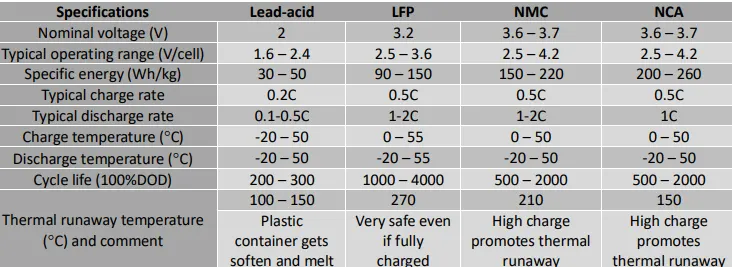
Comparison of Lithium-ion batteries :-
For rechargeable batteries, energy density, safety, charge and discharge performance, efficiency, life cycle, cost and maintenance issues are the points of interest when comparing different technologies.
LFP consists of phosphate in the cathode material. It offers higher thermal stability but moderate specific energy and a lower nominal voltage than some other types of Li-ion batteries. The key benefits are high current rating and long cycle life, as well as enhanced safety and tolerance if abused. The cost of LFP is lowest among different types of Li-ion batteries.
NMC consists of different portions of each of nickel, manganese and cobalt in the cathode material. The advantage of NMC are that its structure can be adapted to the purpose of use, for example to obtain high capacity or high specific power. In addition, it has higher energy density compared to other variants, such as LFP and LMO. However, its thermal stability is poor compared to LFP.
NCA is a development of lithium-nickel oxide, with added aluminium to increase stability. The specific energy density for NCA is similar or even higher than NMC. The battery is mostly used for high energy applications such as electric vehicles. Disadvantages are the safety and cost.
LMO consists manganese oxide in the cathode material. The structure of the cell provides low internal resistance, and thereby fast charging time, as well as thermal stability. The disadvantage of the LMO is that it has both a shorter lifespan and a shorter cycling life.
LCO consists of a cobalt oxide cathode. It offers a high specific energy. The drawback of LCO is a relatively short life span, low thermal stability and limited specific power.
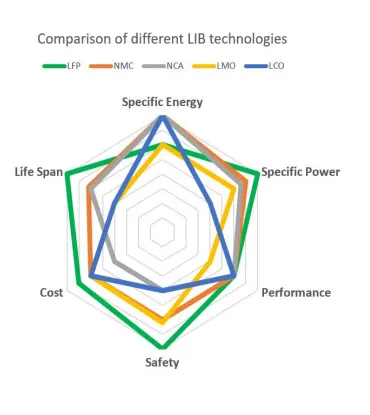
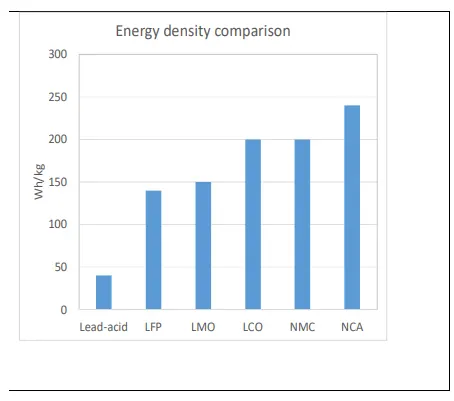
Properties comparision by value for some LIB :-