Week 1 Understanding Different Battery Chemistry
1. Types of Li-ion Battery
A lithium-ion battery or Li-ion battery is a type of rechargeable battery composed of cells in which lithium ions move from the negative electrode through an electrolyte to the positive electrode during discharge and back when charging. Li-ion cells use an intercalated lithium compound as the material at the positive electrode and typically graphite at the negative electrode.
Based on the chemistry of Li-ion they are of different types. Some of the main type and its chemical compound and reaction are compared in the below table.

The details are given in the excel sheet attached with this or in the link given below
In most of the batteries same reaction is happening. A battery is made up of an anode, cathode, separator, electrolyte, and two current collectors (positive and negative). The anode and cathode store the lithium. The electrolyte carries positively charged lithium ions from the anode to the cathode and vice versa through the separator. The movement of the lithium ions creates free electrons in the anode which creates a charge at the positive current collector. The electrical current then flows from the current collector through a device being powered (cell phone, computer, etc.) to the negative current collector. The separator blocks the flow of electrons inside the battery.
While the battery is discharging and providing an electric current, the anode releases lithium ions to the cathode, generating a flow of electrons from one side to the other. When plugging in the device, the opposite happens: Lithium ions are released by the cathode and received by the anode.
2. Comparison based on characteristic of different types of Li-ion battery.
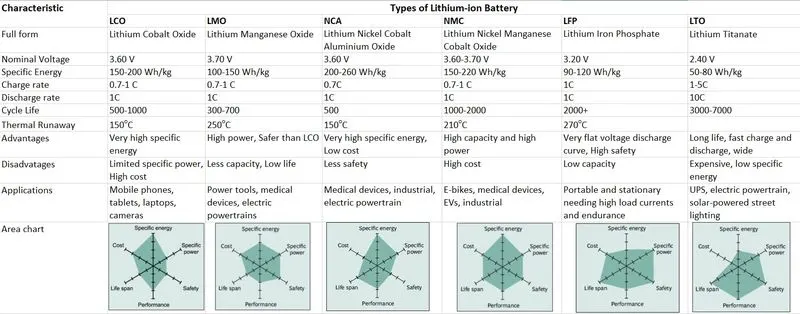
excel sheet link: characteristic comparison of different types of Li-ion batteries
Among this NMC has better area and widely used in EV applications.