Week 1 Understanding Different Battery Chemistry
Aim of the Challange:
1.Prepare a table which includes materials & chemical reactions occurring at the anode and cathode of LCO, LMO, NCA, NMC, LFP and LTO type of lithium ion cells.Give your detailed explanation on it
Introduction of Lithium ion batteries:
A lithium-ion (Li-ion) battery is an advanced battery technology that uses lithium ions as a key component of its electrochemistry. During a discharge cycle, lithium atoms in the anode are ionized and separated from their electrons. The lithium ions move from the anode and pass through the electrolyte until they reach the cathode, where they recombine with their electrons and electrically neutralize. The lithium ions are small enough to be able to move through a micro-permeable separator between the anode and cathode. In part because of lithium’s small size (third only to hydrogen and helium), Li-ion batteries are capable of having a very high voltage and charge storage per unit mass and unit volume.
Li-ion batteries can use a number of different materials as electrodes. The most common combination is that of lithium cobalt oxide (cathode) and graphite (anode), which is most commonly found in portable electronic devices such as cellphones and laptops. Other cathode materials include lithium manganese oxide (used in hybrid electric and electric automobiles) and lithium iron phosphate. Li-ion batteries typically use ether (a class of organic compounds) as an electrolyte.
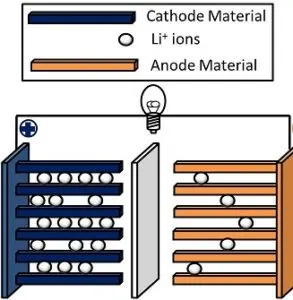
BASICS OF LITHIUM ION CELLS
A battery is made up of an anode, cathode, separator, electrolyte, and two current collectors (positive and negative). The anode and cathode store the lithium. The electrolyte carries positively charged lithium ions from the anode to the cathode and vice versa through the separator. The movement of the lithium ions creates free electrons in the anode which creates a charge at the positive current collector. The electrical current then flows from the current collector through a device being powered (cell phone, computer, etc.) to the negative current collector. The separator blocks the flow of electrons inside the battery.
CHARGE/DISCHARGE
While the battery is discharging and providing an electric current, the anode releases lithium ions to the cathode, generating a flow of electrons from one side to the other. When plugging in the device, the opposite happens: Lithium ions are released by the cathode and received by the anode.
ENERGY DENSITY VS. POWER DENSITY
The two most common concepts associated with batteries are energy density and power density. Energy density is measured in watt-hours per kilogram (Wh/kg) and is the amount of energy the battery can store with respect to its mass. Power density is measured in watts per kilogram (W/kg) and is the amount of power that can be generated by the battery with respect to its mass. To draw a clearer picture, think of draining a pool. Energy density is similar to the size of the pool, while power density is comparable to draining the pool as quickly as possible.
The Vehicle Technologies Office works on increasing the energy density of batteries, while reducing the cost, and maintaining an acceptable power density
Internal construction of lithium-ion battries:
Four Components of Li-ion Battery – Cathode, Anode, Electrolyte,
Separator
Li-ion batteries consist of largely four main components: cathode, anode, electrolyte, and separator.
Every single component of a Li-ion battery is essential as it cannot function when one of the components is missing.
The Four Components of Li-ion Battery
1.“Cathode” determines the capacity and voltage of a Li-ion battery
A Lithium-ion battery generates electricity through chemical reactions of lithium.
This is why, of course, lithium is inserted into the battery and that space for lithium is called “cathode”.
However, since lithium is unstable in the element form, the combination of lithium and oxygen, lithium oxide is used for cathode.
The material that intervenes the electrode reaction of the actual battery just like lithium oxide is called ”active material”.
In other words, in the cathode of a Li-ion battery, lithium oxide is used as an active material.
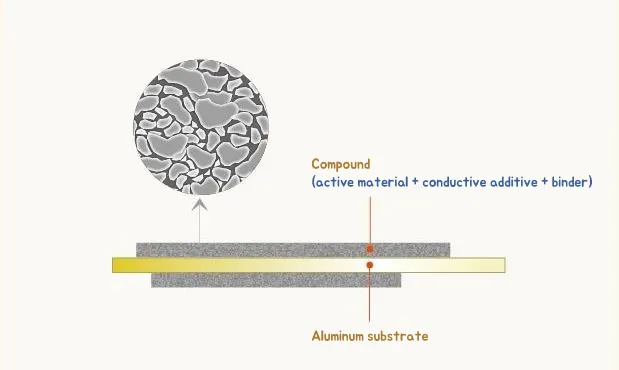
If you take a closer look at the cathode, you willl find a thin aluminum foil used to hold the frame of the cathode coated
with a compound made up of active material, conductive additive and binder.
The active material contains lithium ions, the conductive additive is added to increase conductivity;
and the binder acts as an adhesive which helps the active material and the conductive additive to settle well on the aluminum substrate.
Cathode plays an important role in determining the characteristics of the battery
as the battery’s capacity and voltage are determined by active material type used for cathode.
The higher amount of lithium, bigger the capacity; and the bigger potential difference between cathode and anode, higher the voltage.
The potential difference is small for anode depending on their type but for cathode, the potential difference is relatively high in general.
As such, the cathode plays a significant role in determining the voltage of the battery.
2. ”Anode” sends electrons through a wire
Just like the cathode, the anode substrate is also coated with active material.
The anode’s active material performs the role of enabling electric current to flow through the external circuit
while allowing reversible absorption/emission of lithium ions released from the cathode
When the battery is being charged, lithium ions are stored in the anode and not the cathode.
At this point, when the conducting wire connects the cathode to the anode (discharge state),
lithium ions naturally flow back to the cathode through the electrolyte,
and the electrons (e-) separated from lithium ions move along the wire generating electricity.
For anode graphite which has a stable structure is used, and the anode substrate is coated with active material,
conductive additive and a binder.
Thanks to graphite’s optimal qualities such as structural stability, low electrochemical reactivity,
conditions for storing much lithium ions and price, the material is considered suitable to be used for anode.
3. “Electrolyte” allows the movement of ions only
When explaining about cathode and anode, it was mentioned that lithium ions move through the electrolyte
and electrons move through the wire.
This is the key in enabling the use of electricity in a battery.
If ions flow through the electrolyte, not only can’t we use electricity but safety will be jeopardized.
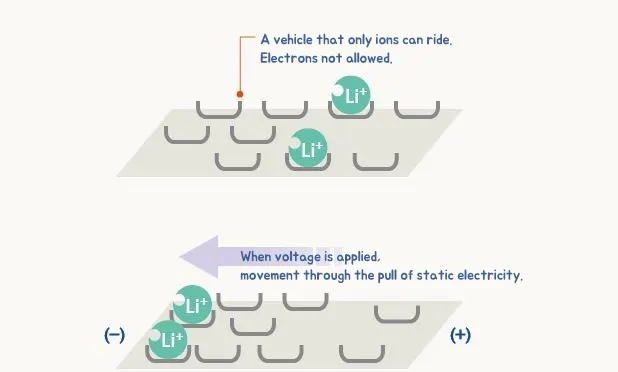
Electrolyte is the component which plays this important role.
It serves as the medium that enables the movement of only lithium ions between the cathode and anode.
For the electrolyte, materials with high ionic conductivity are mainly used so that lithium ions move back and forth easily.
The electrolyte is composed of salts, solvents and additives.
The salts are the passage for lithium ions to move, the solvents are organic liquids used to dissolve the salts,
and the additives are added in small amounts for specific purposes.
Electrolyte created in this way only allows ions to move to the electrodes and doesn’t let electrons to pass.
In addition, the movement speed of lithium ions depends on the electrolyte type.
Thus, only the electrolytes that meet stringent conditions can be used.
4. ”Separator”, the absolute barrier between cathode and anode
While the cathode and anode determine the basic performance of a battery, electrolyte and separator determine the safety of a battery.
The separator functions as a physical barrier keeping cathode and anode apart.
It prevents the direct flow of electrons and carefully lets only the ions pass through the internal microscopic hole.
Therefore, it must satisfy all the physical and electrochemical conditions.
Commercialized separators we have today are synthetic resin such as polyethylene (PE) and polypropylene (PP).
Automotive Applications for Lithium-ion Batteries
There are a range of applications for batteries in passenger cars . The ones that will be considered here were selected either because they already use lithium-ion batteries or because they could potentially do so in the future. Note that there are a number of standard automotive requirements that all lithium-ion batteries used in cars need to meet: these include life (8–15 years are typical requirements), temperature range (–40°C to at least +60°C, ideally 80°C) and vibration resistance (at least 4.5 root-mean-square-acceleration (grms). Each application will now be briefly described.
Typical Passenger Car Applications for Lithium-ion Batteries
| Application | Typical voltage(s), V | Typical Power levels, kW | Typical energy, kWh | Commonest battery type today | Special requirements |
|---|---|---|---|---|---|
| SLI | 14 | 3 | 0.7 | Lead-acid | Cranking at cold |
| Idle stop | 14 | 3 | 0.7 | Lead-acid | Cranking at cold |
| Mild hybrid | 48–200 | 10–30 | 0.3 | NiMH | Long cycle life |
| Full Hybrid | 300–600 | 60 | 1–2.5 | NiMH | Long cycle life |
| PHEV | 300–600 | 60 | 4–10 | Li-ion | Long cycle life |
| EV | 300–600 | 60 | 15+ | Li-ion | Low cost |
Lithium-ion Chemistries
Lithium-ion cells, in their most common form, consist of a graphite anode and a lithium metal oxide cathode and an electrolyte of a lithium salt and an organic solvent. While the basic format remains constant for all lithium-ion cells the detailed chemistry (i.e. cathode and/or anode) can be changed, altering the properties of the cell. It is not the aim of this paper to give a detailed explanation of the manufacture of the various cells.
Summary of the Main Lithium-ion Variants
1. Lithium cobalt oxide
Also known as lithium cobaltate or lithium-ion cobalt batteries, lithium cobalt oxide batteries are made from lithium carbonate and cobalt. Due to their very high specific energy, these batteries are used for cell phones, laptops and electronic cameras. They have a cobalt oxide cathode and use graphite carbon as their anode material; during discharge, lithium ions move from anode to cathode, with the flow reversing when the battery is charging.
This type of battery has some drawbacks, including a relatively short battery life and limited specific power. Additionally, these batteries are not as safe as other types. Even so, their characteristics make them the popular choice for cell phones and other portable electronic devices.
2. Lithium manganese oxide
Lithium manganese oxide batteries are also commonly called lithium manganate or lithium-ion manganese batteries and are sometimes referred to as li-manganese or manganese spinel. The technology for this type of battery was discovered in the 1980s, with the first publication on the subject appearing in the Materials Research Bulletin in 1983. The first commercial lithium-ion cells made with lithium manganese oxide as a cathode material were produced in 1996 by Moli Energy.
Lithium manganese oxide batteries are notable for their high temperature stability and are also safer than other lithium-ion battery types. For this reason, they are often used in medical equipment and devices, but they may also be used in power tools, electric bikes and more. It is also possible to use lithium manganese oxide batteries to power laptops and electric powertrain cars.
3. Lithium iron phosphate
Lithium iron phosphate batteries, also known as li-phosphate batteries, use phosphate as a cathode. They benefit from low resistance properties, which enhance their safety and thermal stability.
Other benefits include durability and a long lifecycle — fully charged batteries can be stored with little change to the total lifespan of the battery’s charge. Li-phosphate batteries are often the most cost-effective option as well when their long battery life is taken into consideration. However, the lower voltage of the li-phosphate battery means that it has less energy than other types of lithium batteries.
Accordingly, these batteries are often used in electric motorcycles as well as other applications that need a long lifecycle and significant safety. Electric vehicles often use these batteries as well.
4. Lithium nickel manganese cobalt oxide
Also known as lithium manganese cobalt oxide or NMC batteries, lithium nickel manganese cobalt oxide batteries are made of several materials common in lithium-ion battery types. They include a cathode made of a combination of nickel, manganese and cobalt.
Like other lithium-ion battery varieties, NMC batteries can have either a high specific energy density or a high specific power. They cannot, however, have both properties. This battery type is most common in power tools and in powertrains for vehicles.
The cathode combination ratio is usually 60 percent nickel, 20 percent manganese and 20 percent cobalt. This means that the raw material cost is lower than it is for other lithium-ion battery options, as cobalt can be quite expensive. These batteries may come down in price further in the future, as some battery makers are planning to switch their battery chemistry to a higher percentage of nickel so that they can use less cobalt. This battery type is commonly preferred for electric vehicles due to its very low self-heating rate.
5. Lithium nickel cobalt aluminum oxide
Lithium nickel cobalt aluminum oxide batteries are also called NCA batteries, and are becoming increasingly important in electric powertrains and in grid storage.
NCA batteries are not common in the consumer industry, but are promising for the automotive industry. NCA batteries provide a high-energy option with a good lifespan, but they are not as safe as they could be compared to other lithium-ion battery types and are quite costly. NCA batteries must be accompanied by monitoring devices to ensure driver safety.
Given the consistent use of NCA batteries in electric vehicles, it is possible that demand for these batteries will rise as electric vehicles become more common.
6. Lithium titanate
Finally, lithium titanate, also known as li-titanate, is a class of battery that allows for ever-increasing applications. The main advantage of the li-titanate battery is its remarkably fast recharge time, thanks to its advanced nanotechnology,
Currently, manufacturers of electric vehicles and bikes use li-titanate batteries, and there is potential for this type of battery to be used in electric buses for public transportation. However, these batteries have lower inherent voltage, or lower energy density, than other lithium-ion battery varieties, which can present issues with powering vehicles efficiently. Even so, the density of lithium titanate batteries is still higher than other non-lithium-ion batteries, which is a plus.
Applications for these batteries can include military and aerospace uses, and they may also be used for storing wind and solar energy and creating smart grids. Furthermore, Battery Space suggests these batteries could also be used in system-critical backups for power systems.
2.Compare the differences between each type of Li+ion batteries based on their characteristics
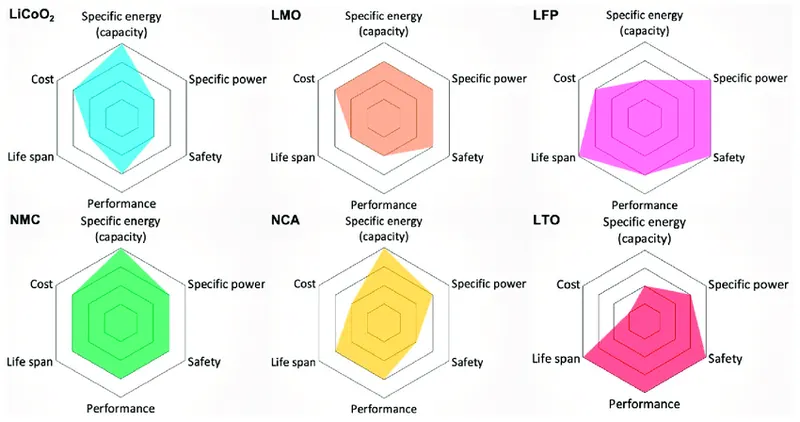
Lithium Cobalt Oxide, LCO
The Lithium Cobalt Oxide, LiCoO2, battery is a type of lithium ion battery that find uses in many consumer items of electronic equipment. It provides a very high level of specific energy density along with a good level of safety.
The battery consists of a cobalt oxide cathode with a layered structure. The anode is graphite (carbon). During the discharge cycle, lithium ions move from the anode to the cathode, and in the reverse direction during charge.
The LCO battery is now being supplanted in some applications by Lithium Manganese, as well as NMC and NCA types. This is occurring as a result of the improved performance of these other types as development improves the performance and as a result of cost.
| SUMMARY OF LITHIUM COBALT OXIDE BATTERY, LCO | |
|---|---|
| ATTRIBUTE | DETAILS |
| Key features | High energy density; high level of safety |
| Main disadvantages | Relatively short life-span; limited high load capability. |
| Main applications | Consumer electronics:- mobile phones, games, laptops, tablets, e-readers, etc. |
| Voltage | 3.60V nominal with typical operating rate between 3.0 - 4.2 V/cell |
| Specific energy (capacity) | 150 - 200Wh/kg typical |
| Battery life | 500 - 1000 cycles |
Lithium Iron Phosphate Battery, LFP
The Lithium Iron Phosphate, LFP type of lithium ion battery provides a low internal resistance and high current capability.
In order to provide its high of current capability, this type of li-ion battery uses a nano-scale phosphate cathode material.
In terms of performance this type of lithium ion battery provides a slightly lower terminal voltage and it has a slightly higher self-discharge rate than other forms. However against this it provides a high current rating, and good thermal stability combined with a good level of, and good thermal stability.
| SUMMARY OF LITHIUM IRON PHOSPHATE, LFP BATTERY | |
|---|---|
| ATTRIBUTE | DETAILS |
| Key features | High current capability, longer calendar lifespan. |
| Main disadvantages | Slightly higher self-discharge rate; low cell voltage (3.3V) |
| Main applications | Power tools, some medical tools, hobbyist |
Lithium Manganese Oxide, LMO
This type of lithium ion battery uses Lithium Manganese Oxide, LiMn2O4 as its cathode material. This type of lithium ion battery is structured to allow high currents to flow and this enables it to provide very high current levels and also to be fast charged as well.
It generally uses a three-dimensional spinel structure, i.e. one in which the crystal structure in the cubic, isometric, system, with the oxide anions arranged in a cubic close-packed lattice. This structure improves the flow of ions on the electrode, thereby increasing he current capability and lowering the internal resistance of the cell. A typical 1500mAh battery may be able to deliver steady currents of up to 20 A, obviously for a relatively short time because of the overall battery capacity.
The structure of this type of lithium ion battery also has the advantage that it improves the thermal stability and improves the safety of the cell.
However the disadvantage of the cell is the limited number of charge discharge / cycles as well as the limited calendar life, i.e. the degradation over time since manufacture.
| SUMMARY OF LITHIUM MANGANESE OXIDE, MNO BATTERY | |
|---|---|
| ATTRIBUTE | DETAILS |
| Key features | High current capability for charge and discharge. |
| Main disadvantages | Lower energy density than other types of lithium ion battery, low cycle life and calendar life. |
| Main applications | Power tools, some medical tools some vehicles. |
| Voltage | ~3.70V nominal |
| Specific energy | 100 - 150Wh/kg |
| Life expectancy | 400 - 750 cycles |
Lithium Nickel Cobalt Aluminium Oxide, NCA
The Lithium Nickel Cobalt Aluminium Oxide battery, or NCA, is a li-ion battery type that is rarely seen in consumer applications but is being investigated for the automotive industry. Its main advantage is that it has a good life span and high energy and power density figures.
However these features come at a cost and in view of the safety elements, it must be used with care. Further development is also required to bring it to a state where this type of li-ion battery can be more widely used.
| SUMMARY OF LITHIUM NICKEL COBALT ALUMINIUM OXIDE, NCA | |
|---|---|
| ATTRIBUTE | DETAILS |
| Key features | High energy density, high power density, good life span. |
| Main disadvantages | High cost; safety requires more care in the design and use. |
| Main applications | |
Lithium Nickel Manganese Cobalt Oxide, NMC
The lithium nickel manganese cobalt oxide lithium battery type uses a cathode comprising of a combination of nickel, manganese, and cobalt.
The key to this lithium ion battery type is the combination of nickel and manganese. Nickel is known for its high specific energy, but poor stability whereas manganese provides low internal resistance but at the cost of low specific energy. Combining both in a cell in the correct manner is able to provide the required balance of the properties of both metals.
The cathode combination often consists of a combination of nickel, manganese and cobalt in equal proportions in a combination known as 1-1-1. This combination reduces cost by reducing the cobalt content, whilst still retaining some of the key performance parameters.
Another popular combination consists of 5 parts nickel, 3 parts cobalt & 2 parts manganese (5-3-2).
The NMC type of lithium ion battery can be optimised for either to high specific power or high specific energy. With the high cost of cobalt, manufacturers are trying to move away from its use, often increasing the use of nickel, so this is often a major fact in the choice of composition of the battery.
| SUMMARY OF LITHIUM NICKEL MANGANESE COBALT OXIDE, NMC | |
|---|---|
| ATTRIBUTE | DETAILS |
| Key features | High specific power or energy. |
| Main disadvantages | Power / energy density not as high as some other types. |
| Main applications | Power tools and electric vehicles. |
| Voltage | 3.60 - 3.70 V |
| Specific energy | 160 - 230Wh/kg |
| Life expectancy | 1000 - 2000 cycles. |
It is important to note that the six types of lithium-ion batteries are compared relative to one another.
| Lithium-ion battery Types | SP | SE | SF | LS | CS | PF |
|---|---|---|---|---|---|---|
|
Lithium Cobalt Oxide |
L |
H |
L |
L |
L |
M |
|
Lithium Manganese Oxide |
M |
M |
M |
L |
L |
L |
|
Lithium Nickel Manganese Cobalt Oxide |
M |
H |
M |
M |
L |
M |
|
Lithium Iron Phosphate |
H |
L |
H |
H |
L |
M |
|
Lithium Nickel Cobalt Aluminum Oxide |
M |
H |
L |
M |
M |
M |
|
Lithium Titanate |
M |
L |
H |
H |
H |
H |
- SP stands for specific power
- SE stands for specific energy
- SF stands for safety
- LS stands for lifespan
- CS stands for cost
- PF stands for performance
- L stands for low
- M stands for moderate
- H stands for high