Week 1 Understanding Different Battery Chemistry
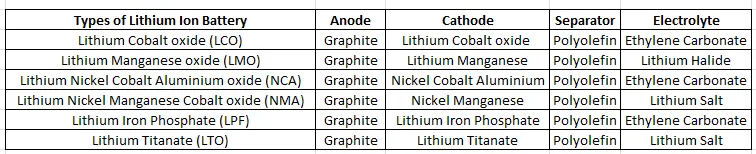
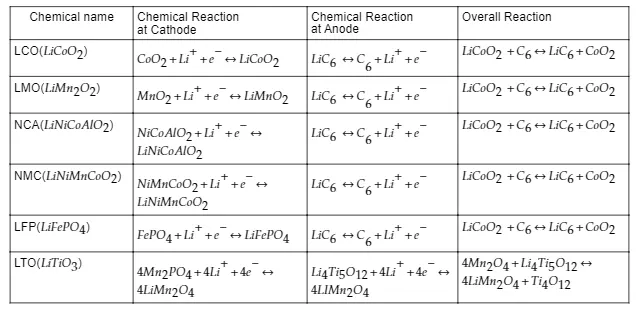
Q 1) Prepare a table which includes materials & chemical reactions occurring at the anode and cathode of LCO, LMO, NCA, NMC, LFP and LTO type of lithium ion cells.Give your detailed explanation on it.
A lithium-ion battery or Li-ion battery is a type of rechargeable battery composed of cells in which lithium ions move from the negative electrode through an electrolyte to the positive electrode during discharge and back when charging. Li-ion cells use an intercalated lithium compound as the material at the positive electrode and typically graphite at the negative electrode.
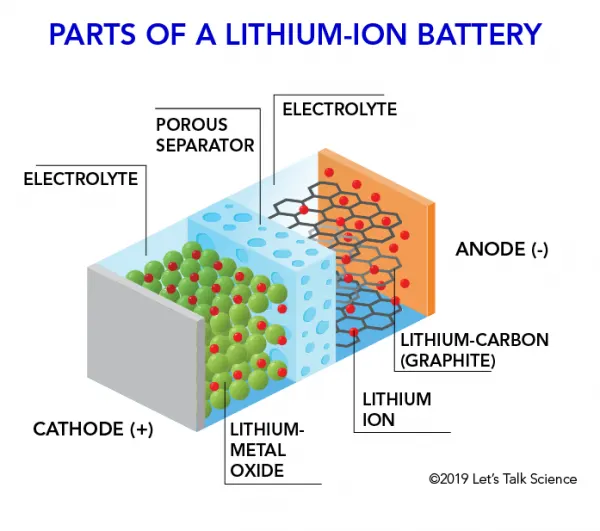
Li-ion batteries have a high energy density, no memory effect (other than LFP cells) and low self-discharge. Cells can be manufactured to either prioritize energy or power density. They can however be a safety hazard since they contain flammable electrolytes and if damaged or incorrectly charged can lead to explosions and fire.
Based on Performance, Chemistry, Cost & Safety characteristics different types of lithium ion batteries. Handheld electronics mostly use lithium polymer batteries (with a polymer gel as electrolyte), a lithium cobalt oxide (LiCoO2) cathode material, and a graphite anode, which together offer a high energy density. Lithium iron phosphate (LiFePO4), lithium manganese oxide (LiMn2O4 spinel, or Li2MnO3-based lithium rich layered materials, LMR-NMC), and lithium nickel manganese cobalt oxide (LiNiMnCoO2 or NMC) may offer longer lives and may have better rate capability. Such batteries are widely used for electric tools, medical equipment, and other roles. NMC and its derivatives are widely used in electric vehicles.
Q 2) Compare the differences between each type of Li+ion batteries based on their characteristics.
| Lithium Cobalt Oxide (LCO) | |
| Voltage | 3.6 V nominal, Typical operating range is 3.0-4.2 V/cell |
| Specific Energy | 150-200Whr/kg, Speciality Cells provide uptu 240 Whr/kg |
| Charge (C-Rate) | 0.7-1 C, charges to 4.20V (most cells); 3h charge typical. Charge current above 1C shortens battery life |
| Discharge (C-Rate) | 1C, 2.50V cut off. Discharge current above 1C shortens battery life. |
| Cycle Life | 500–1000, related to depth of discharge, load, temperature |
| Thermal Runaway | 150°C (302°F). Full charge promotes thermal runaway |
| Application | Mobile phones, tablets, laptops, cameras |
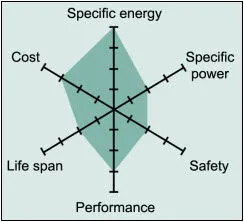
Very high specific energy, limited specific power. Cobalt is expensive. Serves as Energy Cell. Market share has stabilized.
Early version; no longer relevant.
| Lithium Manganese Oxide (LiMn2O4) — LMO | |
| Voltage | 3.70V (3.80V) nominal; typical operating range 3.0–4.2V/cell |
| Specific Energy | 100–150Wh/kg |
| Charge (C-Rate) | 0.7–1C typical, 3C maximum, charges to 4.20V (most cells) |
| Discharge (C-Rate) | 1C; 10C possible with some cells, 30C pulse (5s), 2.50V cut-off |
| Cycle Life | 300–700 (related to depth of discharge, temperature) |
| Thermal Runaway | 250°C (482°F) typical. High charge promotes thermal runaway |
| Application | Power tools, medical devices, electric powertrains |
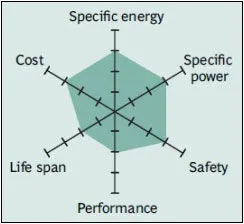
High power but less capacity; safer than Li-cobalt; commonly mixed with NMC to improve performance.
Less relevant now; limited growth potential.
| Lithium Nickel Manganese Cobalt Oxide (LiNiMnCoO2) — NMC | |
| Voltage | 3.60V, 3.70V nominal; typical operating range 3.0–4.2V/cell, or higher |
| Specific Energy | 150–220Wh/kg |
| Charge (C-Rate) | 0.7–1C, charges to 4.20V, some go to 4.30V; 3h charge typical. Charge current above 1C shortens battery life. |
| Discharge (C-Rate) | 1C; 2C possible on some cells; 2.50V cut-off |
| Cycle Life | 1000–2000 (related to depth of discharge, temperature) |
| Thermal Runaway | 210°C (410°F) typical. High charge promotes thermal runaway |
| Application | E-bikes, medical devices, EVs, industrial |
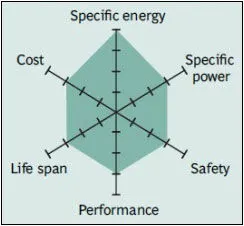
Provides high capacity and high power. Serves as Hybrid Cell. Favorite chemistry for many uses; market share is increasing.
Leading system; dominant cathode chemistry.
| Lithium Iron Phosphate(LiFePO4) — LFP | |
| Voltage | 3.20, 3.30V nominal; typical operating range 2.5–3.65V/cell |
| Specific Energy | 90–120Wh/kg |
| Charge (C-Rate) | 1C typical, charges to 3.65V; 3h charge time typical |
| Discharge (C-Rate) | 1C, 25C on some cells; 40A pulse (2s); 2.50V cut-off (lower that 2V causes damage) |
| Cycle Life | 2000 and higher (related to depth of discharge, temperature) |
| Thermal Runaway | 270°C (518°F) Very safe battery even if fully charged |
| Application | Portable and stationary needing high load currents and endurance |
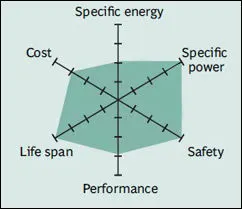
Very flat voltage discharge curve but low capacity. One of safest Li-ions.
Used for special markets. Elevated self-discharge.
Used primarily for energy storage, moderate growth.
| Lithium Nickel Cobalt Aluminum Oxide (LiNiCoAlO2) — NCA | |
| Voltage | 3.60V nominal; typical operating range 3.0–4.2V/cell |
| Specific Energy | 200-260Wh/kg; 300Wh/kg predictable |
| Charge (C-Rate) | 0.7C, charges to 4.20V (most cells), 3h charge typical, fast charge possible with some cells |
| Discharge (C-Rate) | 1C typical; 3.00V cut-off; high discharge rate shortens battery life |
| Cycle Life | 500 (related to depth of discharge, temperature) |
| Thermal Runaway | 150°C (302°F) typical, High charge promotes thermal runaway |
| Application | Medical devices, industrial, electric powertrain (Tesla) |
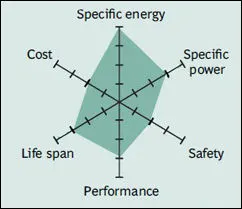
Shares similarities with Li-cobalt. Serves as Energy Cell.
Mainly used by Panasonic and Tesla; growth potential.
| Lithium Titanate (Li2TiO3) — LTO | |
| Voltage | 2.40V nominal; typical operating range 1.8–2.85V/cell |
| Specific Energy | 50–80Wh/kg |
| Charge (C-Rate) | 1C typical; 5C maximum, charges to 2.85V |
| Discharge (C-Rate) | 10C possible, 30C 5s pulse; 1.80V cut-off on LCO/LTO |
| Cycle Life | 3,000–7,000 |
| Thermal Runaway | One of safest Li-ion batteries |
| Application | UPS, electric powertrain (Mitsubishi i-MiEV, Honda Fit EV), solar-powered street lighting |
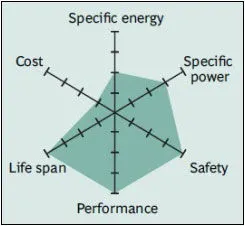
Long life, fast charge, wide temperature range but low specific energy and expensive.
Among safest Li-ion batteries.
Ability to ultra-fast charge; high cost limits to special application.
Future Batteries
Solid-state Li-ion: High specific energy but poor loading and safety.
Lithium-sulfur: High specific energy but poor cycle life and poor loading.
Lithium-air: High specific energy but poor loading needs clean air to breath and has short life.
Conclusion:
Thus we studied the types of battery, there characteristics, their chemical reaction with anode and cathode and Make table.
Ref: https://batteryuniversity.com/article/bu-205-types-of-lithium-ion