Week -2
Que 1)
Make a Simulink model of Doorbell using solenoid block with the following details:
In the above arrangement, when the switch is closed, the electromagnet receives electrical power from the battery and pulls the metal arm to hit the bell producing sound. Create a situation where the switch is closed for 2 seconds and then released. Observe the physical movement of the plunger.
Answer
Solenoid-A solenoid is a device comprised of a coil of wire, the housing and a moveable plunger (armature). When an electrical current is introduced, a magnetic field forms around the coil which draws the plunger in.
Model Block Diagram
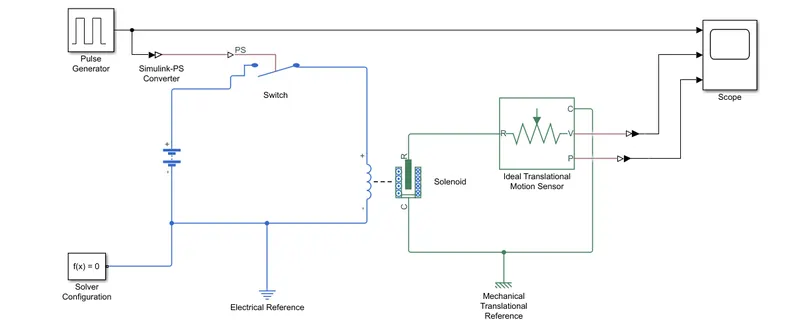
As seen in block diagram coloured one are simscape and black coloured are simulink blocks, so every time when we use simscape to simulink block we use PS to simulink convertor and Vise-versa.
The pulse generator output goes to the switch and scope. The battery is for the supply for coil to form electromagnetism, when pulse appears switch is closed and ckt get completed due to which coil turn into an electromagnet.
This electromagnet pulls out the arm in the solenoied which is called as plunger and when plse goes out it release it back. When ever plunger is move there is linear movement, to observr this movement we connect Ideal translational motor sensor. This is the replicating kind of doorbell whenever plunger pull it rings and this is observe inthe scope.
Also we use Electrical reference, Mechanical reference and solver configuration wherever it is necessary.
Result
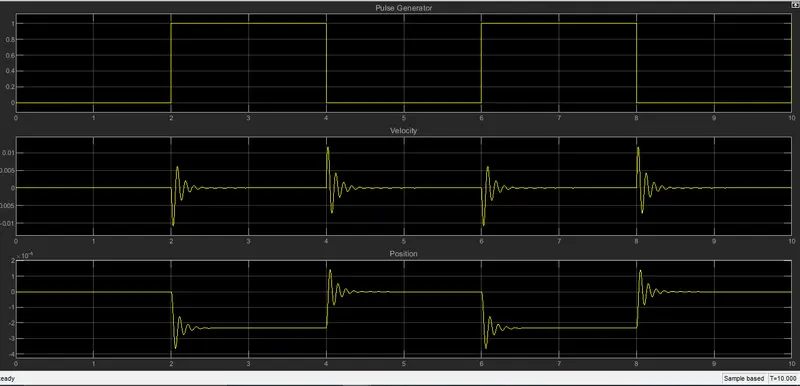
here we can see that switch is close for 2 sec and then open, and for that period velocity and position of sensor is varies to show bell is ringing.
Que 2)
Use a thermistor to sense the temperature of a heater & turn on or turn off the fan as per the below conditions:
Temperature source: 20 °C from 0 to 10 seconds, 27 °C from 10 to 30 seconds, 23 °C from 30 to 50 seconds Fan conditions: ON if the temperature above 25 °C, OFF otherwise
Answer
Thermistor means Thermal Resistance i.e. due to change temperature what effect does the resistance shows. Thermistor have two types 1. Positive Temperature Coefficient 2. Negative Temperature Coefficient.
Model Block Diagram
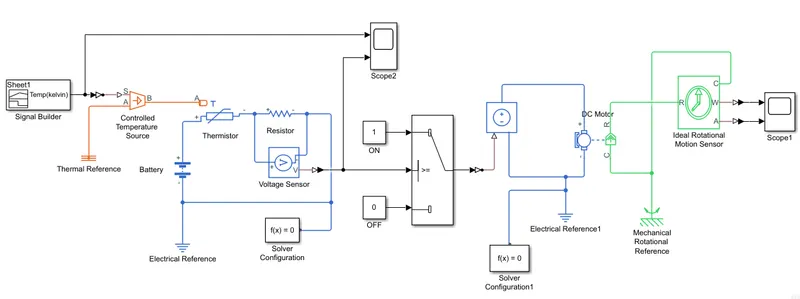
In the above fig to generate fan output sig we have to make a voltage sig. So there are 2 parts in above block diagram, one is to generate volatge sig and other part to turn on/off fan.
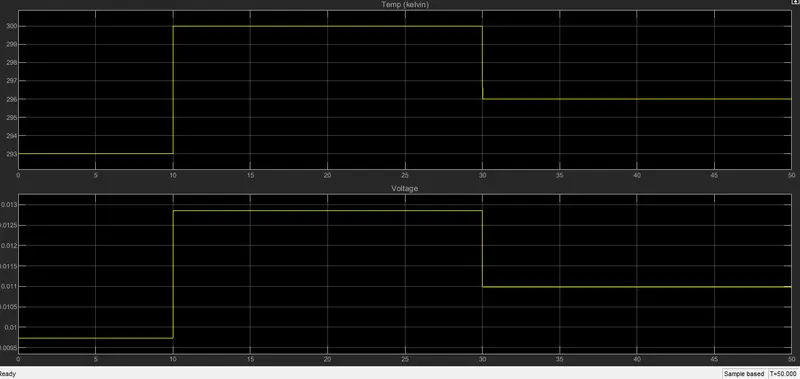
To form this shape in scope we have given data in question that at 0-10 sec temp is 20'c, 10-20 sec temp is 27'c, and 30-50 sec temp is 23'c but we to use kelvin values because all thermal blocks are in kelvin default state.
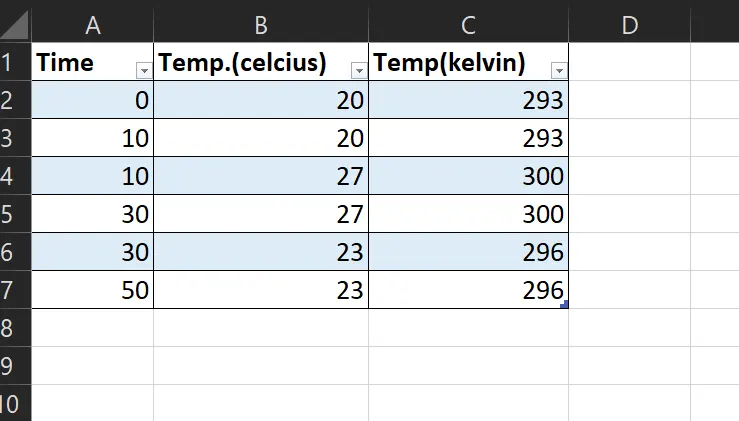
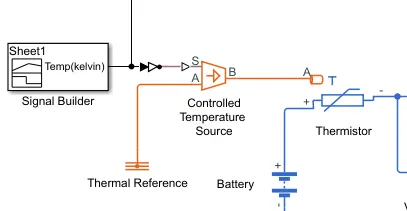
This excel sheet data is given as input to signal builder and then to controlled temp source simscape block with the help of simulink to PS convertor, After this follow by Thermistor. As we see in block diagram all the coloured blocks are simscape while all black colour are simulink blocks, so every time when we use simscape to simulink block we use PS to simulink convertor and Vise-versa.
The resistor is connected in series with Thermistor and to measure voltage we connect voltage sensor across it. Also to give supply for this operation we use dc battery, after that we get dc voltage sig which is given to Switch with threshold valuse condition. The threshold value we observe from scope2 where it have input of temp (kelvin) and output of voltage sensor, here we observe the temp at 25'c as mention in the question and voltage found to be 0.0128594 V. This value is use as threshold for the switch means if input is above this then fan is ON otherwise OFF.
Also we use Electrical reference, Thermal reference, Mechanical reference and solver configuration wherever it is necessary.
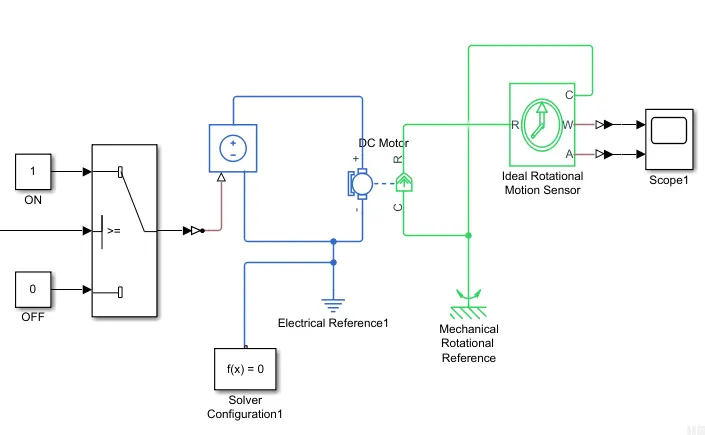
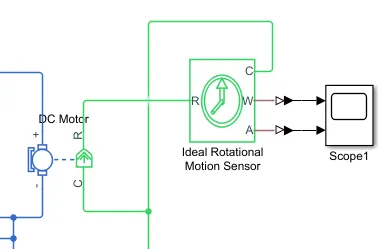
The output of switch is simulink sig so we convert into simscape sig using convertor and given to controlled voltage source for input to dc motor. Here we use dc motor as replica of fan, and dc motor is connected to Ideal Rotational motion sensor to observe the rotation, and output of it is to scope.
Result
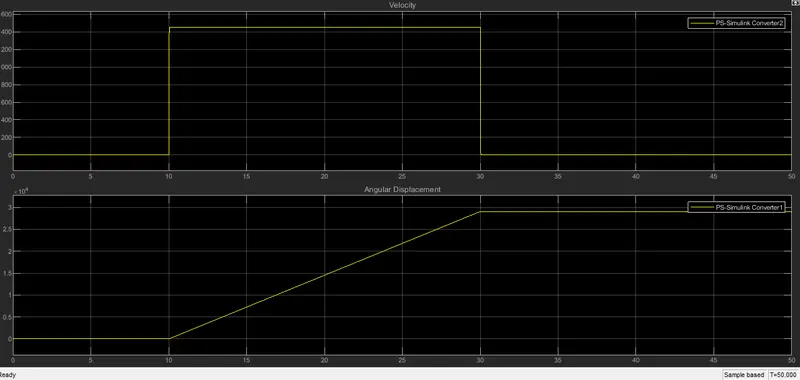
Here we can see that, when temp is above 25'c i.e. between 10-30 sec DC motor show rotation in form of Velocity sig and angular displacement and when temp is below 25'c i.e. between 0-10 sec and 30-50 sec output is zero.