Week 1 Understanding Different Battery Chemistry
1.Prepare a table which includes materials & chemical reactions occurring at the anode and cathode of LCO, LMO, NCA, NMC, LFP and LTO type of lithium ion cells.Give your detailed explanation on it.
Types of Lithium Ion batteries:
1) LCO- Lead cobalt oxide
LCO belongs to the layered transition metal oxide category for lithium ion batteries. It is also known as lithium cobaltate or lithium cobaltite. Its chemical compound is LiCoO2. It is a popular choice for mobile phones, laptops and digital cameras.
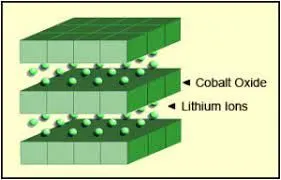
The battery consist of cobalt oxide cathode and a graphite carbon anode. The cathode has a layered structure and during discharge, lithium ions move from anode to cathode. On charging, the ions move from cathode to anode.
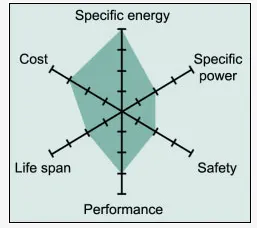
This battery has low thermal stability and very low life span. Per cell the nominal voltage provided by the LCO is 3.60V . Low specific power deals with the load capabilities and with safety, this is the only factor where LCO lacks.
2)LMO- Lithium Maganese Oxide:
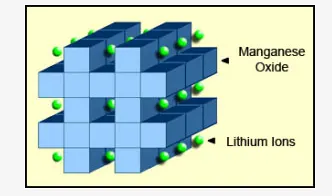
LMO belongs to the SPINELS category of the lithium ion batteries. Lithium Manganese oxide is the cathode material here and architecture represents a 3D spinel structure, which improves the ion flow on the electrode resulting in improved current handling and lower internal resistance.
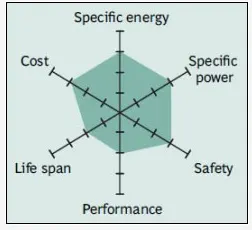
LMO has higher thermal stability as well as safety is also enhanced in comparison to the LCO but the life cycle is limited.
3) NCA- NICKEL COBALT ALUMINIUM OXIDE:
NCA belongs to the layered transition metal oxide category for lithium ion batteries. The main feature of this battery is high specifice energy but safety and cost are the main drawbacks.
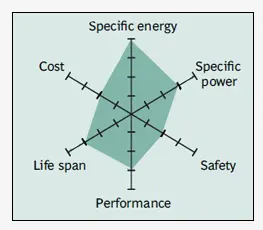
4) NMC- NICKEL MANGANESE COBALT
It also belongs to the metal layered transition metal oxide category of lithium ion batteries. This is one of the most successful lithium ion battery type, used for the automotive operations as well. NMC is the battery choice for electric vehicles and electric bikes .
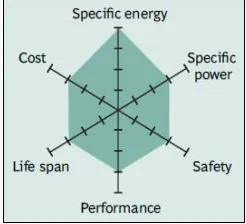
Cathode combination of NMC consist of one-third of nickel, manganese, cobalt each. NMC can produce 4.4 volt/cell, which is the highest of all. All the factors for NMC battery are balanced as shown in the below diagram:
5) LFP- LITHIUM IRON PHOSPHATE
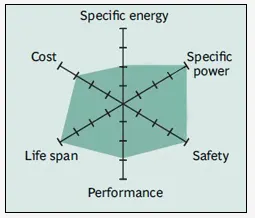
This type of lithium ion battery belongs to the olivines group. They offer good electrochemical performance with low resistance. The key benefits fo the LFP battery is high current rating and longer life cycle as well as good thermal stability.
However, safety is a concern but it can be enhanced by abusing the battery with additives.
6) LTO- LITHIUM TITANATE OXIDE
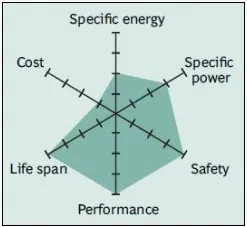
It belongs to the spinels category. Here cathode can be Lithium manganese oxide or NMC. Cost is very high for the LTO batteries and also specific energy is low. Rest all the factors are quite impressive like longer life span and good performance. Main applications of this battery type is in UPS and solar powered street lighting.
| LI-ION BATTERY | ANODE MATERIAL | CATHODE MATERIAL | ANODE REACTION | CATHODE REACTION |
| LCO | GRAPHITE CARBON | COBALT OXIDE | LiC6 → C6 + Li+ + e- | CoO2 + Li+ + e- → LiCoO2 |
| LMO | GRAPHITE CARBON | LITHIUM MANGANESE | LiC6 → C6 + Li+ + e- |  |
| NCA | GRAPHITE CARBON | LITHIUM NICKEL COBALT | LiC6 → C6 + Li+ + e- |  |
| NMC | GRAPHITE CARBON | LITHIUM NICKEL MANGANESE COBALT | LiC6 → C6 + Li+ + e- | |
| LFP | GRAPHITE CARBON | LITHIUM IRON PHOSPHATE | LiC6 → C6 + Li+ + e- |  |
| LTO | GRAPHITE CARBON | LITHIUM TITANATE | LiC6 → C6 + Li+ + e- |  |
2)Compare the differences between each type of Li+ion batteries based on their characteristics
| BATTERY TYPE | COST | LIFE SPAN | SAFETY | VOLTAGE/CELL | PERFORMANCE | SPECIFIC ENERGY | SPECIFIC POWER |
| LCO | LOW | LOW | LOW | 3.60- 4.2V | HIGH | HIGH | LOW |
| LMO | LOW | LOW | REASONABLE | 3.0-4.2V | LOW | REASONABLE | REASONABLE |
| NMC | LOW | HIGH | GOOD | 3.0-4.2 V or higher | GOOD | HIGH | GOOD |
| LFP | LOW | HIGH | HIGH | 2.5- 3.65V | GOOD | LOW | HIGH |
| NCA | HIGH | GOOD | LOW | 3.0-4.2V | GOOD | HIGH | GOOD |
| LTO | HIGH | HIGH | HIGH | 1.8- 2.85V | HIGH | LOW | GOOD |
So, out of all the batteries, NMC is the best option for electric vehicles.