Week 1 Understanding Different Battery Chemistry
Week 1 Understanding Different Battery Chemistry
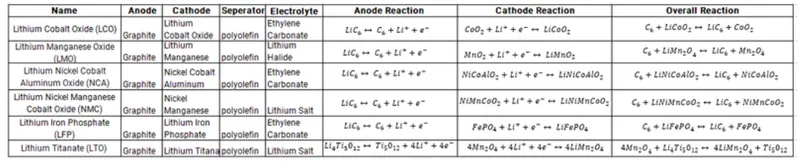
Question 1.Prepare a table which includes materials & chemical reactions occurring at the anode and cathode of LCO, LMO, NCA, NMC, LFP and LTO type of lithium ion cells.Give your detailed explanation on it
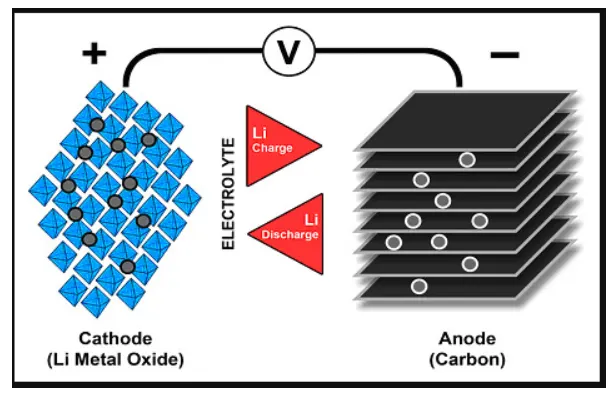
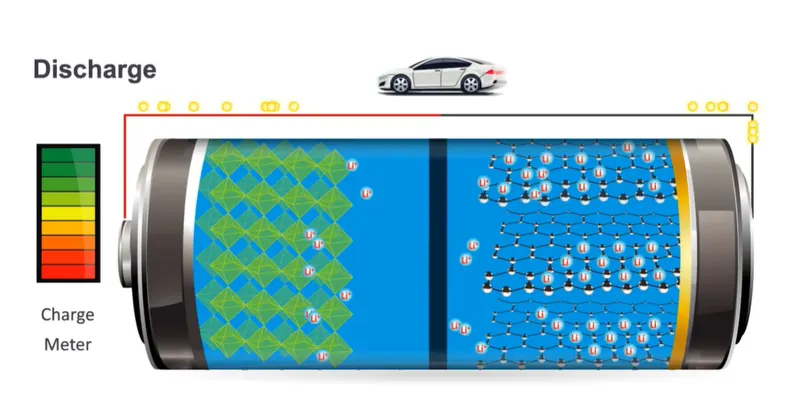
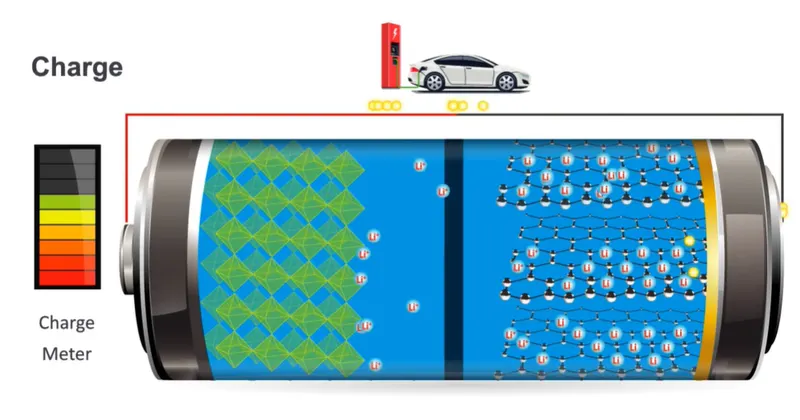
A Lithium-ion battery is Rechargable battery type made up of an anode, cathode, separator, electrolyte, and two current collectors (positive and negative). The anode and cathode store the lithium. The electrolyte carries positively charged lithium ions from the anode to the cathode and vice versa through the separator. The movement of the lithium ions creates free electrons in the anode which creates a charge at the positive current collector. The electrical current then flows from the current collector through a device being powered (cell phone, computer, etc.) to the negative current collector. The separator blocks the flow of electrons inside the battery.
While the battery is discharging and providing an electric current, the anode releases lithium ions to the cathode, generating a flow of electrons from one side to the other. When plugging in the device, the opposite happens: Lithium ions are released by the cathode and received by the anode.
Question 2. Compare the differences between each type of Li+ion batteries based on their characteristics
LCO (Lithium cobalt oxide) was invented in the year 1991. Its anode material is LiaC6, the cathode material is LibCoO2 and the carrier is Li+.It is used in various applications ranging from electronic devices to all laptops and phone batteries. The majority of lithium-ion batteries for the portable devices are cobalt based. The system contains a cobalt oxide cathode (positive electrode) and graphite carbon anode (negative electrode). further advantages of LCO High energy density, Long runtime making it optimum for new technologies
Lithium Magnese Oxide (LiMn2o4) - LMO
LMO (Lithium magnesium oxide) was invented in the year 1996.Its anode material is LiaC6, the cathode material is LibMn2O4 and the carrier is Li+. The Arechitecture forms three dimensional spinel structure was improves the flow of ions between the electrodes. High temperature stability and safety relative to other Li-ion types as it has integrally high thermal stability thus needs less safety circuitry than cobalt system.
Lithium Nickel-Cobalt-Aluminum Oxide (LiNiCoAlO2) - NCA
Lithium Nickel-Cobalt-Aluminum Oxide (NCA) is used as the cathode material for lithium ion batteries is invented in 1999 and is mainly used in electric automobiles. Due to a high nickel content of the Lithium Nickel-Cobalt-Aluminum Oxide (NCA) manufactured by the company, the capacity of batteries can be increased, which contributes to a longer distance that can be covered with a single-time charging. The company’s strength lies in integrated production from the nickel raw material up to the battery material.
Lithium Nickel Magnese Cobalt Oxide (LiNiMnCoO2) - NMC
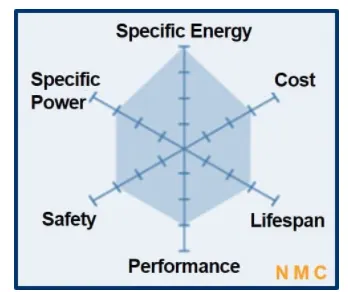
One of the most successful li-ion Systems is a cathode combination nickel-manganese-cobalt. these cells or power cells .For eg. NMC is an 18650 cells for moderate load condition has a capacity of only about 2,800mah and can deliver 4A to 5A.It delivers strong overall performance, excellent specific energy, and the lowest self-heating rate of all mainstream cathode powders, which makes it the preferred option for automotive batteries.
Lithium Irom Phosphate (LiFePO4) - LFP
A lithium iron phosphate (LFP) battery is a type of lithium-ion battery The first model is developed in 1996 that is capable of charging and discharging at high speeds compared to other types of batteries. It is a rechargeable battery consisting of LiFePO4 as its cathode material. LFP is capable of delivering a constant voltage and also has a comparatively higher charge cycle, in the range of 2000-3000 they key feature is Better power density,Low discharge rate,Flat discharge curve,Less heating,Higher number of charge cycles,Increased safety
Lithium Titanate (Li2TiO3) - LTO
LTO is a rechargeable battery based on the, or modified fromthe Lithium-Ion (li-ion) battery. Li-titanate oxide (LTO) replaces the graphite in the anode of the typical Li-Ion battery and forms the materials forms a spinel structure. Li-titanate has a nominal cell voltage of 2.40V. has excellent low- temperature discharge characterstics and obtains a capapcity of 80 percent at -30 C. Lithium Titanate batteries' benefits range from long lifetime to enhanced safety, low-temperature performance and large potential for integration with energy storage solutions.