Week 1 Understanding Different Battery Chemistry
1. Prepare a table that includes materials & chemical reactions occurring at the anode and cathode of LCO, LMO, NCA, NMC, LFP, and LTO type of lithium-ion cells. Give your detailed explanation of it.
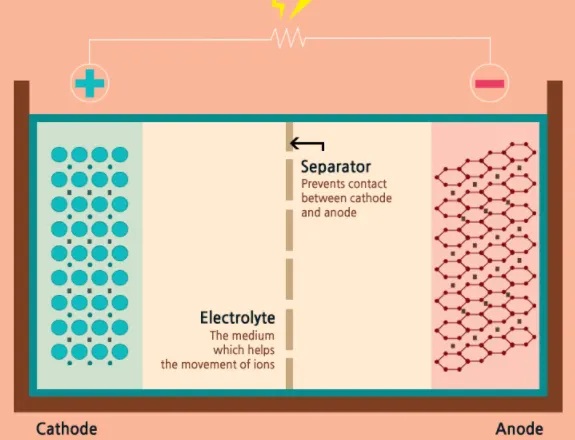
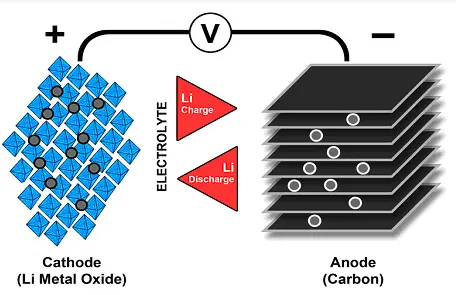
Anode/Cathode
A battery is made up of an anode, cathode, separator, electrolyte. The anode and cathode store the lithium. The electrolyte carries positively charged lithium ions from the anode to the cathode and vice versa through the separator. The movement of the lithium ions creates free electrons in the anode.
Electrons have a negative electrical charge, so the movement of electrons is opposite to that of the conventional current flow.
While the battery is discharging and providing an electric current (from cathode to anode), the anode releases lithium ions to the cathode, generating a flow of electrons from one side to the other. When plugging in the device, the opposite happens: Lithium ions are released by the cathode and received by the anode (electric current flows from anode to cathode).
Electrolyte
Electrolyte plays a key role in transporting the positive lithium ions between the cathode and anode. The most commonly used electrolyte is comprised of lithium salt, such as LiPF6 in an organic solution.
Separator
In view of battery safety, the separator must be able to act as a blocking interface between the electrodes when an internal short circuit occurs, so that the thermal runaway is avoided. Chemical and thermal stability, as well as shutdown function at the set temperature, should be the requirement for the separator. various types of separator materials are used like polyolefin, PVDF(polyvinylidene fluoride), Polyethylene (PE) and Polypropylene (PP), Cellulose/lignin, homogeneous solid medium.
Types of lithium-ion cells (LCO, LMO, NCA, NMC, LFP, and LTO).

Explanation
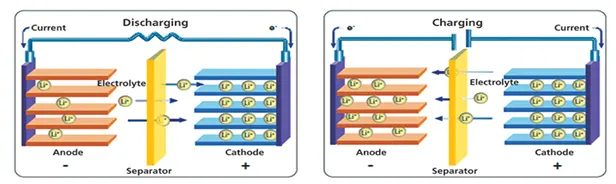
- let's consider the LCO type of lithium-ion battery
- during discharging, the negative electrode anode gives lithium-ion (LiC6 → xLi+ + xe- + C6) and electron (oxidized) to the positive electrode cathode (Li1-X CoO2 + xLi+ + xe- → LiCoO2).
- the lithium-ion moves through the electrolyte and separator
- the electrons move through the external circuit.
- since the direction of the negatively charged electron and the conventional current flow are opposite, we can say that the current flows from the positive electrode (cathode) to the negative electrode (anode) but both the lithium-ions and electrons flow from anode to cathode.
- during charging the reaction is reversed, the negative electrode anode accepts the electrons (reduced) and lithium-ion from the positive electrode cathode.
2. Compare the differences between each type of Li+ion batteries based on their characteristics
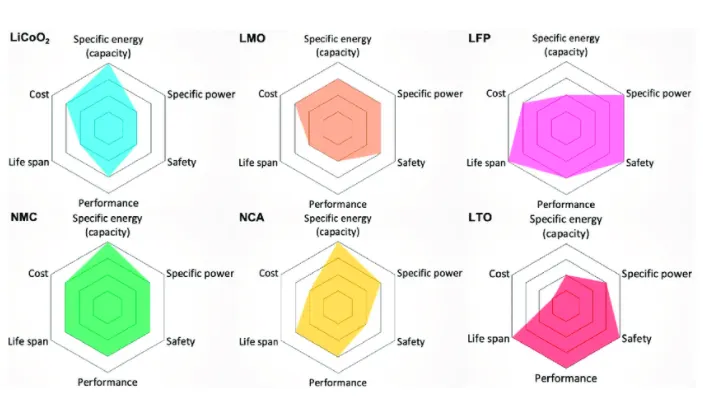
note: cost - the outer hexagon is more desirable, that is cheaper.
all the other characteristics increase with an increase in the hexagon.
LCO - Lithium Cobalt Oxide
- specific energy is higher 150 - 200 Wh/Kg.
- shorter battery life.
- not as safe as other types since thermal instability.
- the nominal voltage is 3.6 V.
- the cost is average. because cobalt is scarce and expensive.
- used in: most cell phones, laptops, electronic cameras.
LMO - Lithium Manganese Oxide
- It has low internal resistance due to spinel structure.
- high thermal stability which increases safety.
- the nominal voltage is 3.7 V. ranging from 3 V to 4.2 V
- specific energy of 100 - 150 Wh/kg.
- charge rate of 0.7 - 1 C
- life span is less, 300 - 700 life cycle.
- cost is average and the performance is poor compared to other types
- these types of batteries are in continuous improvement and advancing in EV powertrains.
LFP - Lithium Iron Phosphate
- It has a low internal resistance
- strong thermal stability and higher safety than other types.
- high current rating
- the nominal voltage is 3.3 V. ranging from 2.5 V - 3.65 V
- less specific energy 90 - 120 Wh/kg
- charging rate of 1C and discharging rate up to 25 C
- higher life cycle 2000 and higher.
- the cost and performance are average.
- used in: portable devices etc
NMC - Lithium Nickel Cobalt Manganese Oxide
- higher specific energy of 150 - 220 Wh/kg
- nominal voltage - 3.7 V. ranging from 3 - 4.2 V.
- higher lifespan when compared to lithium cobalt and manganese.
- high desirable current and safety.
- lifecycle of 1000 - 2000
- most successful type of battery.
- used in: most EV's, power tools, medical devices, and E-bikes.
NCA - Lithium Nickel Cobalt Aluminium Oxide
- good specific power and average life span - 500 lifecycles
- higher specific energy 200 - 300 Wh/kg
- the nominal voltage is 3.6 V
- performance is average.
- less safe should be accompanied with a monitoring system
- expensive.
- used in: Tesla motors.
LTO - Lithium Titanate Oxide
- specific energy is very less, 50 - 80 Wh/kg
- the nominal voltage is 2.4 V, ranging from 1.8 V - 2.85 V
- very high cost due to material and structure.
- due to superior nanotechnology, this type of battery has a very long lifespan of 3000 - 7000 lifecycles and is very safe.
- performance is high.
- used in: Honda, Mitsubishi EV's, military, aerospace, solar, and smart grids.