Week 1 Understanding Different Battery Chemistry
Aim :
- To prepare a table which includes materials & chemical reactions occurring at the anode and cathode of diffrent type of lithium ion cells.
- To compare the differences between each type of Li+ion batteries based on their characteristics
--------------------------------------------------------------------------------------------------------------------------------
1.A lithium-ion battery or Li-ion battery is a type of rechargeable battery in which lithium ions move from the negative electrode through an electrolyte to the positive electrode during discharge and back when charging.
Type of lithium ion cells are
- Lithium Cobalt Oxide (LCO)
- Lithium-ion mangenese oxide battery(LMO)
- Lithium Nickel cobalt aluminium oxide(NCA)
- Lithium Nickel Mangenese Cobalt Oxide(NMC)
- Lithium Iron Phosphate(LFP)
- Lithium Titanate oxide(LTO)
| Types | Cathode | Anode | Reactions occurring at the cathode | Reactions occurring at the anode |
| Lithium Cobalt Oxide (LCO) | Lithium Cobalt oxide |
Graphite Carbon |  |
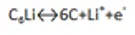 |
| Lithium-ion mangenese oxide battery(LMO) | Lithium mangenese oxide | Graphite Carbon |  |
|
| Lithium Nickel cobalt aluminium oxide(NCA) | Lithium Nickel cobalt aluminium oxide | Graphite Carbon |  |
|
| Lithium Nickel Mangenese Cobalt Oxide(NMC) | Lithium Nickel Mangenese Cobalt Oxide | Graphite Carbon |  |
|
| Lithium Iron Phosphate(LFP) | Lithium Iron Phosphate | Graphite Carbon |  |
|
| Lithium Titanate oxide(LTO) | Manganese oxide | Lithium Titanium Oxide |  |
 |
------------------------------------------------------------------------------------------------------------------------------------------------------------------------------------------------------------------------------------
2. The major parameter considerd to differentiate one another are :-
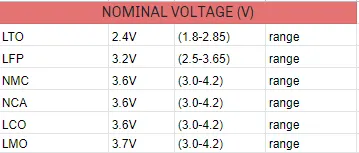
Nominal voltage
- It is the system voltage at which the device is designed to operate.
- The rated voltage is usually higher than the nominal voltage to ensure the safe operation of the device.
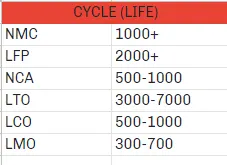
Cycle
- The charge and discharge when took place for a single time makes a cycle.
- The higher the cycles can take place, the higher the cycles can takes place then the lifespan is higher.
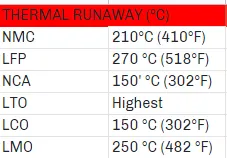
Thermal runway
- The thermal runway begins when the heat generated within a battery exceeds the amount of heat that is dissipated to its surroundings.
- Internal battery temperature will continue to rise, causing the battery current to rise creating a domino effect.
- The rise in temperature in a single battery will begin to affect other batteries nearby and the pattern will continue.
Specific energy :
- It is the amount of energy stored per unit mass (Wh/Kg).
- This is a very important deciding factor that decides how much energy or power from different batteries with the same amount of weight.
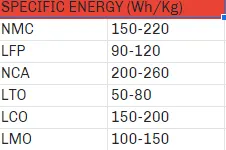
For ease of choosing a battery from laymans perspective, the 6 key features are given a value within 0-5 range for all of the, are given with the same parameters which are considered in case of 5 point hexagonal analysis of the batteries. They are
- Specific energy.
- Specific power.
- Safety.
- Performance.
- Life span.
- Cost.
LCO :
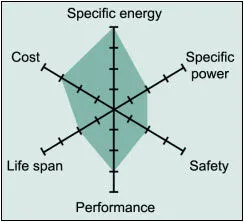
Li-cobalt excels on high specific energy but offers only moderate performance specific power, safety and life span.
LMO :
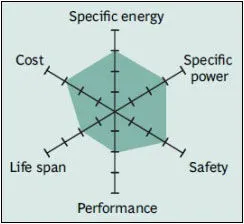
Although moderate in overall performance, newer designs of Li-manganese offer improvements in specific power, safety and life span.
NMC :
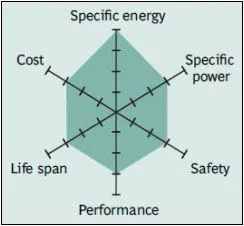
NMC has good overall performance and excels on specific energy. This battery is the preferred candidate for the electric vehicle and has the lowest self heating rate.
LFP :
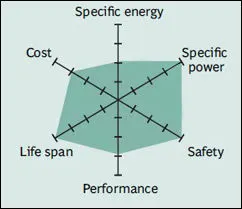
Li-phosphate has excellent safety and long life span but moderate specific energy and elevated self discharge.
NCA :
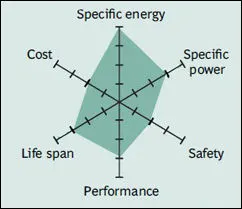
High energy and power densities as well as a good life span make NCA a candidate for EV powertrains. High cost and marginal safety are negative.
LTO :
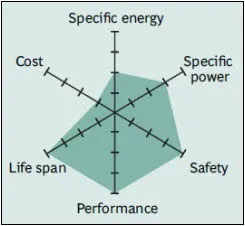
Li-titanate excels in safety, low temperature performance and life span. Efforts are being made to improve the specific energy and lower the cost.
- These types of lithium ion batteries are some of the most popular. As technology is continously seeing more development, new lithium technologies are always being developed and those which exists are being developed.