Week 1 Understanding Different Battery Chemistry
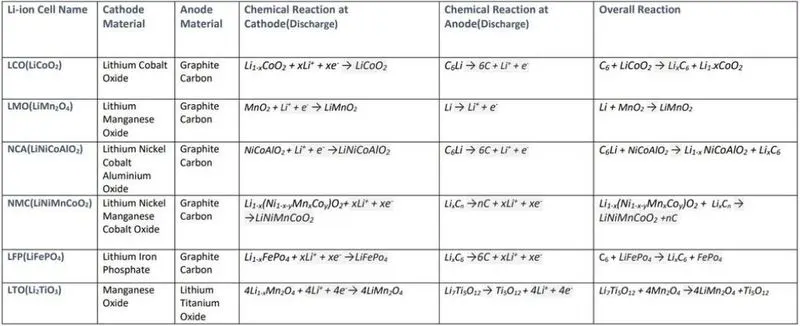
1.Prepare a table which includes materials & chemical reactions occurring at the anode and cathode of LCO, LMO, NCA, NMC, LFP and LTO type of lithium ion cells.Give your detailed explanation on it
Lithium Cobalt Oxide -
The LCO is widely used in electronic equipments and the material used cobalt is expensive than others, but has higher energy density. If the battery has any damage in it, it is not safe to use and it may lead to explosive. The battery Lithiuim cobalt oxide is used only for low dischrage due to their low discharge rate and also have highest energy density (110-190) Wh/kg.
Lithium cobalt oxide, sometimes called lithium cobaltate or lithium cobaltite, is a chemical compound with formula LiCoO ₂. The cobalt atoms are formally in the +3 oxidation state, hence the IUPAC name lithium cobalt oxide.
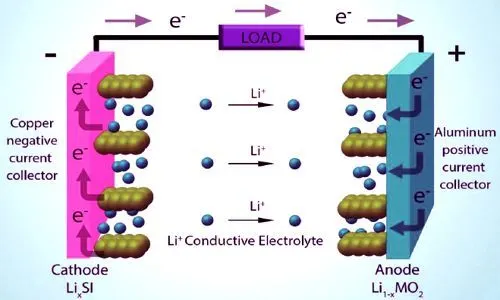
Reduction takes place at the cathode. There, cobalt oxide combines with lithium ions to form lithium-cobalt oxide (LiCoO2).
CoO2 + Li+ + e- → LiCoO2
Oxidation takes place at the anode. The graphite compound LiC6 forms graphite (C6) and lithium ions.
LiC6 → C6 + Li+ + e-
Here is the full reaction (left to right = discharging, right to left = charging):
LiC6 + CoO2 ⇄ C6 + LiCoO2
Lithium-Cobalt batteries have three key components:
- The cathode is an electrode that carries a positive charge, and is made of lithium metal oxide combinations of cobalt, nickel, manganese, iron, and aluminum.
- The anode is an electrode that carries a negative charge, usually made of graphite.
- The electrolyte is a lithium salt in liquid or gel form, and allows the ions to flow from the cathode to the anode (and vice versa).
Lithium manganese oxide -
The lithium manganese oxide battery cost will low. The have very long life and inherently safe. They are Used in Hybrid Vehicles, Cell phones, Laptops. They also have high discharge rates and Lower energy density (110-120) Wh/kg.
LiC6 + Mn2O4 <==>C6 + LiMnO2
In a specific embodiment manganese dioxide powder is reacted with lithium hydroxide to prelithiate the manganese dioxide and the prelithiated manganese dioxide is separated from the reaction mixture and heated and reacted with lithium carbonate at elevated temperature to convert it to lithium manganese oxide spinel.
Lithium nickle cobalt aluminium oxide -
The lithium nickle cobalt aluminium oxide batteries have lower voltage and a better safety characteristic compared with Lithium cobalt oxide based battery. Lithium nickle cobalt aluminium oxide based batteries perform well in terms of power density, energy density and lifetime. The main drawbacks of this Li-ion battery chemistry are coming from their reduced safety and high cost.

Lithium nickel manganese cobalt oxide -
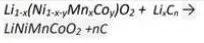
The cathode of lithium nickel manganese cobalt oxide (NMC) is composed of cobalt, nickel, and manganese. The most commonly used NMC composition contains equal amounts of all three transition metals. NMC-based battery cells have a high capacity, good rate capability, and can operate at high voltages.
Lithium Iron phosphate -
The Lithium Iron phosphate batteries have high capacity and they are low cost batteries (lower than LCO batteries) with flat voltage profile and low environmental impact. LFP batteries are operating similar to NCA batteries, but with a higher degree of safety. Lithium iron phosphate batteries are considered suitable for being used in stationary, automotive, and back-up power applications because their characteristics (i.e. high safety, good thermal stability, long lifetime, and low self-discharge rate) are matching the demands of these applications.

Lithium Titanium oxide-
Lithium Titanate oxide is using lithium titanate nanocrystals on the anode surface, instead of carbon. This fact represents an advantage of LTO battery cells because they can release ions repeatedly for recharging and rapidly for high current. LTO has a spinel-framework structure and is characterized by a two-phase electrochemical process evolving with a relatively flat voltage profile. LTO-based batteries offer advantages in terms of power and stability, but they have a lower voltage level than the other Li-ion battery chemistries. However, this lower operating voltage brings advantages in terms of safety.
The characteristics of LTO include high cycling stability, no electrolyte decomposition, and thus no solid electrolyte interface formation, high rate/discharge capability, and high thermal stability in both charge and discharge state. Moreover, LTO-based batteries can operate at low temperatures.

2.Compare the differences between each type of Li+ion batteries based on their characteristics
| LCO | LMO | NMC | LFP | NCA | LTO | |
| Electrolyte | Ethylene Carbonate | Lithium Halide | Lithium Salt | Ethylene Carbonate | Ethylene Carbonate | Lithium Salt |
| Seperator | Polyolefin | Polyolefin | Polyolefin | Polyolefin | Polyolefin | Polyolefin |
| Nominal Voltage & Operating Range |
3.60V nominal; typical operating range 3.0– 4.2V/cell |
3.70V (3.80V) nominal; typical operating range 3.0–4.2V/cell |
3.60V, 3.70V nominal; typical operating range 3.0–4.2V/cell, or higher |
3.20, 3.30V nominal; typical operating range 2.5–3.65V/cell |
3.60V nominal; typical operating range 3.0– 4.2V/cell |
2.40V nominal; typical operating range 1.8– 2.85V/cell |
| Energy Capacity | 150–200Wh/kg | 100–150Wh/kg | 150–220Wh/kg | 90–120Wh/kg | 200-260Wh/kg | 50–80Wh/kg |
| Thermal runaway | 150°C (302°F) | 250°C (482°F) typical | 210°C (410°F) typical | 270°C (518°F) | 150°C (302°F) typical | 120°C |
| Specific power | low | medium | medium | high | medium | medium |
| Cost | low | low | low | low | medium | high |
| Safety | low | medium | medium | high | low | high |
| Applications | Mobile phones, tablets, laptops, cameras |
Power tools, medical devices, electric powertrains |
E-bikes, medical devices, EVs, industrial |
Portable and stationary needing high load currents and endurance |
Applications Medical devices, industrial, electric powertrain |
UPS, electric powertrain solar-powered street lighting |