Week 1 Understanding Different Battery Chemistry
AIM:
To study the given challenges.
OBJECTIVE:
1.Prepare a table which includes materials & chemical reactions occurring at the anode and cathode of LCO, LMO, NCA, NMC, LFP and LTO type of lithium ion cells.Give your detailed explanation on it.
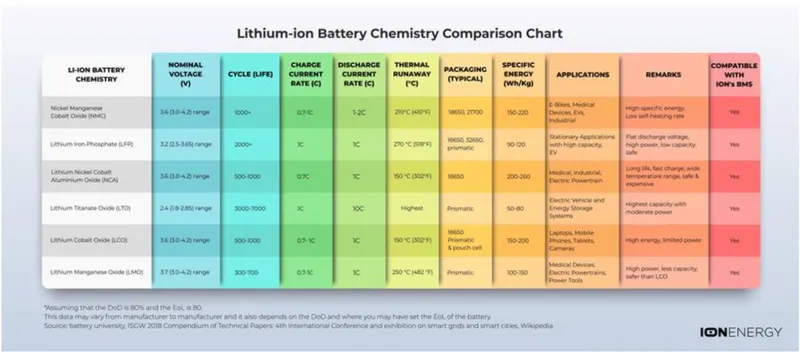
2.Compare the differences between each type of Li+ion batteries based on their characteristics.
THEORY:
BATTERIES:
A battery are a collection of one or more cells whose chemical reactions create a flow of electrons in a circuit. All batteries are made up of three basic components namely Anode(-ve sign), Cathode(+ve sign) and some kind of electolyte.
When the anode and cathode of a battery is connected to a circuit a chemical reaction takes place between the anode and the electrolyte. This reaction causes electrons to flow through the circuit and back into the cathode where another chemical reaction takes place.
When the material in the cathode or consumed are no longer able to be used in the reaction the battery is unable to produce electricity. At that point our battery is dead.
Batteries that must be thrown away after use are known as primary batteries that can be recharged are called secondary batteries.
Without batteries our quadcopter would have to be tethered to the wall we would have crank our car and our Xbox controller would have to plugged in all the time. Batteries offer a way to store electrical potential energy in a portable container.
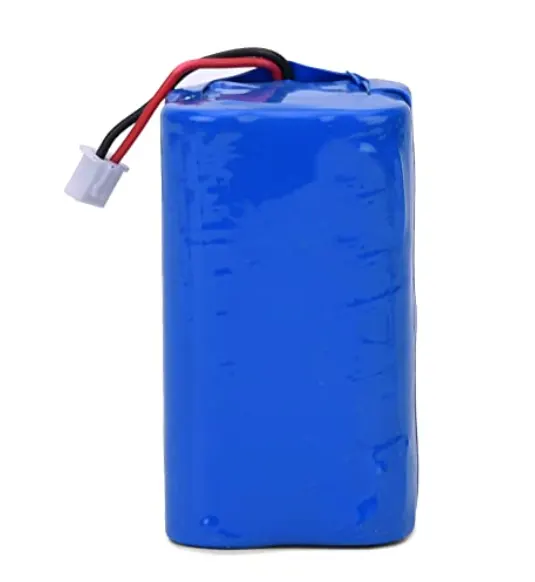
FIGURE OF RECHARGEABLE BATTERY:
COMPONENTS OF BATTERY:
A spearartor is often used to prevent the anode and cathode from touching if the electrolyte is not sufficient. In order to store these components batteries usually have some kind of casing.
Both anode and cathode are types of electrodes. Electrodes are conductors through which electricity enter or leaves a component in a circuit.
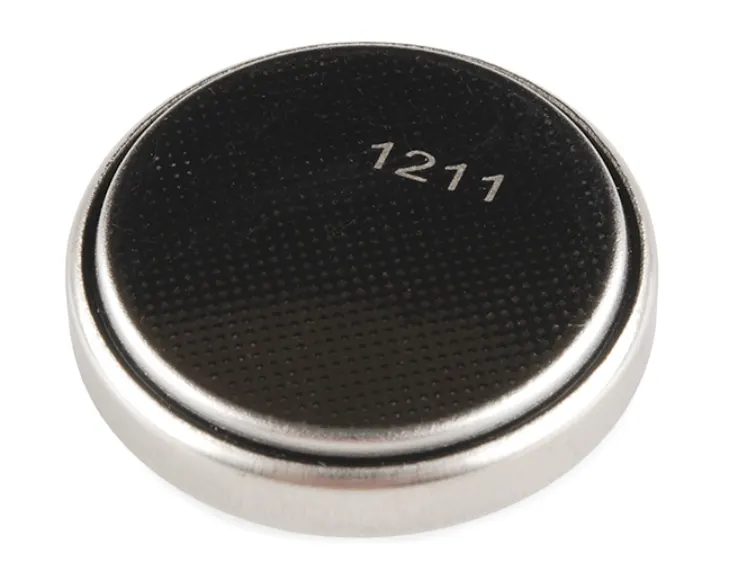
ANODE:
Electrons flow out form the anode in a device connected to a circuit. This means that conventional current flows into an anode.
CATHODE:
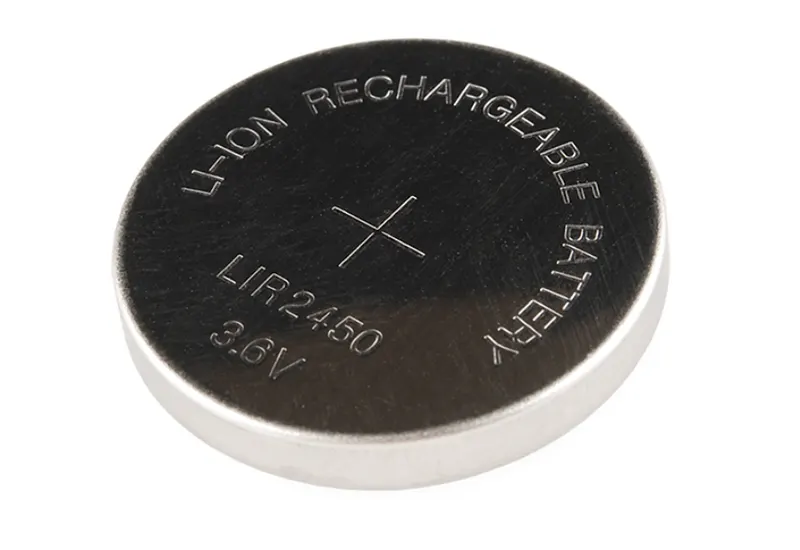
Electrons flow into the cathode in a device connected to a circuit. This means that conventional current flows out from a cathode.
ELECTROLYTE:
The electolyte is the substances often a liquid or gel that is capable of transporting ions between the chemical reactions that happen at the anode and cathode. The electolyte also inhibits the flow of electrons between the anode and cathode so that the electrons more easily flow through the external circuit rather than through the electrolyte.
SEPARATOR:
A Separator are porous materials that prevent the anode and cathode form touching which would cause a short circuit in the battery. This can be made from a variety of materials including cotton, nylon, polyester, cardboard, synthetic polymer films.
TYPES OF LITHIUM ION:
1.Lithium Cobalt Oxide(LiCoO2)-LCO:
Lithium cobalt oxide, sometimes called lithium cobaltate or lithium cobaltite, is a chhemical compound with formula LiCoO2. The cobalt atoms are formally in the +3 oxidation state, hence the IUPAC name lithium cobalt(III) oxide.
Lithium cobalt oxide is a dark blue or bluish-gray crystalline solid,and is commonly used in the positive electrodes of lithium ion batteries.
SUMMARY TABLE:
2.Lithium Mangnese Oxide (LiMn2O4)-LMO:
Lithium manganate oxide, whose chemical formula is LiMn2O4 (LCM), is one of the promising lithium ion anode materials. Compared with traditional anode materials such as lithium cobalt oxides, lithium manganate oxide has rich resources, low cost, no pollution, good safety and nice rate capability. It is an ideal anode material for power battery.
SUMMARY TABLE:
3.Lithium Nickel Cobalt Aluminium Oxide(LiNiCoAIO2)-NCA:
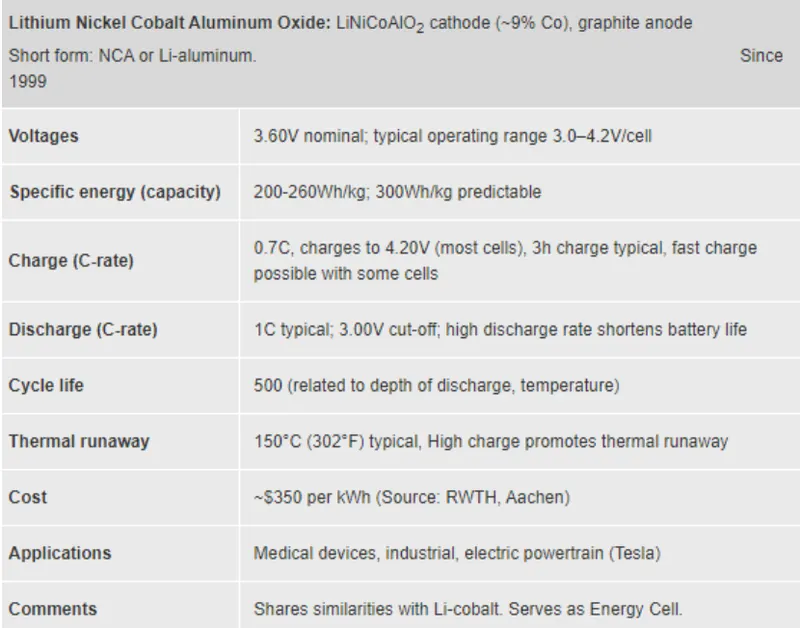
Lithium Nickel Cobalt Aluminum Oxide (NCA) is a highly thermally stable cathode material used lithium-ion batteries. Doping the lithium nickel cobalt oxide with aluminum both stabilizes its thermal and charge transfer resistance.
Lithium Nickel Cobalt Aluminum Oxide is generally immediately available in most volumes. American Elements produces to many standard grades when applicable.
Including Mil Spec (military grade); ACS, Reagent and Technical Grade; Food, Agricultural and Pharmaceutical Grade; Optical Grade, USP and EP/BP (European Pharmacopoeia/British Pharmacopoeia) and follows applicable ASTM testing standards.
Typical and custom packaging is available. Additional technical, research and safety (MSDS) information is available as is a Reference Calculator for converting relevant units of measurement.
SUMMARY TABLE:
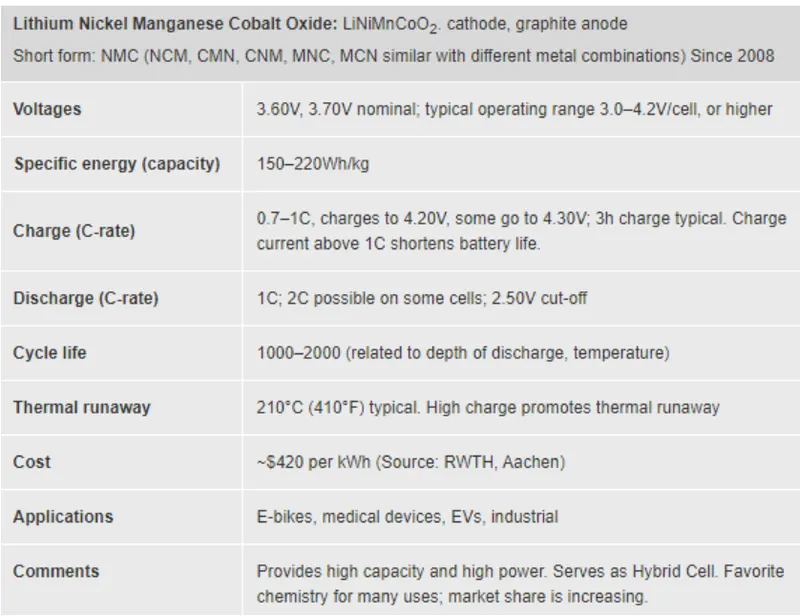
4.Lithium Nicke Mangnaese Cobalt Oxide(LiNiMnCoO2)-NMC:
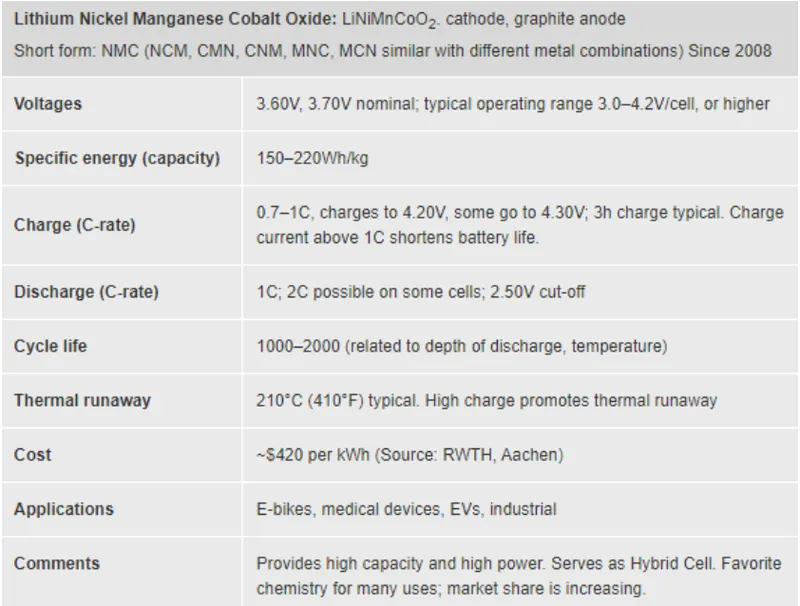
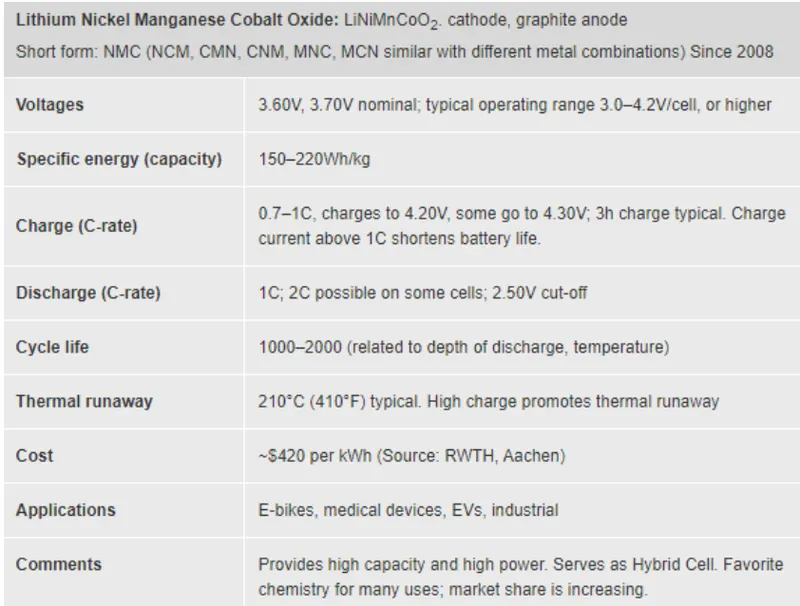
Lithium nickel manganese cobalt oxides are mixed metal oxides of lithium, nickel, manganese and cobalt. They have the general formula LiNixMnyCozO2.
The most important representatives have a composition with x + y + z that is near 1, with a small amount of lithium on the transition metal site. In commercial NMC samples, the composition typically has < 5% excess lithium.
Structurally materials in this group are closely related to lithium cobalt(III) oxide (LiCoO2) and have a layered structure but possess an ideal charge distribution of Mn(IV), Co(III), and Ni(II) at the 1:1:1 stoichiometry.
For more nickel-rich compositions, the nickel is in a more oxidized state for charge balance. NMCs are among the most important storage materials for lithium ions in lithium ion batteries. They are used on the positive side, which acts as the cathode during discharge.
SUMMARY TABLE:
5.Lithium Titanate(Li2TiO3)-LTO:
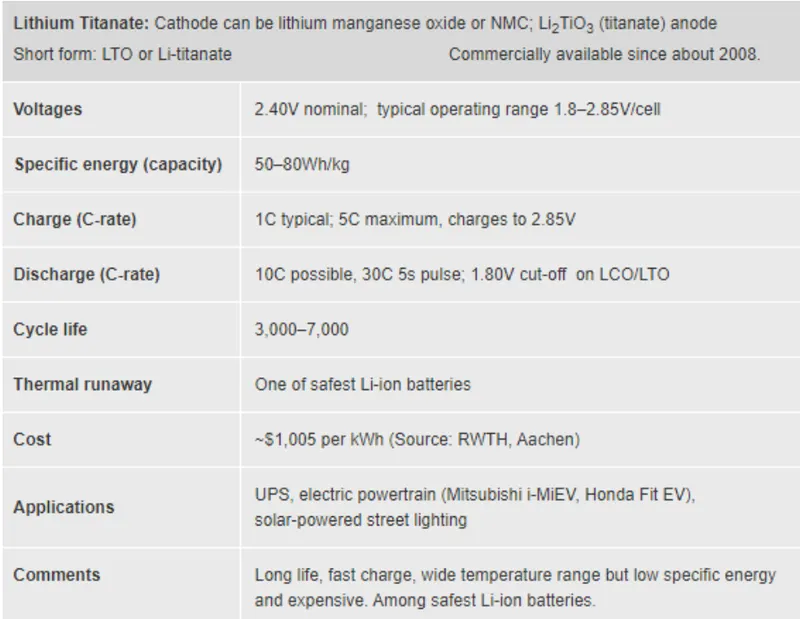
Lithium titanate is a compound with the chemical formula Li2TiO3. It is a white powder with a melting point of 1,533 °C (2,791 °F).
Lithium titanate is the anode component of the fast recharging lithium-titanate battery. It is also used as an additive in porcelain enamels and ceramic insulating bodies based on titanates.
It is frequently utilized as a flux due to its good stability. In recent years, along with other lithium ceramics, metatitanate pebbles have been the subject of research efforts towards tritium breeding materials in nuclear fusion applications.
SUMMARY TABLE:
6.Lithium Iron Phosphate(LiFePO4)-LFP:
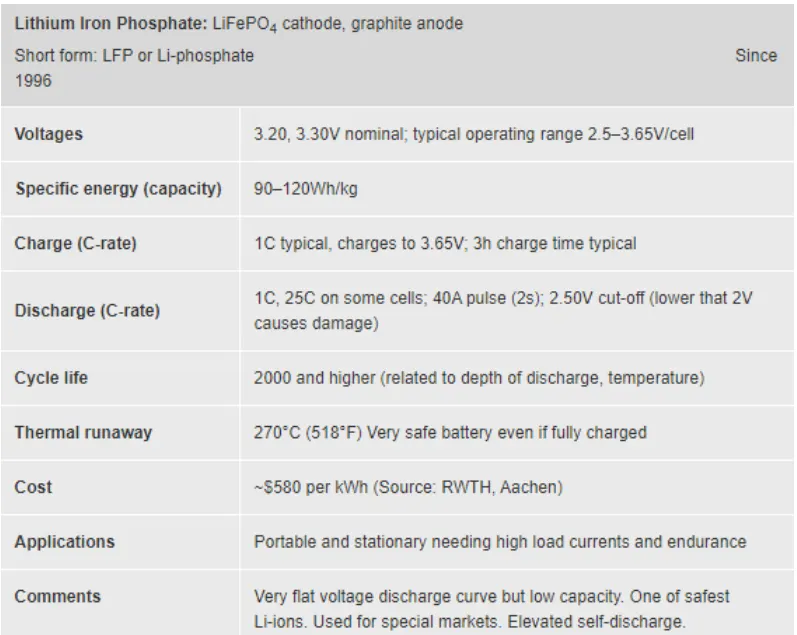
The lithium iron phosphate battery (LiFePO4 battery) or LFP battery (lithium ferrophosphate), is a type of lithium-ion battery using lithium iron phosphate (LiFePO4) as the cathode material, and a graphitic carbon electrode with a metallic backing as the anode.
The energy density of LiFePO4 is lower than that of lithium cobalt oxide (LiCoO2), and also has a lower operating voltage. The charge-discharge profiles of LFP cells are typically very flat. The main drawback of LiFePO4 is its low electrical conductivity.
Therefore, all the LiFePO4 cathodes under consideration are actually LiFePO4/C (composite made with carbon). Because of low cost, low toxicity, well-defined performance, long-term stability, etc. LiFePO4 is finding a number of roles in vehicle use, utility scale stationary applications, and backup power. LFP batteries are cobalt-free.
SUMMARY TABLE:
The materials and chemical reactions occuring at the anode, cathode and overall reactions of all types of Li-ion cells are given:

DIFFERENCES BETWEEN EACH TYPE OF Li+ IONS BATTERIES BASED ON THEIR CHARCTERSTICS:
OBJECTIVE:
Thus the given question is verified sucessfully.
RESULT:
Thus the given challenge is studied sucessfully.