Week 1 Understanding Different Battery Chemistry
Aim :
Understanding Different Battery Chemistry
Objective :
1. Prepare a table that includes materials & chemical reactions occurring at the anode and cathode of LCO, LMO, NCA, NMC, LFP, and LTO type of lithium-ion cells. Give your detailed explanation on it
2. Compare the differences between each type of Li+ion batteries based on their characteristics
#First Objective :
what are the parts of lithium batteries?
A battery is made up of several individual cells that are connected to one another. Each cell contains three main parts: a positive electrode (a cathode), a negative electrode (an anode), and a liquid electrolyte.
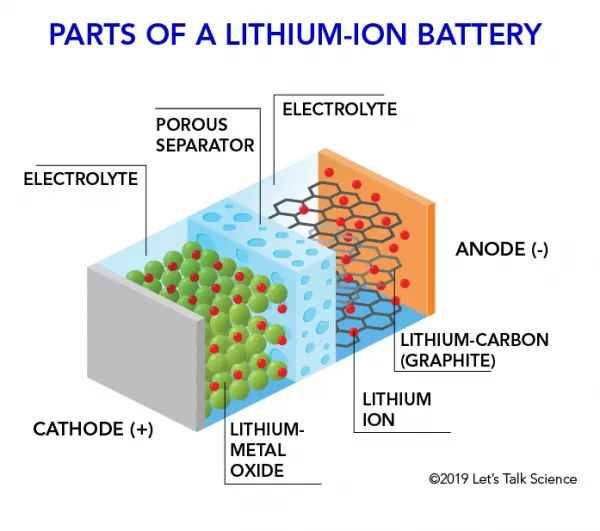
Just like alkaline dry cell batteries, such as the ones used in clocks and TV remote controls, lithium-ion batteries provide power through the movement of ions. Lithium is extremely reactive in its elemental form. That’s why lithium-ion batteries don’t use elemental lithium. Instead, lithium-ion batteries typically contain lithium-metal oxide, such as lithium cobalt oxide (LiCoO2). This supplies the lithium-ions. Lithium-metal oxides are used in the cathode and lithium-carbon compounds are used in the anode. These materials are used because they allow for intercalation. Intercalation means that the molecules are able to insert something into them. In this case, the electrodes are able to have lithium-ions move easily in and out of their structures.
how does recharging take place in Lithium-ion battery work?
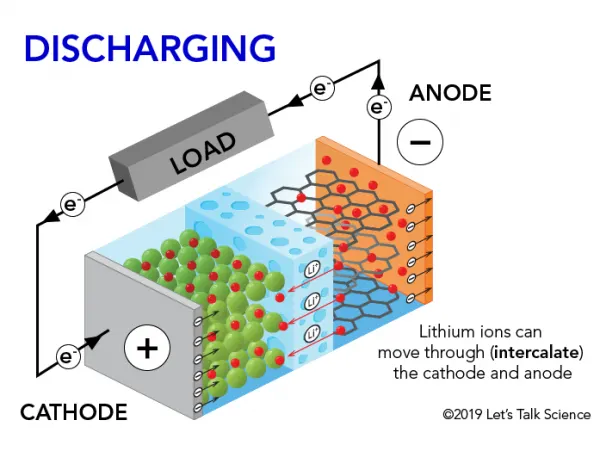
When the lithium-ion battery in your mobile phone is powering it, positively charged lithium ions (Li+) move from the negative anode to the positive cathode. They do this by moving through the electrolyte until they reach the positive electrode. There, they are deposited. The electrons, on the other hand, move from the anode to the cathode.
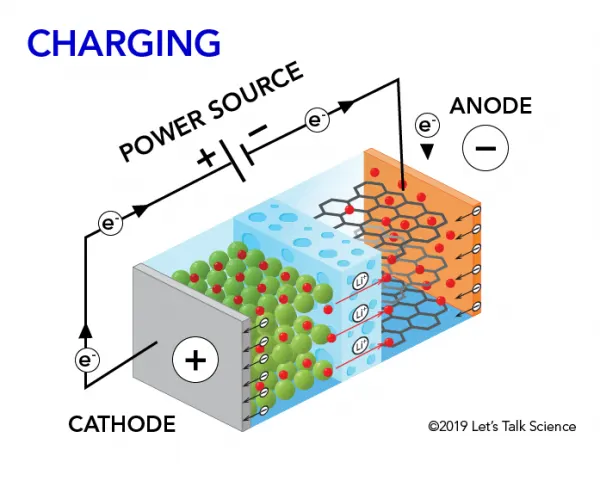
When you charge a lithium-ion battery, the exact opposite process happens. The lithium ions move back from the cathode to the anode. The electrons move from the anode to the cathode.
This is the table that includes materials & chemical reactions occurring at the anode and cathode of LCO, LMO, NCA, NMC, LFP, and LTO type of lithium-ion cells
| type | chemical name | cathode material | chemical reaction cathode(discharge) | Anode material | chemical reaction at the anode (discharge) |
| Lithium Cobalt Oxide (LCO) | `LiCoO_2` | Lithium Cobalt Oxide |  |
Graphite Carbon |  |
|
Lithium Manganese oxide (LMO) |
`LiMn_2O_4` | Lithium Manganese oxide | MnO2+ Li + e– `to` MnOOLi | Graphite Carbon | Li `to`Li + e– |
| Lithium Nickel Cobalt Aluminium Oxide (NCA) | `LiNiCoAlO_2` | Lithium Nickel Cobalt Aluminium Oxide |
Li(1-x) NiCoAlO2 (s) + x Li+ + xe- `to` LiNiCoAlO2 (s) |
Graphite Carbon |
C6Li `to` 6C +Li+ + e- |
| Lithium Nickel Manganese cobalt oxide (NMC) | `LiNiMnCoO_2` | Lithium Nickel Manganese cobalt oxide |
Li(1-x) NiMnCoO2 + x Li+ +xe- `to`LiNiMnCoO2 |
Graphite Carbon |
C6Li `to` 6C +Li+ + e- |
| Lithium Iron Phosphate(LFP) | `LiFePO_4` | Lithium iron phosphate |
Li(1-x) FePO4 (s) + x Li+ + xe- `to`Li FePO4 (s) |
Graphite Carbon |
C6Li `to` 6C +Li+ + e- |
| Lithium Titanate Oxide(LTO) | `LiTiO_3` | Manganese Oxide | Li2TiO3 (s) + x Li+ + xe-
`to`Li2TiO3 (s) |
Lithium Titanium oxide | Li2TiO3 + x Li+ + xe- `to`Li2TiO3 + 3Li+ + 3e- |
#Second Objective :
| Type | voltage | specific energy(capacity) | charge(c-rate) | discharge(c-ate) | cycle life | Thermal run away | application |
| Lithium Cobalt Oxide (LCO) | 3.60V nominal; typical operating range 3.0–4.2V/cell | 150–200Wh/kg | 0.7–1C | 1C; 2.50V cut off. Discharge current above 1C shortens battery life. | 500–1000, related to the depth of discharge, load, temperature | 150°C (302°F). Full charge promotes thermal runaway | Mobile phones, tablets, laptops, cameras |
|
Lithium Manganese oxide (LMO) |
3.70V (3.80V) nominal; typical operating range 3.0–4.2V/cell | 100–150Wh/kg | 0.7–1C typical, 3C maximum, charges to 4.20V (most cells) | 1C; 10C possible with some cells, 30C pulse (5s), 2.50V cut-off | 300–700 (related to the depth of discharge, temperature | 250°C (482°F) typical. High charge promotes thermal runaway | Power tools, medical devices, electric powertrains |
| Lithium Nickel Cobalt Aluminium Oxide (NCA) | 3.60V nominal; typical operating range 3.0–4.2V/cell | 200-260Wh/kg; 300Wh/kg predictable | 0.7C, charges to 4.20V (most cells), 3h charge typical, fast charge possible with some cells | 1C typical; 3.00V cut-o | 500 (related to the depth of discharge, temperature) | 150°C (302°F) typical, High charge promotes thermal runaway | Medical devices, industrial, electric powertrain (Tesla) |
| Lithium Nickel Manganese cobalt oxide (NMC) | 3.60V, 3.70V nominal; typical operating range 3.0–4.2V/cell, or higher | 150–220Wh/kg | 0.7–1C, charges to 4.20V, some go to 4.30V; 3h charge typical. Charge current above 1C shortens battery life. |
1C; 2C possible on some cells; 2.50V cut-o | 1000–2000 (related to the depth of discharge, temperature) | 210°C (410°F) typical. High charge promotes thermal runaway | E-bikes, medical devices, EVs, industrial |
| Lithium Iron Phosphate(LFP) | 3.20, 3.30V nominal; typical operating range 2.5–3.65V/cell | 90–120Wh/kg | 1C typical, charges to 3.65V; 3h charge time typical | 1C, 25C on some cells; 40A pulse (2s); 2.50V cut-o | 1C, 25C on some cells; 40A pulse (2s); 2.50V cut-o | 270°C (518°F) Very safe battery even if fully charged | Portable and stationary needing high load currents and endurance |
| Lithium Titanate Oxide(LTO) | 2.40V nominal; typical operating range 1.8–2.85V/cell | 50–80Wh/kg | 1C typical; 5C maximum, charges to 2.85V | 10C possible, 30C 5s pulse; 1.80V cut-o | 3,000–7,000 | One of safest Li-ion batteries | UPS, electric powertrain (Mitsubishi i-MiEV, Honda Fit EV), solar-powered street lighting |
Conclusion :
Prepared the table for different types of lithium cells with their reaction
also differentiate the lithium-ion batteries on the basis of their characteristics