Week 1 Understanding Different Battery Chemistry
1.Prepare a table which includes materials & chemical reactions occurring at the anode and cathode of LCO, LMO, NCA, NMC, LFP and LTO type of lithium ion cells.Give your detailed explanation on it
Ans-
A lithium-ion (Li-ion) battery is a high-performance battery that employs lithium ions as a key component of its electrochemistry. Lithium atoms in the anode are ionised and separated from their electrons during a discharging process. The lithium ions go from the anode via the electrolyte to the cathode, where they recombine with their electrons and become electrically neutral. Between the anode and the cathode, the lithium ions are tiny enough to pass through a micro-permeable separator. Li-ion batteries are capable of having a very high voltage and charge storage per unit mass and unit volume, in part due to lithium's small size (third only to hydrogen and helium).
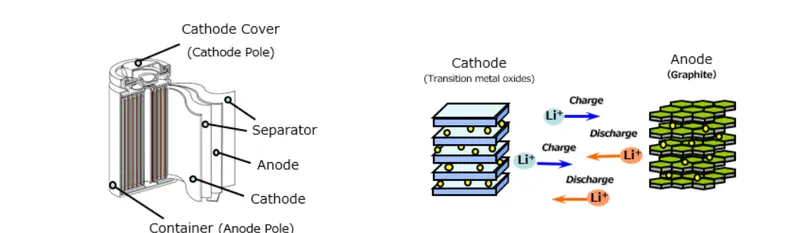
Li-ion batteries provide a variety of advantages over other high-quality rechargeable battery technologies (nickel-cadmium or nickel-metal-hydride). They offer one of the highest energy densities of any battery technology on the market right now. They have the ability to provide enormous amounts of current for high-power applications. Li-ion batteries are also low-maintenance, as they don't need to be cycled on a regular basis to keep their life. They don't contain the hazardous cadmium found in Ni-Cd batteries, making them easier to dispose of.Now lets know about the types of Lithium ion batteries used.
Lithium Cobalt Oxide battery(LCO)-
In the cathode, lithium-metal oxides are used, and in the anode, lithium-carbon compounds are used.A cobalt oxide cathode (positive electrode) and a graphite carbon anode are used in the system (negative electrode) Because they allow for intercalation, these materials are used. Intercalation refers to the ability of molecules to insert something into one another. The electrodes in this situation can easily transfer lithium ions in and out of their structures.Lithium is oxidised from Li to Li + (0 to +1 oxidation state) in the lithium-graphite anode during discharge. These lithiums ions flows through the electrolyte
to the cathode where the reduction process happens in lithium cobalt oxide.It is utilised in a variety of applications ranging from electronic gadgets to laptop and phone batteries.
Lithium Magnesium Oxide Battery(LMO)-
In 1996, LMO (Lithium Magnesium Oxide) was developed. LiaC6 is the anode material, LibMn2O4 is the cathode material, and Li+ is the carrier material. The first time lithium manganese oxide was used as a cathode material was in 1996. This arrangement created a three-dimensional spinel structure, which improved ion transport between the electrodes. Internal resistance is reduced and loading capacity is increased as a result of the rapid flow. Medical instruments and equipment, power tools, and electric motorcycles all employ LMO batteries.It have high temperature stability and provides a better safety compared to other batteries.Low internal cell resistance allows for fast charging and strong current discharging, resulting in a high rate capability.
Lithium nickel cobalt aluminum oxide (NCA)-
In the year 1999, the NCA (Lithium nickel cobalt aluminium oxide) battery was invented. LiaC6 is the anode material, LibNi0.8Co0.15Al0.05O2 is the cathode material, and Li+ is the carrier material. It's employed in a variety of applications, including power grids, medical gadgets, and electric vehicles. Tesla, for example, uses NCA batteries in its electric vehicle system. The term "NCA battery" refers to a lithium nickel cobalt aluminium oxide battery (LiNiCoAlO2). In addition, NCA batteries are becoming increasingly significant in applications including as in-grid storage and electrical power terrain.It is less safe compared to the other Li-ion batteries so it requires additional safety features compared to others,And production cost of the battery is also high compared to others.
Lithium Nickel Manganese Cobalt Oxide(NMC)
A cathode combination of nickel, manganese, and cobalt is one of the most successful Li-ion systems (NMC). Lithium nickel manganese cobalt oxide batteries, often known as lithium-manganese-cobalt-oxide batteries, or NMC batteries, are built of a variety of components found in other lithium iron batteries. These involve a nickel, manganese, and cobalt cathode combination. The cathode combination ratio is commonly one-third nickel, one-third manganese, and one-third cobalt, implying that the raw material cost is lower than for other alternatives, as cobalt may be fairly expensive on its own.
Lithium iron phosphate battery(LFP)-
Phosphate is used as the cathode material. They also benefit from low resistance qualities, which improve thermal stability and safety. In 1996, LFP (Lithium Iron Phosphate) was created. LiaC6 is the anode material, LibFePO4 is the cathode material, and Li+ is the carrier material. They employ LFP batteries in a variety of applications, including electric automobiles, buses, and trucks. Because the battery is less energy dense but less expensive to manufacture than other Li-ion battery types, the LFP is suited for usage in electric trucks or buses, where volume or weight aren't as much of an issue as they are in vehicles. FP has a low resistance and high electrochemical performance.
Lithium titanite battery(LTO)-
In the year 2008, TO (Lithium tintate) was created. Li4+aTi5O12 is the anode material, LibFePO4 is the cathode material, and Li+ is the carrier material. UPS, electrical power trains, solar powered street lighting, quick charge stations, and forklifts are just a few of the applications. Other possibilities for LTO batteries include aerospace and military applications, as well as wind and solar energy storage and the building of smart grids. In the anode of a typical lithium-ion battery, Li-titanate is utilised instead of graphite, and the material is shaped into a spinel structure. LMO or NMC is used as the cathode material.
| Battery Type | Anode | Cathode | Seperator | Electrolyte | Anode reaction | Cathode reaction | Overall reaction |
| Lithium Cobalt Oxide battery(LCO) | Graphite Carbon | Lithium Cobalt Oxide | Polyolefin | Ethylene Carbonate | `Liunderset(6)(C) harr underset(6)(C)+ overset(+)(Li) + overset(-)(e)` | `Counderset(2)(O)+ overset(+)(Li)+overset(-)(e) harr LiCounderset(2)(O)` | `underset(6)(C) +LiCounderset(2)(O) harr Liunderset(6)(C) + Counderset(2)(O)` |
| Lithium Magnesium Oxide Battery(LMO) | Graphite Carbon | Lithium Manganese | Polyolefin | Lithium Halide | `Liunderset(6)(C) harr underset(6)(C)+ overset(+)(Li) + overset(-)(e)` | `Mn underset(2)(O) + overset(+)(Li)+overset(+)(e) harr LiMn underset(2)(O)` | `underset(6)(C) + Liunderset(2)(Mn)underset(4)(O) harr Liunderset(6)(C) + underset(2)(Mn)underset(4)(O)` |
| Lithium nickel cobalt aluminum oxide (NCA) | Graphite Carbon |
Nickel Cobalt Aluminium |
Polyolefin | Ethylene Carbonate | `Liunderset(6)(C) harr underset(6)(C)+ overset(+)(Li) + overset(-)(e)` | `NiCoAlunderset(2)(O) + overset(+)(Li)+ overset(-)(e) harr LiNiCoAlunderset(2)(O)` | `underset(6)(C) +LiNiCoAlunderset(2)(O) harr Liunderset(6)(C)+ NiCAlunderset(2)(O)` |
| Lithium Nickel Manganese Cobalt Oxide(NMC) | Graphite Carbon | Nickel Manganese | Polyolefin | Lithium Salt | `Liunderset(6)(C) harr underset(6)(C)+ overset(+)(Li) + overset(-)(e)` | `NiMnCounderset(2)(O)+overset(+)(Li)+overset(-)(e) harr LiNiCoAlunderset(2)(O)` | `underset(6)(C)+ LiNiMnCounderset(2)(O) harr Liunderset(6)(C) + NiMnCounderset(2)(O)` |
| Lithium Iron Phosphate(LFP) | Graphite carbon | Lithium iron Phosphate | Polyolefin | Ethylene Carbonate | `Liunderset(6)(C) harr underset(6)(C)+ overset(+)(Li) + overset(-)(e)` | `FePunderset(4)(O)+overset(+)(Li) +overset(-)(e) harr LiFePunderset(4)(O)` | `underset(6)(C) +LiFePunderset(4)(O) harr Liunderset(6)(C)+ FePunderset(4)(O` |
| Lithium Titanite(LTO) | Graphite | Lithium Titanite | Polyolefin | Lithium salt | `underset(4)(Li)underset(5)(Ti)underset(12)(O) harr underset(5)(Ti)underset(12)(O) +4overset(+)(Li)+4overset(-)(e)` | `4underset(2)(Mn)underset(4)(O) +4overset(+)(Li) + 4overset(-)(e) harr 4Liunderset(2)(Mn)underset(4)(O)` | `4underset(2)(Mn)underset(4)(O)+ underset(4)(Li)underset(5)(Ti)underset(12)(O) harr 4Liunderset(2)(Mn)underset(4)(O)+underset(5)(Ti)underset(12)(O)` |
2.Compare the differences between each type of Li+ion batteries based on their characteristics
Ans-
There are many different types of lithium ion batteries to choose from.
Each type of lithium ion battery has its unique set of properties, which means that different Li-ion battery types will be employed in different applications.As a result, choosing the proper type of lithium ion battery for any use is critical; understanding the various varieties and their features allows the right type to be selected for any application.
The chemistry, cost, size, weight, capacity, and a variety of other characteristics change between the many varieties of lithium ion batteries.Handheld electronic devices, such as cell phones, tablet computers, games, e-readers, and other similar devices, require great energy density mixed with high levels of safety. Lithium Cobalt Oxide batteries are commonly utilised in these applications.In some cases, a lower energy density is acceptable, but a longer battery life is required.
Lithium Cobalt Oxide(LCO)
The Lithium Cobalt Oxide, or LiCoO2, battery is a form of lithium ion battery that can be found in a variety of consumer electronics. It offers a high amount of specific energy density as well as a high level of safety. A layered cobalt oxide cathode forms the basis of the battery. Graphite is used as the anode (carbon). Lithium ions flow from the anode to the cathode during the discharge cycle, and from the cathode to the anode during the charge cycle.
As the solid electrolyte contact changes and the anode thickens, the battery life is limited by the graphite anode. Newer batteries may contain nickel or manganese to extend battery life while lowering production costs.
One of the disadvantages of the LCO battery is that it has a restricted current capacity in both charge and discharge. As a general rule, it should not be charged or discharged faster than its capacity, hence a 2400mAh battery should not be charged or discharged at a current higher than 2400mA. 0.8 of the charge level is frequently advised.
|
ATTRIBUTE |
DETAILS |
|
Key features |
High energy density; high level of safety |
|
Main disadvantages |
Relatively short life-span; limited high load capability. |
|
Main applications |
Consumer electronics:- mobile phones, games, laptops, tablets, e-readers, etc. |
|
Voltage |
3.60V nominal with typical operating rate between 3.0 - 4.2 V/cell |
|
Specific energy (capacity) |
150 - 200Wh/kg typical |
|
Battery life |
500 - 1000 cycles |
Lithium Magnesium Oxide(LMO)
LMO batteries have the capacity to supply a large amount of energy in a short amount of time, making them ideal for power tools such as drills. The first time lithium manganese oxide was used as a cathode material was in 1996. This arrangement created a three-dimensional spinel structure, which improved ion transport between the electrodes. Internal resistance is reduced and loading capacity is increased as a result of the rapid flow. LMO batteries are commonly found in medical devices, power tools, electric bikes, and other applications. Because of its increased safety and thermal resistance. Laptops and electric cars can both benefit from LMO batteries.High temperature stability and safety compared to other Li-ion kinds since it has built-in thermal stability, which means it requires less safety circuitry than a cobalt system. Although it has a lower capacity than a cobalt-based system, it nevertheless has a nearly 50% higher energy density than a nickel-based system.
Lithium Nickel Cobalt Aluminium Oxide-(NCA)
The Lithium Nickel Cobalt Aluminium Oxide (NCA) battery is a form of lithium-ion battery that is rarely used in consumer applications but is being studied for use in the automobile industry. It has a long life lifetime and high energy and power density numbers, which are its key advantages.
These features, however, come at a cost, and because of the safety aspects, it must be utilised with caution. It will take additional work to get to the point where this form of lithium-ion battery can be utilised more widely. Compared to other Li-ion battery types, it has a lower level of safety (they require extra safety features and circuits for use in electric cars for example) In comparison to other Li-ion battery types, it is more expensive.
|
Key features |
High energy density, high power density, good life span. |
|
Main disadvantages |
High cost; safety requires more care in the design and use. |
|
Main applications |
Traction batteries,high power batteries |
Lithium Nickel Manganese Cobalt Oxide-(NMC)
A cathode made up of nickel, manganese, and cobalt is used in the lithium nickel manganese cobalt oxide lithium battery.The combination of nickel and manganese is the key to this lithium ion battery type. Nickel has a high specific energy but has poor stability, whereas manganese has a low internal resistance but a low specific energy. The perfect combination of both metals in a cell can give the appropriate balance of attributes for both metals.Nickel, manganese, and cobalt are frequently combined in identical amounts in the cathode, resulting in a 1-1-1 combination.
Lithium ion batteries of the NMC type can be tuned for high specific power or high specific energy. Because of the expensive cost of cobalt, manufacturers are attempting to move away from it, typically increasing the use of nickel, hence this is frequently a deciding factor in the battery's composition.
|
ATTRIBUTE |
DETAILS |
|
Key features |
High specific power or energy. |
|
Main disadvantages |
Power / energy density not as high as some other types. |
|
Main applications |
Power tools and electric vehicles. |
|
Voltage |
3.60 - 3.70 V |
|
Specific energy |
160 - 230Wh/kg |
|
Life expectancy |
1000 - 2000 cycles. |
Lithium Titanium Oxide (LTO)
Lithium titanate, often known as li-titanate, is a type of battery that has a growing number of uses. The lithium-titanate battery's key advantage is its incredibly quick recharge time. Li-titanate batteries are being employed by makers of electric vehicles and bicycles, and this type of battery has the potential to be used in electric buses for public transit. However, these batteries have a lower intrinsic voltage or energy density than other lithium-ion battery types, which might cause problems when it comes to efficiently powering automobiles. Despite this, lithium titanate batteries have a higher density than non-lithium-ion batteries, which is a benefit.
Lithium iron phosphate (LFP)
Lithium iron phosphate batteries (LiFePO4 or LFP) offer lots of benefits compared to lead-acid batteries and other lithium batteries. Longer life span, no maintenance, extremely safe, lightweight, improved discharge and charge efficiency,It Offers up to 20 times the cycle life and five times the float/calendar life of a lead acid battery, lowering total cost of ownership and lowering replacement costs. A equivalent lead acid battery weighs about 40% of the weight of this cell. A 'plug-and-play' substitute for lead-acid batteries. The chemistry of lithium iron phosphate minimises the potential of explosion or combustion as a result of heavy impact, overcharging, or short circuiting. The modular design allows up to four batteries to be connected in series and up to ten batteries to be connected in parallel.Lithium iron phosphate (LiFePO4) can withstand a wide range of temperatures, making it an excellent choice for a variety of applications, including those that require severe temperatures. Lithium is the ideal choice for applications that will deplete the batteries or operate in harsh environments.