Week 1 Understanding Different Battery Chemistry
Li-ion Batteries:
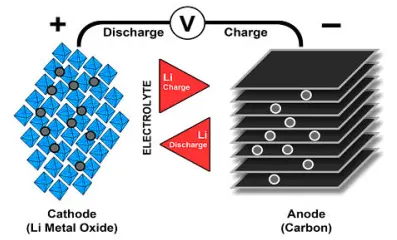
A lithium-ion battery or Li-ion battery is a type of rechargeable battery. Lithium-ion batteries are commonly used for portable electronics and electric vehicles and are growing in popularity for military and aerospace applications. In the batteries, lithium ions move from the negative electrode through an electrolyte to the positive electrode during discharge, and back when charging. Li-ion batteries use an intercalated lithium compound as the material at the positive electrode and typically graphite at the negative electrode. The batteries have a high energy density, no memory effect (other than LFP cells) and low self-discharge. They can however be a safety hazard since they contain flammable electrolytes, and if damaged or incorrectly charged can lead to explosions and fires.
|
Battery Type |
Cathode |
Anode |
Electrolyte |
Anode Reaction |
Cathode Reaction |
|
Lithium Cobalt |
Lithium Cobalt oxide |
Graphite |
Ethylene Carbonate |
LiC6 -> C6+ Li+ + e- |
Li1−xCoO2+xLi++xe−→LiCoO2 |
|
Lithium Manganese |
Lithium Manganese Oxide |
Graphite |
Lithium Haide |
LiC6 -> C6+ Li+ + e- |
MnO2 + Li+ + e- <--> LiMnO2 |
|
Lithium Aluminium |
Lithium Nickel Cobalt Aluminium Oxide |
Graphite |
Ethylene Carbonate |
LiC6 -> C6+ Li+ + e- |
NiCoAlO2 + Li+ + e- <--> LiNiCoAlO2 |
|
Lithium Nickel Manganese Cobalt |
Lithium Nickel Manganese Cobalt Oxide |
Graphite |
Lithium Salt |
LiC6 -> C6+ Li+ + e- |
NiMnCoO2 + Li+ + e- <--> LiNiMnCoO2 |
|
Lithium Iron Phosphate |
Lithium iron Phosphate |
Graphite |
Ethylene Carbonate |
LiC6 -> C6+ Li+ + e- |
FePO4+Li++e−→LiFePO4 |
|
Lithium Titanate |
Lithium Manganese Oxide |
Titanate |
Lithium Salt |
Li4+Ti5O12 <--> Ti5 O12 + 4Li+ + 4e- |
4Mn2O4 + 4Li+ + 4e- <--> 4LiMn2O4 |
2 .Compare the differences between each type of Li+ion batteries based on their characteristics
TYPES OF LITHIUM ION BATTERIES:
LITHIUM COBALT OXIDE:
Lithium Cobalt Oxide (LiCoO2) First developed by Sony in 1991, the lithium cobalt oxide battery has been the battery of choice for most personal electronics (laptops, cameras, tablets, etc.) due to their high energy density, long life cycle and ease of manufacturing. Lithium cobalt batteries are very reactive and therefore suffer from poor thermal stability and must be monitored during operation to ensure safe use. The limited availability of cobalt also makes it more expensive and difficult to be a viable option for use in EVs.
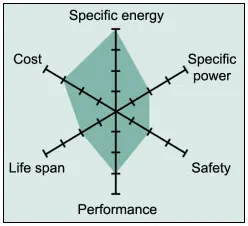
These batteries have high specific energy and have a layered structure. They have short life span, low thermal stability and limited load capabilities. The cobalt is more expensive raw material than others and hence the cost for this type of batteries is high.
Lithium Manganese Oxide (LiMn2O4)
Lithium manganese oxide batteries (LMO) were first introduced in the early 1980’s. The architecture forms a three-dimensional spinel structure that improves ion flow on the electrode, which results in lower internal resistance and improved current handling. Low internal cell resistance enables fast charging and high-current discharging. Li-manganese can be discharged at currents of 20–30 A with moderate heat buildup in an 18,650 package. This chemistry provides better thermal stability than the lithium cobalt oxide.
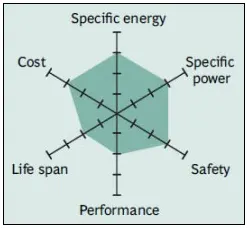
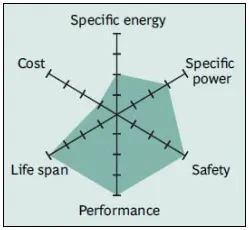
The characteristics appear marginal but newer designs have improved in terms of specific power, safety and life span. Pure Li-manganese batteries are no longer common today; they may only be used for special applications.
Lithium Nickel Cobalt Aluminum Oxide (Li(NixCoyAl1−x−y)O2)
Lithium Nickel Cobalt Aluminum Oxide (NCA) has been around since 1999 for special applications. It shares similarities with NMC by offering high specific energy and specific power (the rate at which the battery can deliver energy), and a long life span. NCA is not as safe as the others listed above and as such, require special safety monitoring measures to be employed for use in EVs. They are also more costly to manufacture, limiting their viability for use in other applications.
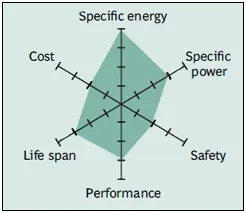
Lithium Nickel Manganese Cobalt Oxide (Li(NixMnyCo1−x−y)O2)
Lithium Nickel Manganese Cobalt Oxide (NMC) electrodes can be designed for high specific energy or power with high density. The secret of NMC lies in combining nickel and manganese: nickel is known for its high specific energy but poor stability; manganese has the benefit of forming a spinel structure to achieve low internal resistance but offers a low specific energy.
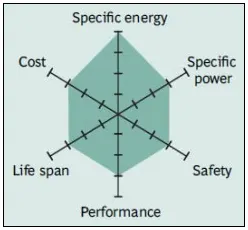
Lithium Iron Phosphate (LiFePO4)
LiFePO4 (LFP) offers good electrochemical performance with low resistance, besides high current rating and long cycle life. The phosphate helps to stabilize the electrode against overcharging and provides a higher tolerance to heat which limits the breakdown of the material. These batteries have a wide temperature range and can operate between +60 ◦C to −30 ◦C and are much less likely to suffer from a thermal runaway. LiFePO4 has a higher self-discharge than other Li-ion batteries, which can cause balancing issues with aging. This can be mitigated through the use of sophisticated control electronics, at increased battery pack cost.
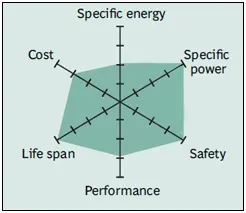
Lithium Titanate (Li4Ti5O12)
Li-titanate (LTO) replaces the graphite in the negative electrode of a typical Li-ion battery and the material forms into a spinel structure. The counter-electrode can be lithium manganese oxide or NMC. Spinel lithium titanate has been regarded as a highly useful electrode material because of the zero volume change during lithiation, leading to an extremely long operational lifetime for the electrode, coupled with the improved safety owing to an extremely flat discharge and charge plateau at about 1.55 V vs. Li/Li+ . This material has low electronic conductivity and the Li+ diffusion coefficient of this material can result in poor performance at high power levels, though this can be improved through the reduction of the lithium ion transport path lengths through proper nano structuring, and the improvement of the electronic conductivity through doping, surface coating, and forming composites with better electronic conductors such as carbon materials. The main drawback is very expensive and has low specific power.