Week 1 Understanding Different Battery Chemistry
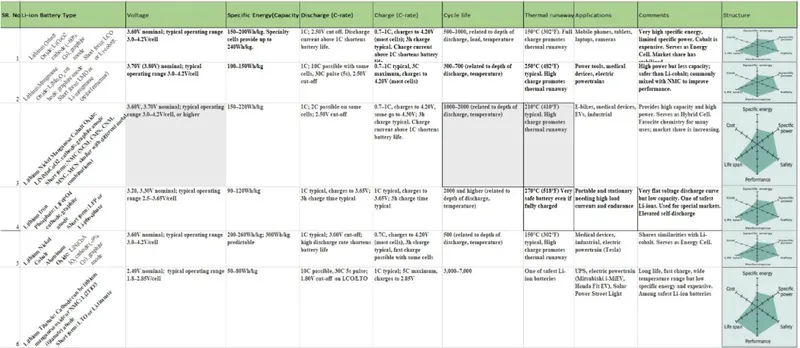
1)Prepare a table which includes materials & chemical reactions occurring at the anode and cathode of LCO, LMO, NCA, NMC, LFP and LTO type of lithium ion cells.Give your detailed explanation on it
A battery is a source of electric power consisting of one or more electrochemicals with external connections for powering electrical devices such as flashlights , mobiles, and electric cars. When a battery is supplying electric power, its positive terminal is the cathode and its negative terminal is the anode. The terminal marked negative is the source of electrons that will flow through an external electric circuit to the positive terminal. When a battery is connected to an external electric load, a redox reaction converts high-energy reactants to lower-energy products, and the free energy difference is delivered to the external circuit as electrical energy.
2 Types of Batteries
1) Primary Batteries:
As the name indicates these batteries are meant for single usage. Once these batteries are used they cannot be recharged as the devices are not easily reversible and active materials may not return to their original forms. Battery manufacturers recommend against recharge of primary cells.
2) Secondary Batteries:
Secondary batteries are also called as rechargeable batteries. These batteries can be used and recharges simultaneously. They are usually assembled with active materials with active in the discharged state. Rechargeable batteries are recharged by applying electric current, which reverses the chemical reactions that occur during discharge. Chargers are devices which supply the required current.
Lithium (Li) Battery:
We all use it in portable devices such as cell phone, a laptop computer or a power tool. The lithium battery has been one of the greatest achievements in portable power in the last decade; with use of lithium batteries we have been able to shift from black and white mobile to color mobiles with additional features like GPS, email alerts etc. These are the high energy density potential devices for higher capacities.
Lithium –Ion batteries are now popular in majority of electronic portable devices like Mobile phone, Laptop, Digital Camera, etc due to their long lasting power efficiency. These are the most popular rechargeable batteries with advantages like best energy density, negligible charge loss and no memory effect. Li-Ion battery uses Lithium ions as the charge carriers which move from the negative electrode to the positive electrode during discharge and back when charging. During charging, the external current from the charger applies an over voltage than that in the battery. This forces the current to pass in the reverse direction from the positive to the negative electrode where the lithium ions get embedded in the porous electrode material through a process called Intercalation. The Li- Ions pass through the non aqueous electrolyte and a separator diaphragm. The electrode material is intercalated lithium compound.
The negative electrode of the Li-Ion battery is made up of carbon and the positive electrode is a metal oxide. The most commonly used material in the negative electrode is Graphite while that in the positive electrode may be Lithium cobalt oxide, Lithium ion phosphate or Lithium manganese oxide. Lithium salt in an organic solvent is used as the electrolyte. The electrolyte is typically a mixture of organic carbonates like Ethylene carbonate or Diethyl carbonate containing lithium ions. The electrolyte uses anion salts like Lithium hexa fluoro phosphate, Lithium hexa fluoro arsenate monohydrate, Lithium per chlorate, Lithium hexa fluoro borate etc. Depending upon the salt used, the voltage, capacity and life of the battery varies. Pure lithium reacts with water vigorously to form lithium hydroxide and hydrogen ions. So the electrolyte used is non aqueous organic solvent. The electrochemical role of the electrodes charge between anode and cathode depends on the direction of current flow.
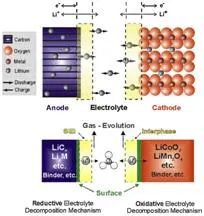
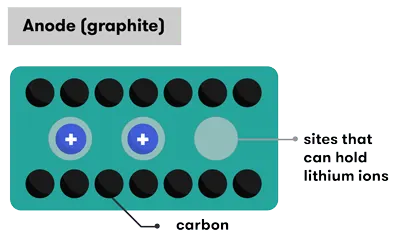
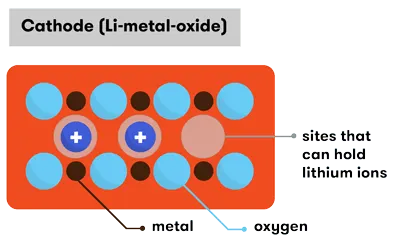
In the Li-Ion battery, both the electrodes can accept and release lithium ions. During the Intercalation process, the lithium ions move into the electrode. During the reverse process called de intercalation, the lithium ions move back. During discharging, the positive lithium ions will be extracted from the negative electrodes and inserted into the positive electrode. During the charging process, the reverse movement of lithium ions takes place.
types of lithium ion battries
LITHIUM COBALT OXIDE (LiCoO2)
DURING DISCHARGE
At the anode, lithium is oxidised. Lithium ions are released from the carbon, along with electrons:
At the cathode, lithium-ions are absorbed by the lithium dioxide, and the electrode is reduced as it also receives the electrons from the circuit:
The overall reaction is:
LITHIUM IRON PHOSPHATE (LiFePO4)
DURING DISCHARGE
At the anode, lithium is oxidised. Lithium ions are released from the carbon, along with electrons:
At the cathode, lithium ions are absorbed by the lithium dioxide, and the electrode is reduced as it also receives the electrons from the circuit:
The overall reaction is:
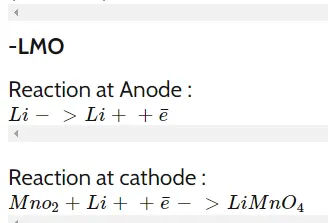
LITHIUM MANGANESE OXIDE (LiMn2O4)
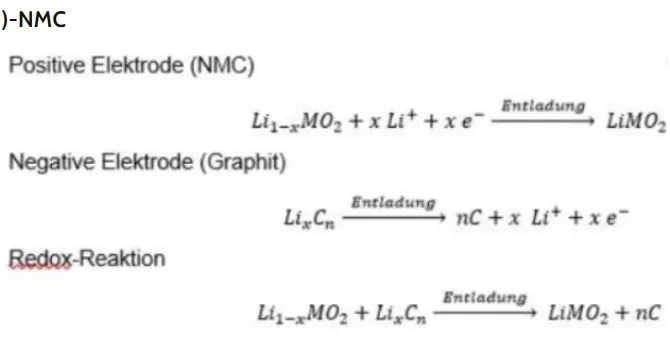
LITHIUM NICKEL MANGANESE COBALT OXIDE (LiNiMnCoO2 or NMC)
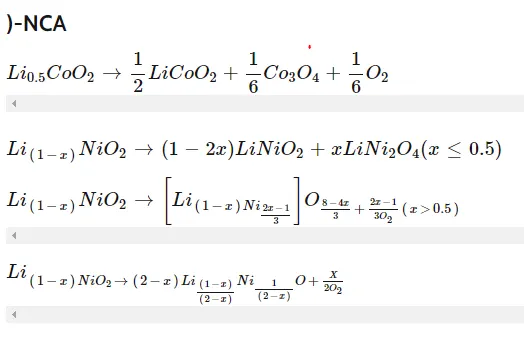
LITHIUM NICKEL COBALT ALUMININUM OXIDE(LiNiCoAlO2)
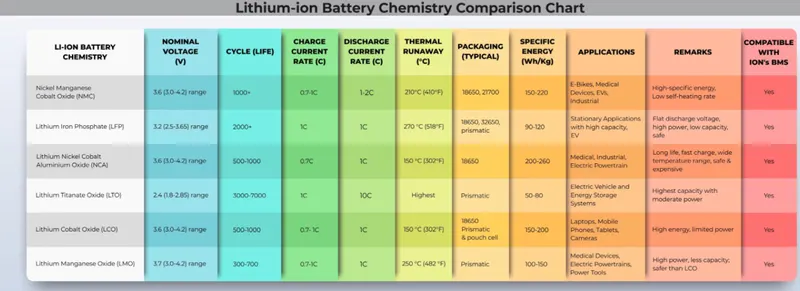
2.Compare the differences between each type of Li+ion batteries based on their characteristics