Week 1 Understanding Different Battery Chemistry
Answer 1: Cathode: This is the cell positive electrode and typically made of, layered transition metal oxides, spinels and olivines.
Anode: This is the cell negative electrodeand usualy made of graphite or hard caron.
The below table includes materials of anode and cathode of LCO, LMO, NCA, NMC, LFP and LTO type of Lithium ion cells.
| Serial No. | Type of cell | Material | |
| Cathode | Anode | ||
| 1 | LCO | Lithium Cobalt oxide | Graphite Carbon |
| 2 | LMO | Lithium Manganese | Graphite Carbon |
| 3 | NCA | Lithium Nickel Cobalt | Graphite Carbon |
| 4 | NMC | Lithium Nickel Manganese Cobalt | Graphite Carbon |
| 5 | LFP | Lithium Iron Phosphate | Graphite Carbon |
| 6 | LTO | Lithium Titanate | Graphite Carbon |
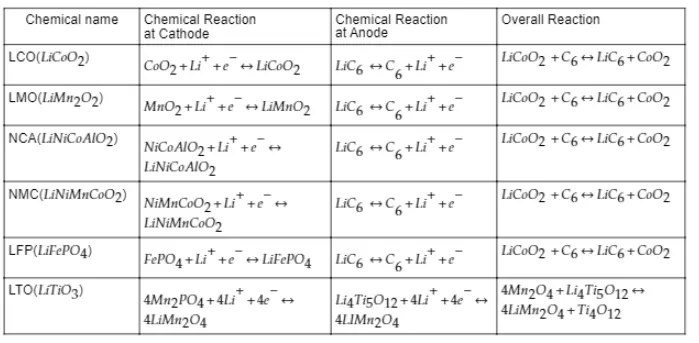
The image below shows chemical reactions occuring at anode and cathode of LCO, LMO, NCA, NMC, LFP and LTO type of Lithium ion cells.
Answer 2: The characteristics of different type of Li-ion batteries are compared as follows,
LCO :
| Voltages | 3.60V nominal; typical operating range 3.0–4.2V/cell |
| Specific energy (capacity) | 150–200Wh/kg. Specialty cells provide up to 240Wh/kg. |
| Charge (C-rate) | 0.7–1C, charges to 4.20V (most cells); 3h charge typical. Charge current above 1C shortens battery life. |
| Discharge (C-rate) | 1C; 2.50V cut off. Discharge current above 1C shortens battery life. |
| Cycle life | 500–1000, related to depth of discharge, load, temperature |
| Thermal runaway | 150°C (302°F). Full charge promotes thermal runaway |
| Applications | Mobile phones, tablets, laptops, cameras |
| Comments | Very high specific energy, limited specific power. Cobalt is expensive. Serves as Energy Cell. |
LMO :
| Voltages | 3.70V (3.80V) nominal; typical operating range 3.0–4.2V/cell |
| Specific energy (capacity) | 100–150Wh/kg |
| Charge (C-rate) | 0.7–1C typical, 3C maximum, charges to 4.20V (most cells) |
| Discharge (C-rate) | 1C; 10C possible with some cells, 30C pulse (5s), 2.50V cut-off |
| Cycle life | 300–700 (related to depth of discharge, temperature) |
| Thermal runaway | 250°C (482°F) typical. High charge promotes thermal runaway |
| Applications | Power tools, medical devices, electric powertrains |
| Comments | High power but less capacity; safer than Li-cobalt. |
NMC:
| Voltages | 3.60V, 3.70V nominal; typical operating range 3.0–4.2V/cell, or higher |
| Specific energy (capacity) | 150–220Wh/kg |
| Charge (C-rate) | 0.7–1C, charges to 4.20V, some go to 4.30V; 3h charge typical. Charge current above 1C shortens battery life. |
| Discharge (C-rate) | 1C; 2C possible on some cells; 2.50V cut-off |
| Cycle life | 1000–2000 (related to depth of discharge, temperature) |
| Thermal runaway | 210°C (410°F) typical. High charge promotes thermal runaway |
| Applications | E-bikes, medical devices, EVs, industrial |
| Comments | Provides high capacity and high power. Serves as Hybrid Cell |
LFP:
| Voltages | 3.20, 3.30V nominal; typical operating range 2.5–3.65V/cell |
| Specific energy (capacity) | 90–120Wh/kg |
| Charge (C-rate) | 1C typical, charges to 3.65V; 3h charge time typical |
| Discharge (C-rate) | 1C, 25C on some cells; 40A pulse (2s); 2.50V cut-off (lower that 2V causes damage) |
| Cycle life | 2000 and higher (related to depth of discharge, temperature) |
| Thermal runaway | 270°C (518°F) Very safe battery even if fully charged |
| Applications | Portable and stationary needing high load currents and endurance |
| Comments | Very flat voltage discharge curve but low capacity. One of safest Li-ions. Used for special markets. Elevated self-discharge. |
NCA :
| Voltages | 3.60V nominal; typical operating range 3.0–4.2V/cell |
| Specific energy (capacity) | 200-260Wh/kg; 300Wh/kg predictable |
| Charge (C-rate) | 0.7C, charges to 4.20V (most cells), 3h charge typical, fast charge possible with some cells |
| Discharge (C-rate) | 1C typical; 3.00V cut-off; high discharge rate shortens battery life |
| Cycle life | 500 (related to depth of discharge, temperature) |
| Thermal runaway | 150°C (302°F) typical, High charge promotes thermal runaway |
| Applications | Medical devices, industrial, electric powertrain (Tesla) |
| Comments | Shares similarities with Li-cobalt. Serves as Energy Cell. |
LTO:
| Voltages | 2.40V nominal; typical operating range 1.8–2.85V/cell |
| Specific energy (capacity) | 50–80Wh/kg |
| Charge (C-rate) | 1C typical; 5C maximum, charges to 2.85V |
| Discharge (C-rate) | 10C possible, 30C 5s pulse; 1.80V cut-off on LCO/LTO |
| Cycle life | 3,000–7,000 |
| Thermal runaway | One of safest Li-ion batteries |
| Applications | UPS, electric powertrain (Mitsubishi i-MiEV, Honda Fit EV), solar-powered street lighting |
| Comments | Long life, fast charge, wide temperature range but low specific energy and expensive. Among safest Li-ion batteries. |