Understanding Different Battery Chemistry
Tasks
- Prepare a table that includes materials & chemical reactions occurring at the anode and cathode of LCO, LMO, NCA, NMC, LFP and LTO type of Li-ion cells. Give your detailed explanation on it
- Compare the differences between each type of Li-ion batteries based on their characteristics.
Task 1
Chemical reactions occurring at the anode and cathode of LCO, LMO, NCA, NMC, LFP and LTO Batteries
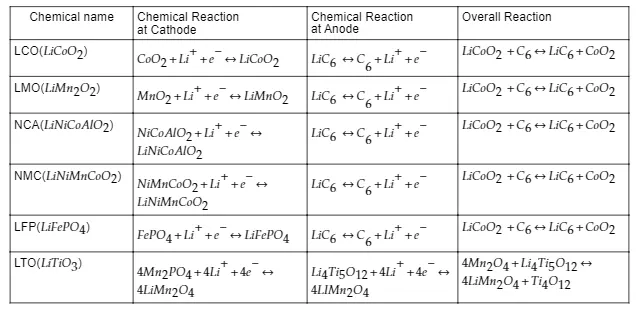
Task 2
Characteristics of Li-ion batteries with a detailed explanation:
Characteristics of lithium cobalt oxide( LCO)
| Lithium Cobalt Oxide: LiCoO2 cathode (~60% Co), graphite anode Short form: LCO or Li-cobalt. |
|
| Voltages | 3.60V nominal; typical operating range 3.0–4.2V/cell |
| Specific energy (capacity) | 150–200Wh/kg. Speciality cells provide up to 240Wh/kg. |
| Charge (C-rate) | 0.7–1C, charges to 4.20V (most cells); 3h charge typical. Charge current above 1C shortens battery life. |
| Discharge (C-rate) | 1C; 2.50V cut off. Discharge current above 1C shortens battery life. |
| Cycle life | 500–1000, related to the depth of discharge, load, temperature |
| Thermal runaway | 150°C (302°F). Full charge promotes thermal runaway |
| Applications | Mobile phones, tablets, laptops, cameras |
| Comments |
Very high specific energy, limited specific power. Cobalt is expensive. Serves as Energy Cell. Market share has stabilized. |
Characteristics of Lithium Manganese Oxide( LMO)
| Lithium Manganese Oxide: LiMn2O4 cathode. graphite anode Short form: LMO or Li-manganese (spinel structure) |
|
| Voltages | 3.70V (3.80V) nominal; typical operating range 3.0–4.2V/cell |
| Specific energy (capacity) | 100–150Wh/kg |
| Charge (C-rate) | 0.7–1C typical, 3C maximum, charges to 4.20V (most cells) |
| Discharge (C-rate) | 1C; 10C possible with some cells, 30C pulse (5s), 2.50V cut-off |
| Cycle life | 300–700 (related to the depth of discharge, temperature) |
| Thermal runaway | 250°C (482°F) typical. High charge promotes thermal runaway |
| Applications | Power tools, medical devices, electric powertrains |
| Comments | High power but less capacity; safer than Li-cobalt; commonly mixed with NMC to improve performance. |
Characteristics of Lithium Nickel Cobalt Aluminum Oxide(NCA)
| Lithium Nickel Cobalt Aluminum Oxide: LiNiCoAlO2 cathode (~9% Co), graphite anode Short form: NCA or Li-aluminum. |
|
| Voltages | 3.60V nominal; typical operating range 3.0–4.2V/cell |
| Specific energy (capacity) | 200-260Wh/kg; 300Wh/kg predictable |
| Charge (C-rate) | 0.7C charges to 4.20V (most cells), 3h charge typical, fast charge possible with some cells |
| Discharge (C-rate) | 1C typical; 3.00V cut-off; high discharge rate shortens battery life |
| Cycle life | 500 (related to the depth of discharge, temperature) |
| Thermal runaway | 150°C (302°F) typical, High charge promotes thermal runaway |
| Cost | ~$350 per kWh (Source: RWTH, Aachen) |
| Applications | Medical devices, industrial, electric powertrain (Tesla) |
| Comments | Shares similarities with Li-cobalt. Serves as Energy Cell. Mainly used by Panasonic and Tesla; growth potential. |
Characteristics of lithium nickel manganese cobalt oxide (NMC)
| Lithium Nickel Manganese Cobalt Oxide: LiNiMnCoO2. cathode, graphite anode Short form: NMC |
|
| Voltages | 3.60V, 3.70V nominal; typical operating range 3.0–4.2V/cell, or higher |
| Specific energy (capacity) | 150–220Wh/kg |
| Charge (C-rate) | 0.7–1C, charges to 4.20V, some go to 4.30V; 3h charge typical. Charge current above 1C shortens battery life. |
| Discharge (C-rate) | 1C; 2C possible on some cells; 2.50V cut-off |
| Cycle life | 1000–2000 (related to the depth of discharge, temperature) |
| Thermal runaway | 210°C (410°F) typical. High charge promotes thermal runaway |
| Cost | ~$420 per kWh (Source: RWTH, Aachen) |
| Applications | E-bikes, medical devices, EVs, industrial |
| Comments | Provides high capacity and high power. Serves as Hybrid Cell. Favourite chemistry for many uses; market share is increasing. |
Characteristics of lithium iron phosphate(LFP)
| Lithium Iron Phosphate: LiFePO4 cathode, graphite anode Short form: LFP or Li-phosphate. LIP is also common. |
|
| Voltages | 3.20, 3.30V nominal; typical operating range 2.5–3.65V/cell |
| Specific energy (capacity) | 90–120Wh/kg |
| Charge (C-rate) | 1C typical charges to 3.65V; 3h charge time typical |
| Discharge (C-rate) | 1C, 25C on some cells; 40A pulse (2s); 2.50V cut-off (lower than 2V causes damage) |
| Cycle life | 2000 and higher (related to the depth of discharge, temperature) |
| Thermal runaway | 270°C (518°F) Very safe battery even if fully charged |
| Cost | ~$580 per kWh (Source: RWTH, Aachen) |
| Applications | Portable and stationary needing high load currents and endurance |
| Comments | Very flat voltage discharge curve but low capacity. One of safest Li-ions. Used for special markets. Elevated self-discharge. |