Week 1 Spur Gear Challenge
Spur Gear Challenge-
Aim:-
To perform static structural analysis on spur gear with different materials as shown below-
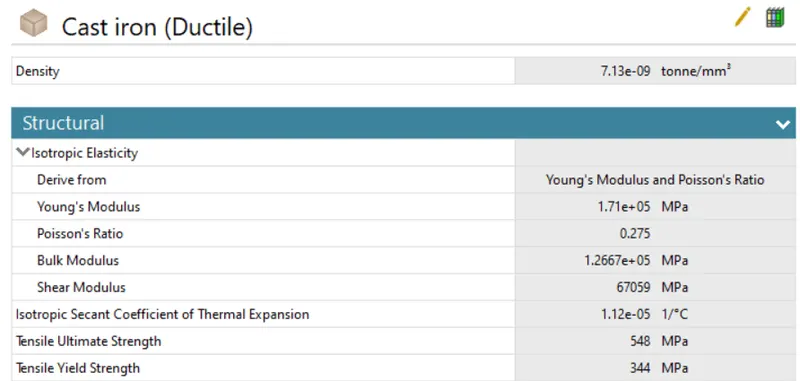
Case 1: Cast Iron (Ductile)
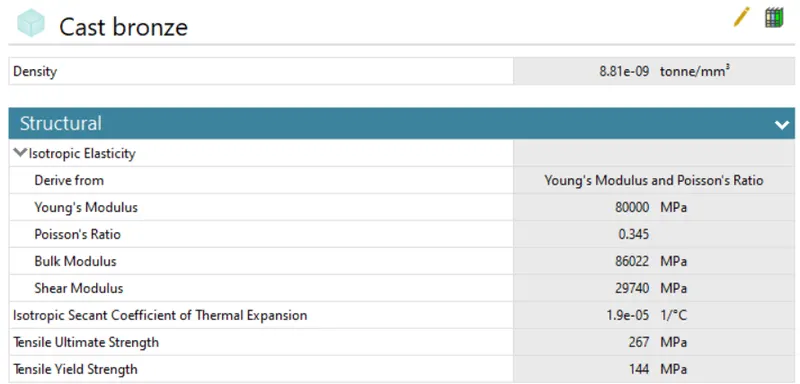
Case 2: Cast Bronze
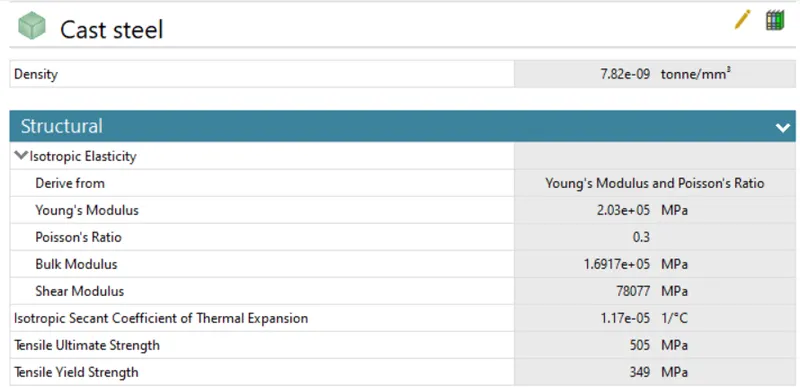
Case 3: Cast Steel
We have to find equivalent stress, total deformation and stress intensity for above three cases and recommending coice of material by comparing the results.
1. Stress intensity, Stress Intensity Factor (K) and Fracture development in specimen-
Stress intensity in other words is the stress state near the tip of a crack or notch caused by a remote load or residual stresses. The term stress intensity factor is used in fracture mechanics to predict stress intensity at given location caused by applied loads and generated stresses. Basically, it is s theoritical concept usually applied to a homogenous, linear, elastic material and is useful for providing a failure criterion for brittle materials, and is a critical technique in the discipline of damage control. The concept can also be applied to materials that exhibit small scale yeildiing at a crack tip.
The traditional approach to the design and analysis of a part is to use strength-of -materials concepts. In this case, the stresses due to applied loading are calculated. Failure is determined to occur once the applied stress exceeds the material's strength(either yeild strength or ultimate strength, depending on the criteria for failure.)
In fracture mechanics, stress intensity factor is calculated as a function of applied stress, crack size and part geometry. Failure occurs once the stress intensity factor exceeds the material's fracture toughness. At this point the crack will grow in a rapid and unstable manner until fracture.
2. Analysis set-up for Spur gear-
I. Geometry:
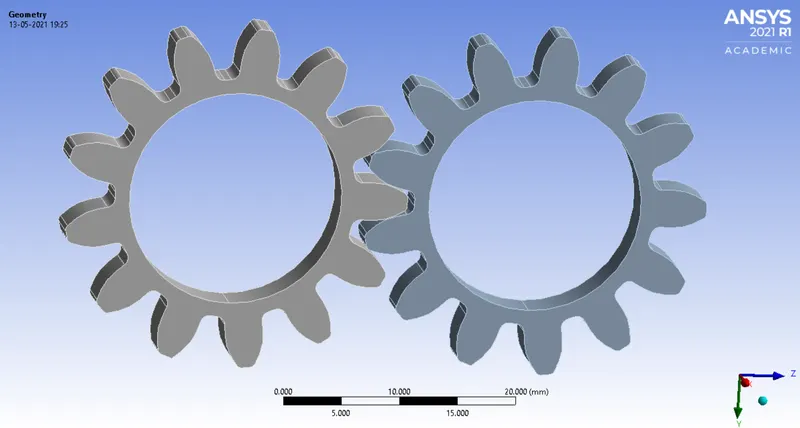
The CAD model of spur gear is imported in Ansys static structural environment. Both the driver and driven gear have 13 teeths. The gear on the left is called Left Spur gear and on the right is called Right Spur gear.
II. Material Property:
Below are the three materials used for analysis of spur gear. The analysis is carried out for each material individually
Case 1: Cast Iron (Ductile)
Case 2: Cast Bronze
Case 3: Cast Steel
The detailed engineering data of each material is as shown in below image:
III. Connection Details:
(a) Contact Details:
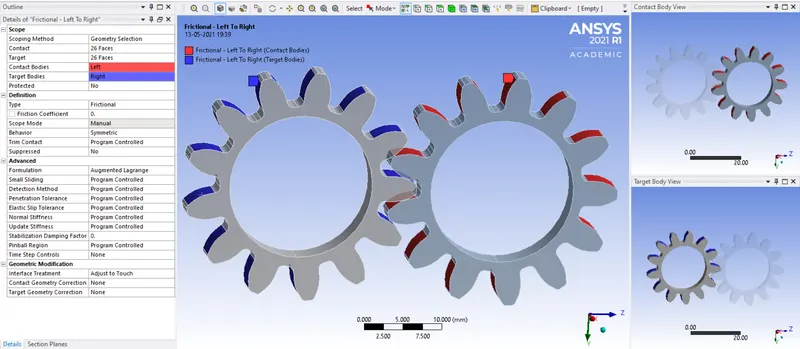
Frictional contact is given between faces of left and right spur gear as seen in the image below. The 26 faces on tooth of each gears are selected as these surfaces are come in contact, the other surfaces on the gear tooth can be neglected as contact surface is negligible. The formulation is changed to Augmented Langrange to minimize the interference errors. The interference errors. The interference treatment is changed to adjust to touch to avoid penetration.
(b) Joint Details:
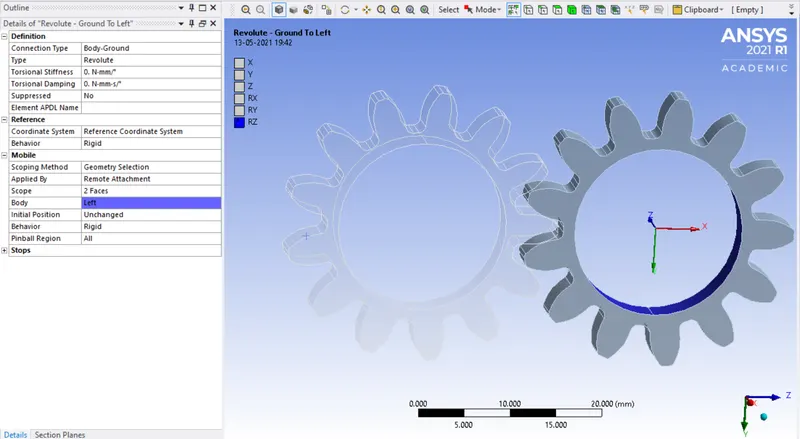
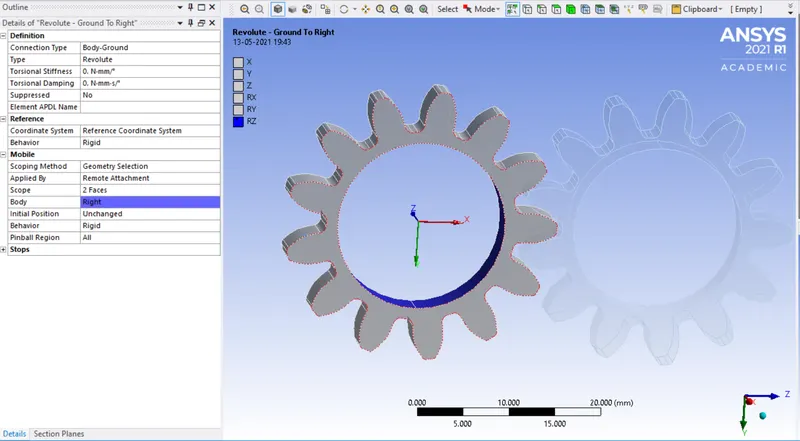
Both left and right spur gear are given revolute joint about its axis with Body-Ground type connection.
IV. Mesh:
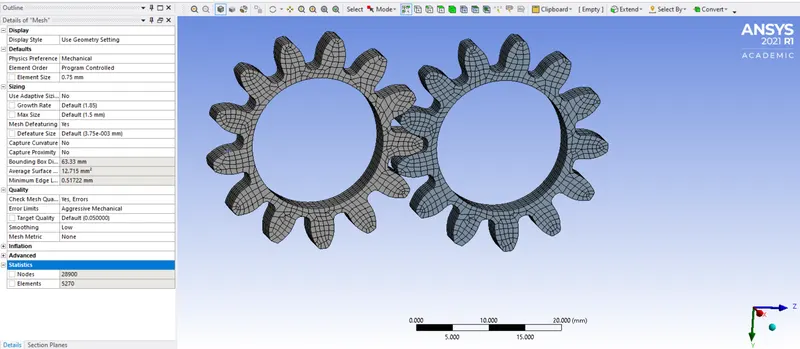
Program controlled mesh of element size 0.75 mm is used for all the three cases. A fine mesh is generated with 28900 nodes and 5270 elements which is sufficient to carry out simulation giving desired results.
V. Boundary conditions and Analysis Settings:
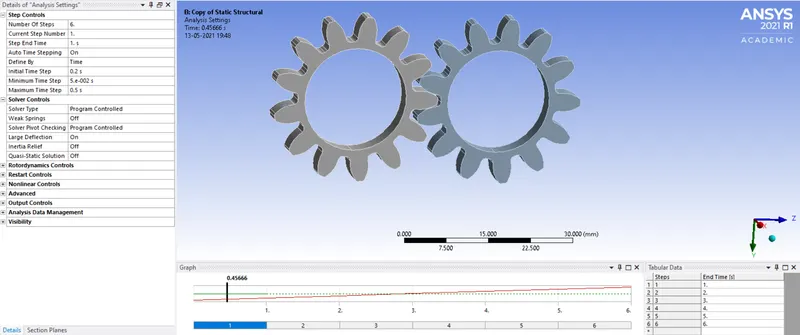
(a) Analysis Settings:
For this analysis total number of steps is set to 6 with Auto Time stepping set to ON. The initial time step is set to 0.2 seconds with minimum and maximum time step as 0.05 and 0.5 sec respectively. Larger deflection option is set to ON, so as to account for changes in stiffness due to changes in shape of the gears.
(b) Joint load details:
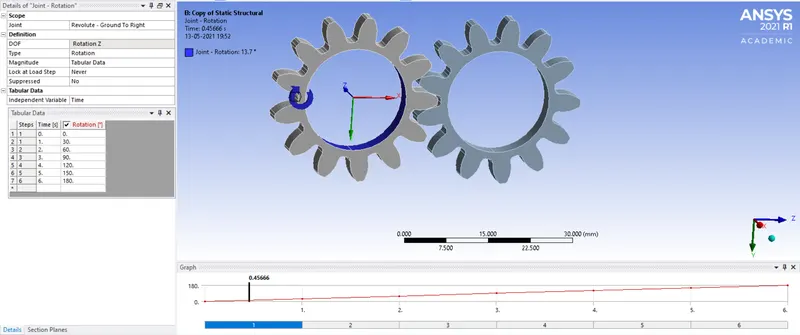
- Right Gear:
Right spur gear is the driving gear, hence a clockwise rotation of 180 degrees is given to it with increment of 30 degrees in 6 steps.
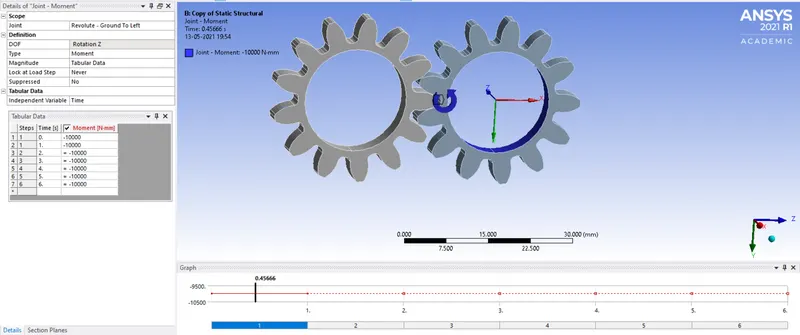
- Left Gear:
Left spur gear is driven by right gear, hence a anticlockwise moment of 10 N-m is applied to it
VI. Post-Processing and Results:
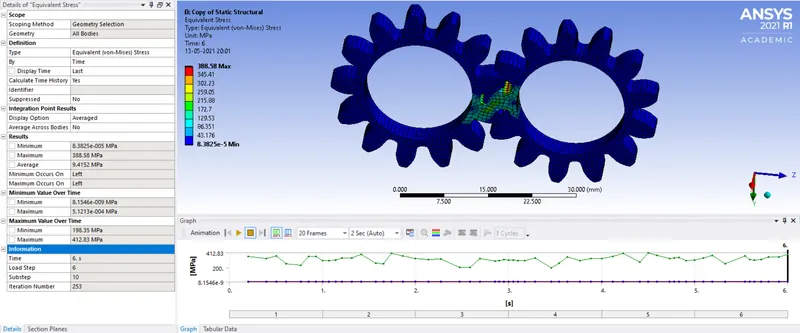
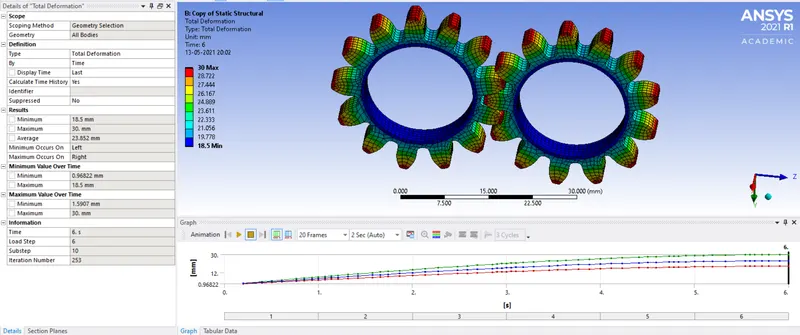
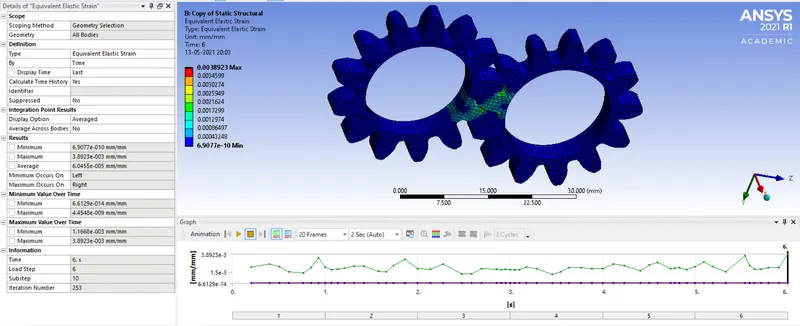
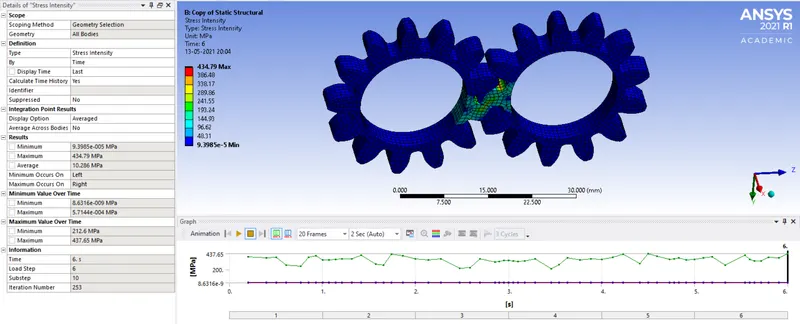
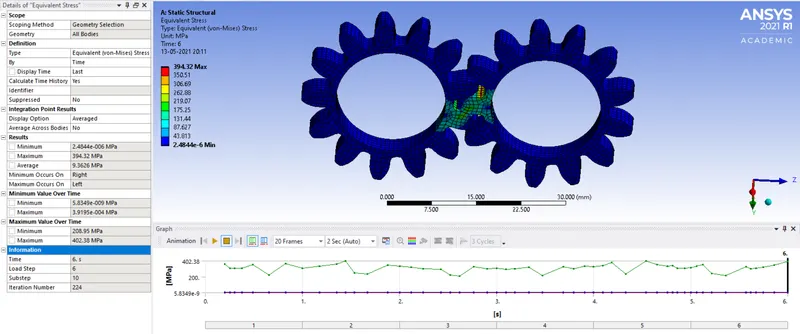
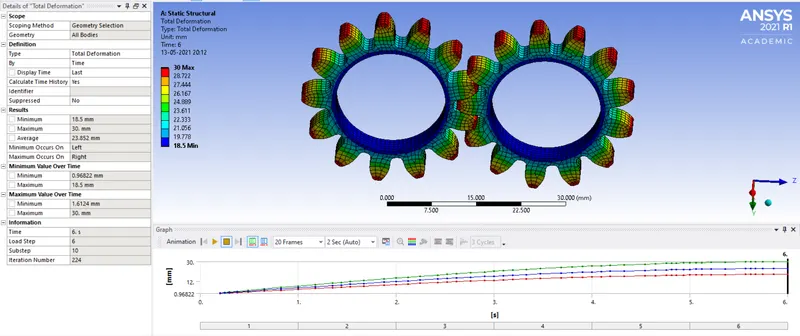
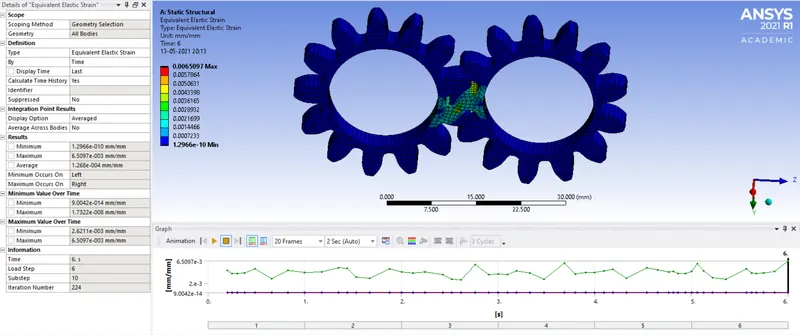
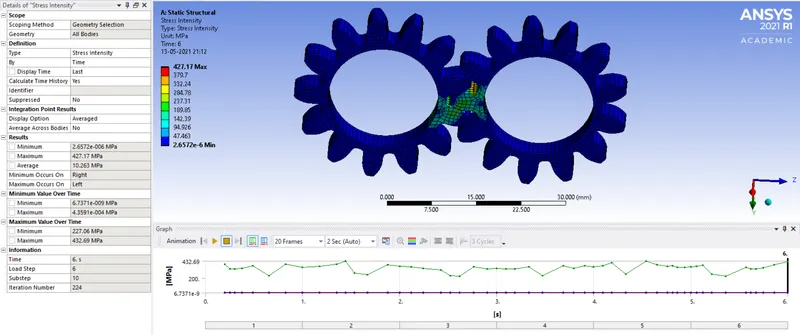
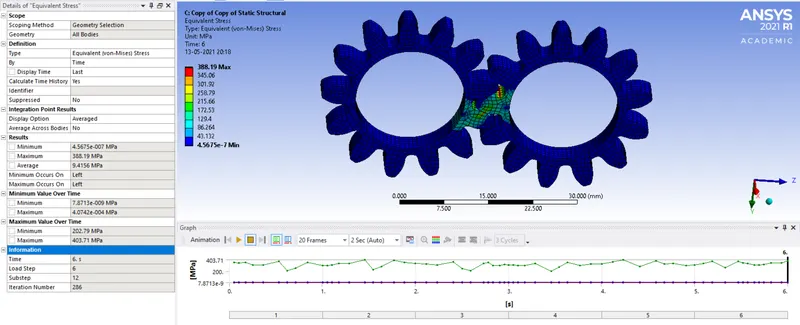
Spur gear is analyzed for three materials viz Cast Iron (Ductile), Cast Bronze, and Cast steel for equivalent stress. Total deformation, Equivalent elastic strain and stress intensity. The results for each case is as below-
(a) Case1- Cast Iron Ductile:
(1) Equivalent stress:
(2) Total Deformation:
(3) Equivalent Elastic strain:
(4) Stress Intensity:
(b) Case 2- Cast Bronze:
(1) Equivalent stress:
(2) Total Deformation:
(3)Equivalent Elastic strain:
(4) Stress Intensity:
(c) Case 2- Cast Steel:
(1) Equivalent stress:
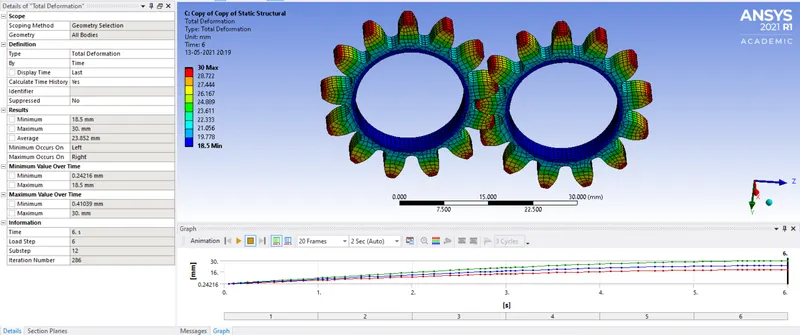
(2) Total Deformation:
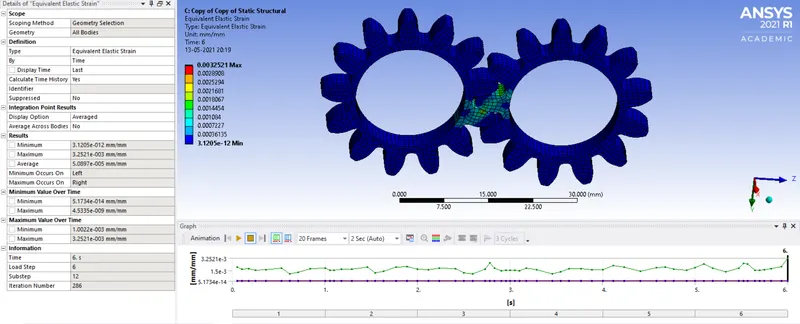
(3)Equivalent Elastic strain:
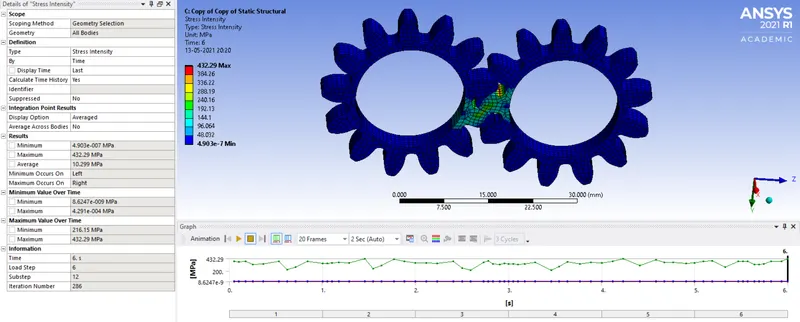
(4) Stress Intensity:
3. Post-processing Results and Summary-
| Materials | Equivalent Stress (MPa) | Total Deformation (mm) | Equivalent Elastic strain (mm/mm) | Stress Intensity (MPa) |
| Min Max | Min Max | Min Max | Min Max | |
| Cast Iron (Ductile) | 8.3825e-005 388.58 | 18.5 30 | 6.9077e-010 3.8923e-003 | 9.3985e-005 434.79 |
| Cast Bronze | 2.4844e-006 394.32 | 18.5 30 | 1.2966e-010 6.5097e-003 | 2.6572e-006 427.17 |
| Cast Steel | 4.5675e-007 388.19 | 18.5 30 | 3.1205e-012 3.2521e-003 | 4.903e-007 432.29 |
4. Results and Conclusion-
- Equivalent stress is lowest in Cast Bronze as compared to other material.
- The minimum and maximum value of deformation is same in all cases.
- Equivalent Elastic strain is highest in Cast Bronze as compared to other two materials.
- Stress intensity is maximum in Cast Iron.
After analyzing and comparing above results, we can see that Equivalent stress generated is less in Cast Bronze as compared to other materials but yield and ultimate strength is lowest for Cast Bronze. As a result Cast Bronze will fail first among all the cases. Now, we are left with two materials CI(Ductile) and Cast steel which have max Equivalent stresses as 388.58 and 388.19 respectively. The ultimate tensile strength values for CI is higher than that of Cast Steel. The stress intensity value for CI is the lowest. Also there is not a hugh difference in strain values of these two materials. Hence when crack will generate in CI(Ductile) it will slowly increase but till then the gears will keep on running as ultimate tensile strength value as compared to Cast Bronze.
Therefore, from above results we can say that, eventhough Equivalent stresses generated is higher in CI(Ductile), it is the most suited material for this application as its ultimate strength is higher which will result in its operation till rupture. Also, CI(Ductile), it is the most suited material for this application as its ultimate strength is higher which will result in its operation till rupture. Also, Cast iron (Ductile) is easy to machine as compared to other materials and has good wear resistance which makes it more practical for this application.