Week 1:- Introduction to BiW and Fixtures Challenge
BIW(BODY IN WHITE) AND ITS PARTS:
- The stage in which the automobile sheet metal car body is assembled by welding and other Joining Processes.
- As a result, one body will be present, and that body will be deep in primer solution with a grayish color and that's the reason behind the name kept of BIW(Body in White).
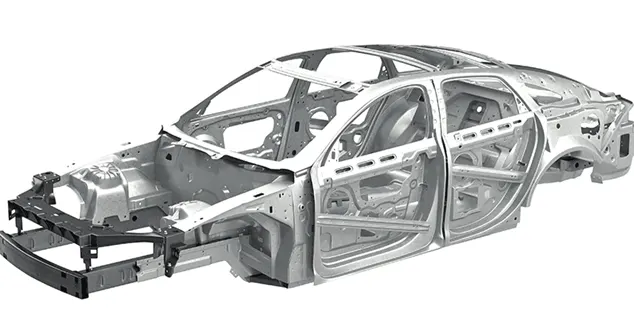
- BIW (Body in white) parts are mainly categorized as:
- Body Side
- Underbody
- Closure
- Roof
- Fender
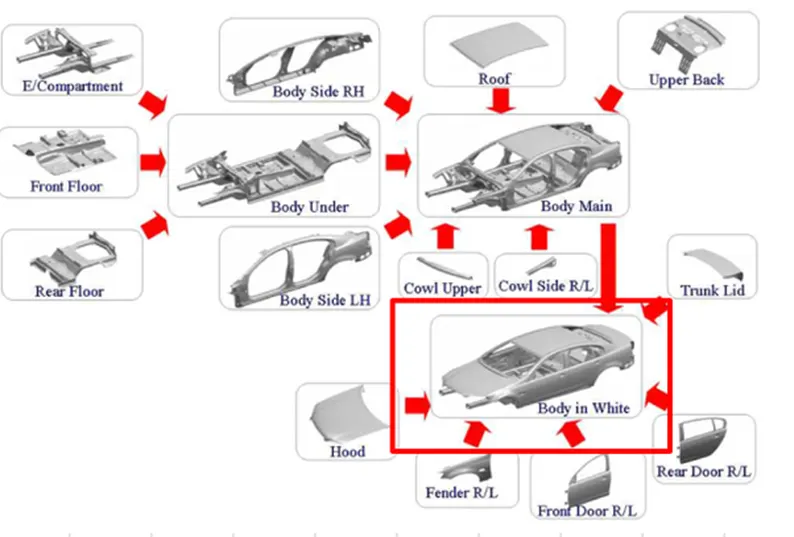
- Body side : Refers to the right and left sides of the vehicle sheet metal body. The outer panels provide the shape of the body, and the inner panels reinforce the body shell.
- Underbody : The main purpose of underbody protection is to effectively protect the key components of the transmission and steering.
- Closure : Car Closure are the most important parts of the vehicle that contribute to the safety of the vehicle.
- Roof: The car roof or car top is the part of the car that is located above the passenger seat and protects the passengers from the sun, wind, rain and other external factors.
- Fender : The main purpose is to prevent the rotating tires from throwing sand, mud, rocks, liquids and other road splashes into the air.
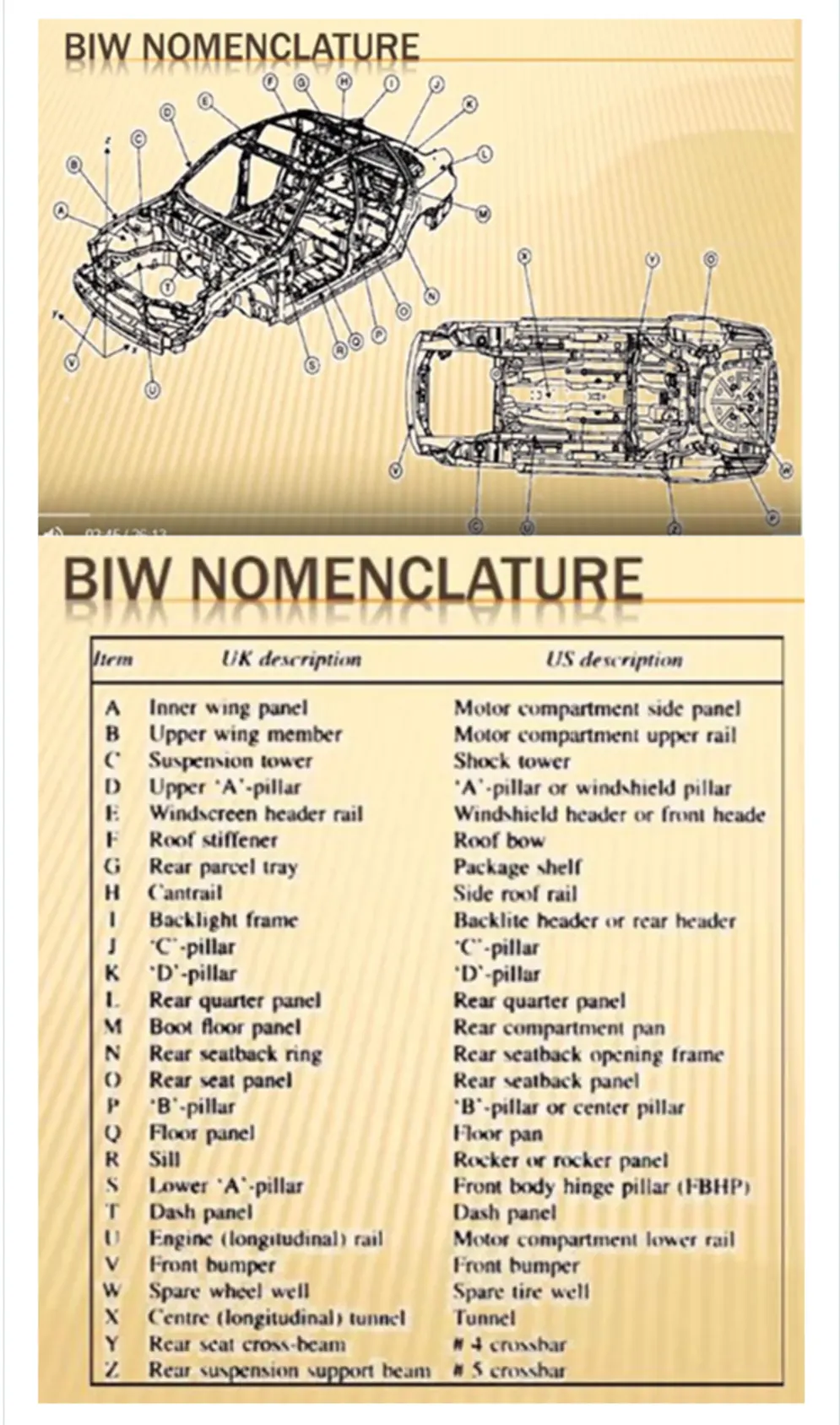
BIW Nomenclature:
BIW fixtures and its types:
- The fixture should firmly fix the workpiece without causing vibration, deformation, or stress to the workpiece, and should not interfere with or hinder the processing of the workpiece.
- To achieve this, the mounting elements should be carefully arranged, the clamps should be light but strong, the arrangement of the clamping elements should be far from the welding area, and the fixture should be stable and strong enough to withstand the welding stress. Welding equipment (tools) consists of several devices that hold automobile panels together.
- Welding equipment is generally designed to hold and support the various components being welded.
- Types of Fixture:
- Production Fixture : This type of Fixture is used in mass production. It is the equipment that assembles the body of a car and sends it to the end user. This type of fixture requires a high level of consistency during operation to maintain the shape of the part. These fixtures are used in mass production and must be simple, robust and durable. These devices must be serviced regularly to avoid errors and repairs.
2. Pre-production fixtures : These can be called prototype fixtures. Once the pre-production fixtures are working properly, changes are made to improve them and make them easier and more reliable. These devices are used in special cases or in the early or control stages of processing/production.
3. Test Fixtures: Used for testing and inspection. No processing is done in these fixtures. These fixtures consist of gauges that check dimensions, tolerances, and accuracy. In some inspection fixtures, the fixtures are fixed and the CMM device checks for geometric accuracy. All installations and other assemblies are checked using gauges.
Basic Design Principle of Fixture
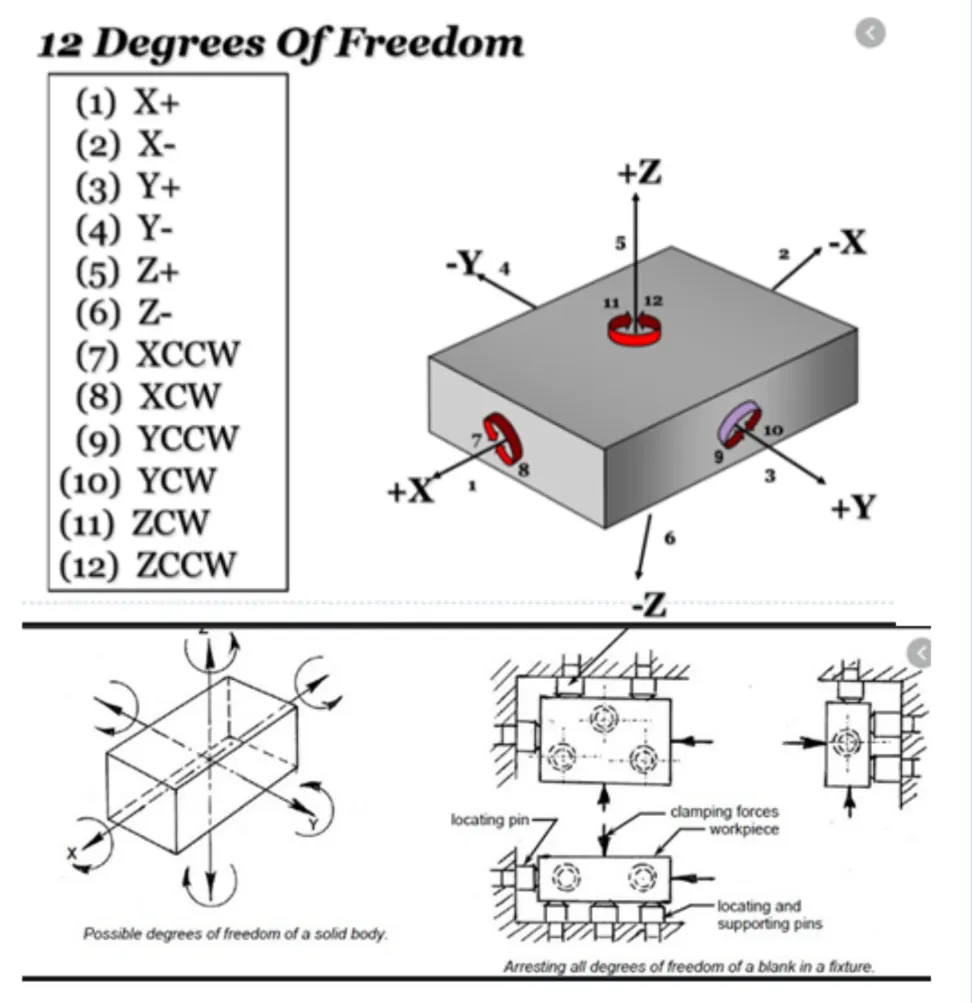
- According to the basic design principle of the device, each body has 12 degrees of freedom, 6 translational and 6 rotational degrees of freedom.
- According to the basic design principle of the device, each body has 12 degrees of freedom, 6 translational and 6 rotational degrees of freedom.
- All 12 degrees of freedom must be fixed. 6 degrees of freedom of translation: X, -X, Y, -Y, Z, -Z
- 6 degrees of freedom of rotation
- -Clockwise around the X-axis (CROT-X) -Counterclockwise around the X-axis (ACROT-X)
- -Clockwise around the Y-axis (CROT-Y) -Counterclockwise around the Y-axis (ACROT-Y)
- -Clockwise around the Z-axis (CROT-Z) -Counterclockwise around the Z-axis (ACROT-Z)
- Arrangement Principle: 3-2-1 Principle: The 3-2-1 method is a work fixation principle in which three pins are located in the first basic plane, namely XY, YZ, ZX.
- Then, two pins are located in the second plane which is perpendicular to the first plane, and finally, one pin in the plane is perpendicular to the first and second planes.
Types of BIW stations:
- BIW assembly line is a line that joins various types of panels to specific areas such as the underbody, hood, etc.
- These areas are further subdivided into stations where various processes such as welding, bonding, and inspection are performed in some parts of the specific area before assembly.
- For example, various reinforcements need to be added to the roof area before being connected to the side area.
- BIW assembly line can be classified as follows:
1. Tools 2. Grip 3. Rack 4. Miscellaneous
1. Tools : A tool is a device consisting of several parts to hold panels or assemblies of a car.
a. Geo-tool : A Geo-tool is a device that precisely determines the shape of a panel to be welded. In a Geo-tool, two panels are loaded and welded together. Geo-fix pin tolerance is approximately -0.15mm.
b. Re-spot tool : A reweld tool is a device that takes a panel that has already been welded and brings it in for additional welding. For example, a particular panel required 50 welds, but due to assembly line limitations, 30 could be done on the geo-fixer and the remaining 20 were done on the reweld tool. The pin tolerance of the reweld tool is -0.28mm.
c. Marriage or Hemming : A scrap or hemming tool is a tool that holds the inner and outer panels together. Hemming is not performed on all parts, but only on parts where two panels are to be joined without a separate joining process, as it can affect the aesthetics of the car. Hemming is on the hood, tailgate, etc.
d. Checking Station : This is used to inspect car parts or assemblies to ensure that all consistent and relative dimensions and positions are within tolerance. They can be classified as follows: A gage-type inspection fixture is where the workpiece is fixed and various gauges are introduced to ensure sizing and repeatability. A fixed test fixture uses clamps and pins to hold the workpiece, measures the coordinates of various points on the panel using a 3D measuring machine, compares them to the nominal value, and provides a report to correct the error. An automatic test device is a device that uses sensors, PLCs, switches, etc. to perform automatic adjustments and sound an alarm if there is an abnormality that can be corrected. It is not widely used because it is expensive.
2. Grippers Station : A gripper is a device that can hold an object for manipulation. A simpler way to describe a grip is to imagine a human hand. Like a hand, a gripper can hold, squeeze, manipulate, and release an object. A gripper is just one component of an automation system. A gripper can be attached to a robot or be part of a fixed automation system. BIW uses a variety of grippers, including:
A) Material Handling Grippers As the name suggests, these grippers are used for material. These grippers can pick up an assembly from one station and place it on another.
B) Process Grips In addition to moving materials, these grippers are used to perform specific processes, such as bonding, welding, and riveting. The gripper is positioned under the bonding stand for bonding processes, and under the pedestal welding stand for welding processes.
C) Combined Grips A combination gripper is a gripper that can perform multiple tasks. For example, it can move materials and also perform some specific processes, such as bonding and welding. Welding gun grip.
D) Double grip Use this grip when you need one left and one right side. You can move the material from one station to another.
3. Stand Station : The stand is used to hold the part when not in use or to mount some parts or housings. BIW uses different racks.
A) Pedestal Stands : The welding gun is mounted on a fixed stand fixed to the floor and the gripper can carry the panel under the stand to perform the task.
B) Gluing and sealing stand : The glue gun or caulking gun is attached to a welding post or standard post built into the floor.
C) Docking stand : The robot has some limitations due to its carrying capacity and the lack of robots. If you choose a robot for multitasking, it cannot perform two tasks at the same time. In this case, a docking rack is added to accommodate some equipment that is not used for the current task but will be needed for the next task. So the robot can release the gripper or gun and select the next equipment to perform the task from the dock.
D) Date Stamp Stand: All products produced have some data that needs to be stamped or embossed, such as serial number, batch number, future reference date or data collection date. The required data is stamped or extruded using the installed stamping device.
4. Miscellaneous Stand :
a) Curing : Since it takes some time to cool after bonding, the assembly is placed on some belts and the panels are moved to other stations while the bonding cools.
b) Buffer Stand : After some work, several assemblies can be placed on this bench, which is a buffer and can be easily moved to another station. It is also used to store inventory while the machine undergoes some maintenance.
c) Take out Trolleys : It is used to remove some panels between cycles to ensure that the process is running correctly.
d) Conveyor : A conveyor is a rotating path that transports parts to the next station after they are stored on it.
Basic Terminology Used in BIW Fixtures
- BIW uses the following terms:
A) NC/Mylar/Finger : Mylar is the component that holds the panel in place. It is placed both above and below. The top mylar is called the clamp mylar and the bottom mylar is the rest mylar. Each clamp mylar has a rest mylar. It prevents deformation of the part due to welding stress.
B) Principal Position Point (PLP): This is a point used to accurately position the part to maintain its shape. The panel has many imprecise holes due to the stamping operation. The PLP is defined on the drawing. The positional dimensions or relative dimensions are very accurate in stamping and fixtures.
C) Riser :There are different types of risers, including L-shaped risers and square tube risers. A riser is a manufactured part that gives height to an assembly.
D) Blade : A blade is a plate that is mounted on other parts such as cylinders, arms, etc. that are mounted on the blade. One.
E) Shims : Shims are small pieces with thicknesses of 0.1mm, 0.2mm, 0.5mm, etc. They provide tolerances to all parts of the fixture. These tolerances cause the Mylar to rise or fall at certain locations.If the Mylar falls from a certain height, it can leave marks or dents on the panel. If the Mylar is lifted, it will warp due to welding stresses. Use shims to adjust the Mylar to a specific position so that the panel does not deform or leave marks.
F) Rough Locator : The operator may place the part in the wrong orientation. The rough locator serves as a guide when placing the part in the fixture, and the part is loaded in the desired orientation. This is part of the protection against mishandling.
G) Hardware : Hardware - Hex bolts, Hex bolts, Hex nuts, Lock washers, Self-locking nuts.
H) CMM : CMM is an abbreviation for Coordinate Measure Machine. It is a device that measures the shape of a physical object by measuring individual points on the surface of the object using a probe. It generates a report by comparing the data with CAD file data.
I) Unit : Fastening is the assembly of various types of unit to form a part. There are various Unit such as pin unit, base unit, and clamp unit.
J) Number plate : The number plate is an aluminum embossing plate placed on each block to easily identify the part blocks.
K) Name plate : Information such as the manufacturer's name, device type, and device weight are printed on the plate and attached to the device.
L) Clamping Arm : The clamp arm is part of the clamp assembly that moves the clamp arm that holds the Mylar.
M) Pivot : This is the axis on which the clamping arm rotates.
N) Class A Surfaces/Cladding Surfaces : The exterior panels of the vehicle are visible to the customer, such as hoods, doors, tailgates, fenders, and roofs. The exterior panels aesthetically pleasing. They must be free of scratches and dents. When designing the fastening to the cover surface, the clamping material must be soft enough to not leave marks or dents on the cover. Nylon or polyurethane materials are typically used for clamping.
O) Reed Switches and Sensors : Electrical components used in automation. A reed switch is an electrical switch that operates under the influence of an applied magnetic field. Whether the panel is loaded or not is determined using a sensor.
References:
Skill lync