Week 1:- Introduction to BiW and Fixtures Challenge
1. BIW - BODY IN WHITE:
Body in white (BIW) is the stage in automobile manufacturing in which a car body's frame has been joined together, that is before painting and before the motor, chassis sub-assemblies, or trim (glass, door locks/handles, seats, upholstery, electronics, etc.) have been integrated into the structure. Assembly involves different techniques such as welding (spot, MIG/MAG), riveting, clinching, bonding, and laser brazing.
BIW PARTS
1. BODY SIDES:
The sideward parts of the BIW structure fall into this category
- Body side Outer: This refers to the sideward outer parts of the body/frame
- Body side inner: This refers to the sideward inner parts of the body/frame
2.UNDERBODY
The bottom/downward parts of the BIW structure falls into this category
- Front end under frame: This refers to the frame under the front end i.e. under the engine bonnet
- Main floor: This refers to the frame under the middle i.e. under the seats
- Rear end under frame: This refers to the frame under the rear end i.e. under the boot cabin
3.CLOSURES
The closing parts of the BIW structures such as doors/lids parts fall into this category
- Front door: This refers to the parts of front door panels of the automobile
- Rear door: This refers to the parts of rear door panels of the automobile
- Hood: This refers to the closure door the hood of the automobile
- Deck lid: This refers to the closure lid of the deck of the automobile
4.ROOF
The top covering parts of the BIW structure falls into this category
- Roof inner: This refers to the inner side of the roof surface
- Roof outer: This refers to the outer side of the roof surface
5.FENDER: The front and rear fender parts of the BIW structures fall into this category.
.
.
.
2. BIW NOMENCLATURE:
The devising or choosing of names for things, especially in a science or other discipline. In formal, the term or terms are applied to someone or something.
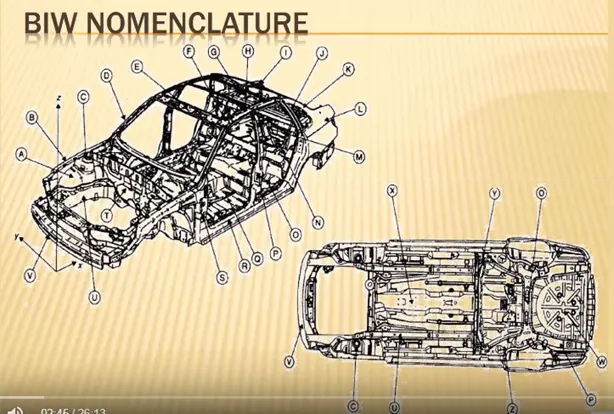
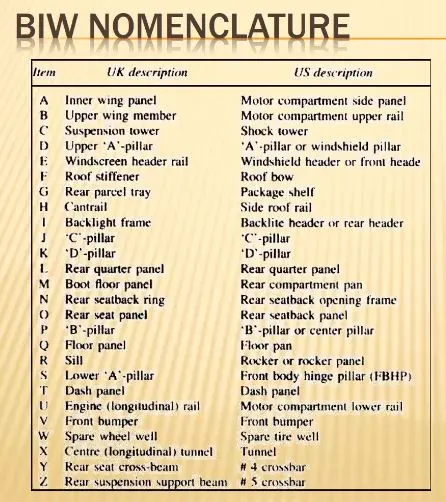
An overview of parts used in BIW at two different regions shows the emphasis on tagging names for the parts which are useful for collaborating vehicles for different geographical locations
Figure 1. Picture of BIW
.
.
.
3. FIXTURES :
Fixtures are used for securing and locating various BIW Parts during different manufacturing processes. Each part requires special types of fixtures and respective operations and holds the parts in 3-2-1 principle.
Securing parts is absolutely necessary to avoid distortion in the workpiece and clamping has to firm with the correct location of parts. This enables a stable working environment and helps to withstand various stresses caused by different operations.
Fixtures are also useful during mass production which helps to achieve repeatability and automatic transmission between different stations by reducing variations in the parts produced during different operations.
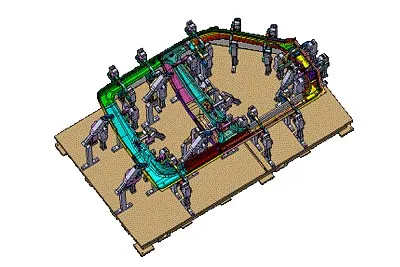
The Types of BIW Fixtures are
- Production Fixtures
- Pre-Production Operation Fixtures
- Checking Fixtures
a. PRODUCTION FIXTURES
- They are used for mass production and are usually implemented after testing for dimensions, tolerances to reduce variations and are present on the shop floor till the final stage of production processes.
- The Productions fixtures are designed for feasible access to operators with affordable working space and easy to maintain.
- Automation levels are high in these types of fixtures as functioning of production fixtures are always tested before implementation.
b.PREPRODUCTION OPERATION FIXTURES
- These are an initial type of fixtures used for Pilot production to study and validate the process.
- Manual involvement is high as they are used for prototyping
c.CHECKING FIXTURES
- Checking fixtures are used for geometric inspection of car panels from the assembly.
- It is used to inspect the BIW panels post-production to measure gaps and flushes, gauging accurate dimensions, etc.
.
.
.
4.TYPES OF BIW STATIONS
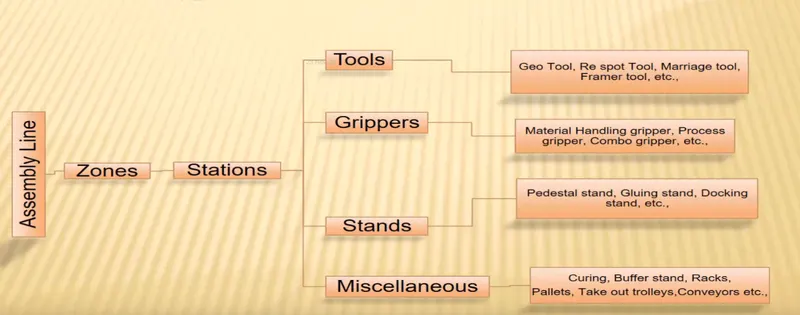
BIW Assembly line is where different types of panels are joined together in each specified zones. These individual zones are classified into stations such as tools, grippers, Stands and miscellaneous
1.TOOL STATION
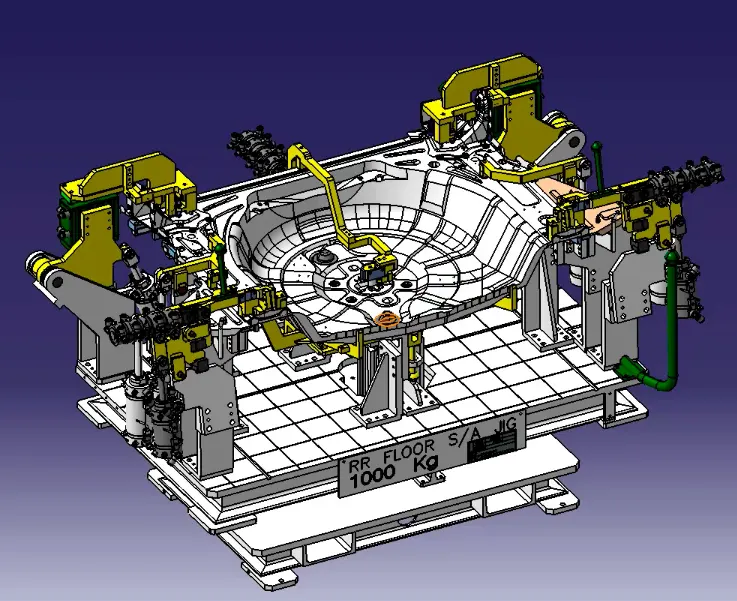
Tool Station is where different parts are held together for manufactuing operation. Some of Fixtures used in tool station are
GEO TOOL:
- In Geo tool fixtures the geometry of the panel to be operated or held together very precisely with closer tolerances.
- For instance, a hole with dimension of 20 mm will have a pin designed with tolerance less than 0.15 mm.
- Thus Geo Fixtures help in achieving the geometry of the panels hence tighter tolerance are required to hold the panels firmly.
2.RESPOT TOOL:
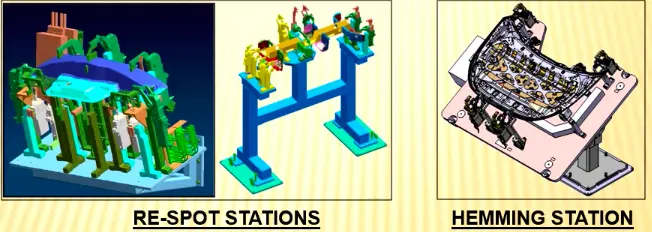
- In order to tackle the lead time and reduce the waiting time between two different station staions , not all welding spots are acchieved in geo fixture. Hence remaining tacks of prewelded panel are completed in Respot Fixtures.
- The tolerance standard for Respot Fixture is 0.28mm in general. Since Respot Fixtures are used for already welded panels there is a slight relacation in tolerance compared to geo fixtures.
MARRIAGE TOOL
- Marriage tool also called as hemming tool fixture is used to join inner and outer panels together.
- Hemming Fixtures are used to assemble specific components especially closure panels like Hood, Tail gate which has outer panel enveloped around the inner panel.
CHECKING STATION
- Checking station is used to gauge the processed automotive panels to ensure the coordinates, relative dimensions and position of parts as per tolerances
- The types of fixtures used in checking stations are gauge type, fixed type and automated checking fixtures.
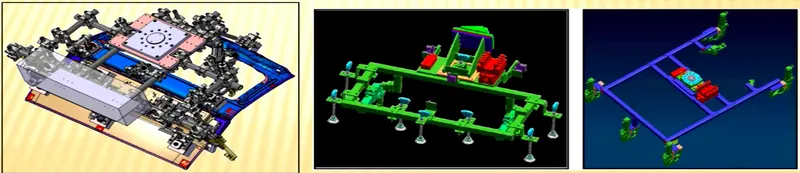
GRIPPER STATION:
Gripper is type of fixture with lesser parts and weight compated Tool Fixtures and is used to hold the car panel.
.
.
.
6.Basic terminologies used in the BIW fixture:
NC/Mylars/Fingers: These are the components that hold the parts from both top and bottom directions. The top side mylars are called clamping mylars whereas the bottom side is called as resting mylars
- Principle Locating Point: These points help to accurately locate the part to maintain the geometry of the assembly
- Risers: These provide support and height to the assembly base
- Blade: These are plates mounted on the riser
- Shims: These are very small parts with a lesser thickness which helps to balance the dimensional tolerances
- Rough locators: This is a kind of fool proofing that allows the operator to load the component only in the correct location and orientation
- Hardware: These are bolts, nuts, and self-locking nuts, etc.
- CMM: Coordinate measuring machine is a machine that measures the geometry of the component using a probe by physically sensing at discrete points
- Unit: The fixture assembly consists of different units such as base unit, gripping unit etc.
- Number plate: It is a plate which have numbers embossed on it. Which helps in recognizing the part later
- Name plate: It is a plate which consists of all the details of the fixture embossed on it.
- Clamp arm: It is an arm of the clamp which rotates along the pivoted axis
- Pivot: It is the axis or bearing about which the clamp arm rotates
- Class A surface/skin surface: These are the outer aesthetic components which are visible as the final assembly. While designing fixtures to such a parts the fixtures should be of soft materials and should hold firmly
- Reed switches: These are the electronic switches which are operated by the sensors or sometimes manually
- Sensors: These are the electronic devices which senses the components on the fixture and helps to operate or send input commands to the other mechanical or electronic components