Week 1:- Introduction to BiW and Fixtures Challenge
1.) What is BIW & define its parts?
BIW is acronym of “body in white”. It is stage in automotive design or automobile manufacturing in which the car body sheet metal components are been assembled by welding and by other joining process.
OR
BIW refers to the welded sheet metal components which form the vehicle structure to which the other components will be married e.g. Engine, chassis etc.
In BIW stage car body sheet metal includes doors, hoods and deck lids gets assembled or designed but before the components like chassis, motor and trim (windshield, seat, door locks/handle, upholstery, electronics etc.)
After welding and before painting body submerged into liquid called primer from there it is derived BIW (Body in White).
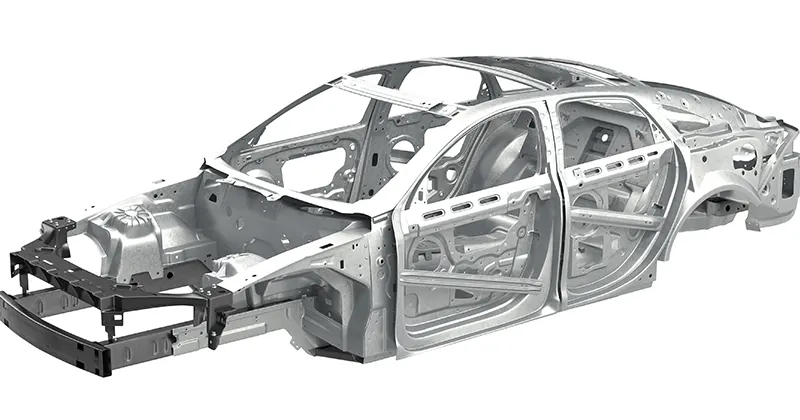
BODY IN WHITE
BIW parts are mainly categorized as below
- Body Sides- The right and left side of an automobile body. Body side outer, Body side inner.
- Under Body- It is the combination of Front end under frame (engine compartment), Main floor, Rear end under frame (rear compartment).
- Closures- The parts which are used as closures like Front door, Rear door, Hood, Deck lid


- Roof- The top most part of the body .Roof inner, Roof outer
- Fender- It is a part of body in automobile that frames wheel well. Its primary function is to prevent sand, mud, liquid etc. to surrounding by rotating tires.
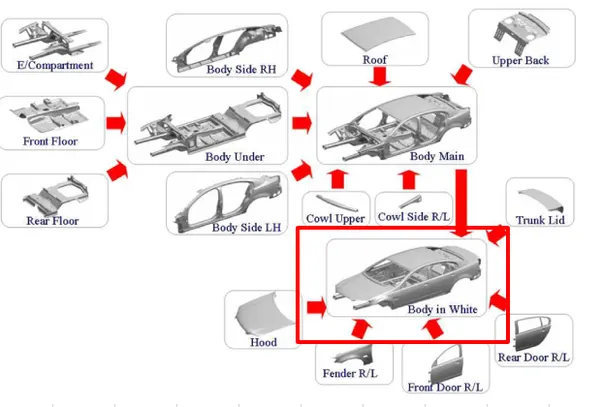
PARTS OF BIW
2.) What do you understand by BIW nomenclature?
Different names are given to different parts in BIW structure in manufacturing/designing Firms. Following are the some examples
|
UK DESCRIPTION |
US DESCRIPTION |
|
Inner wing panel |
Motor compartment side panel |
|
Upper wing member |
Motor compartment upper rail |
|
Suspension tower |
Shock tower |
|
Upper ‘A’ Pillar |
A pillar or windshield pillar |
|
Windscreen header rail |
Windshield header or front header |
|
Roof stiffener |
Roof bow |
|
Rear parcel tray |
Package shelf |
|
Contrail |
Side roof rail |
|
Backlight frame |
Backlight header or roof header |
|
C- pillar |
C- pillar |
|
D- pillar |
D- pillar |
|
Rear quarter panel |
Rear quarter panel |
|
Boot floor panel |
Rear compartment pan |
|
Rear seat back ring |
Rear seatback opening frame |
|
Rear seat panel |
Rear seatback panel |
|
Sill |
Rocker or rocker panel |
|
Lower ‘A’ pillar |
Front body hinge pillar |
|
Dash panel |
Dash panel |
|
Engine (longitudinal rail) |
Motor compartment lower rail |
|
Front bumper |
Front bumper |
|
Spare wheel well |
Spare tire well |
|
Centre (longitudinal tunnel) |
Tunnel |
|
Rear seat cross beam |
# 4 crossbar |
|
Rear suspension support beam |
#5 crossbar |
|
B-pillar |
B-pillar or rocker panel |
|
Floor panel |
Floor pan |
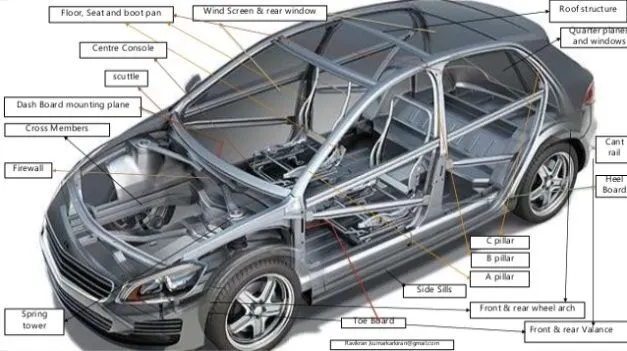
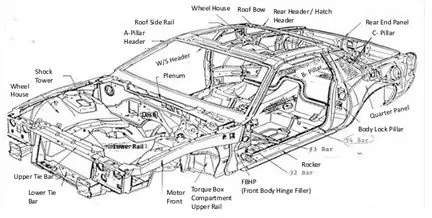
BIW NOMENCLATURE
3.) What is fixture & its types?
A fixture is a device which holds the work-piece to be processed by using 3-2-1 principle.
OR
A device that holds the work-piece in specific position and orientation ensuring all parts are produced will maintain conformity and interchangeability.
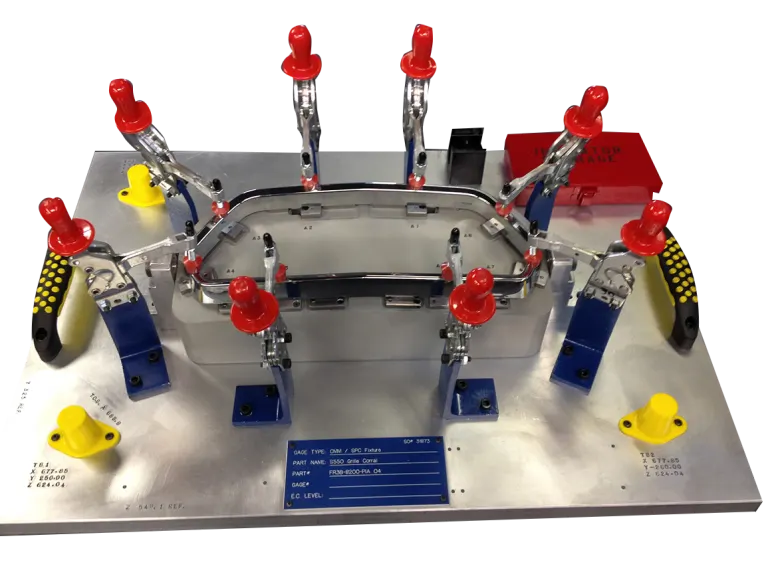
FIXTURE
Fixtures are classified as follows
- Production fixture- It is used for Mass production purpose. As it using for mass production it should be simple, rigid, hard and should have design in such a way that work-piece can easily assemble and dissemble fast plus easily maintainable.
- Pre-production operation fixture (PPO) - It is generally designed as prototype for initial batch production to study feasibility and to make any improvement in production fixture. This is the base or benchmark for production fixture.
- Checking fixture- As name suggests it is used for checking the dimensions/ tolerances of assembly. This is quite similar geo-fixture but here no operation happens like welding, guiling etc.
4.) What is the basic principle of fixture design?
The basic principle in designing the fixture is restrict all the 12 (twelve) degree of freedom in desired location/orientation. 6 (six) translational degree of freedom and 6 (six) rotational degree freedom so that work piece should not move in any direction during processing.
|
SIX TRANSLATIONAL DEGREES OF FREEDOM |
SIX ROTATIONAL DEGREES OF FREEDOM |
|
+X |
CROT-X |
|
-X |
ACROT-X |
|
+Y |
CROT-Y |
|
-Y |
ACROT-Y |
|
+Z |
CROT-Z |
|
-Z |
ACROT-Z |
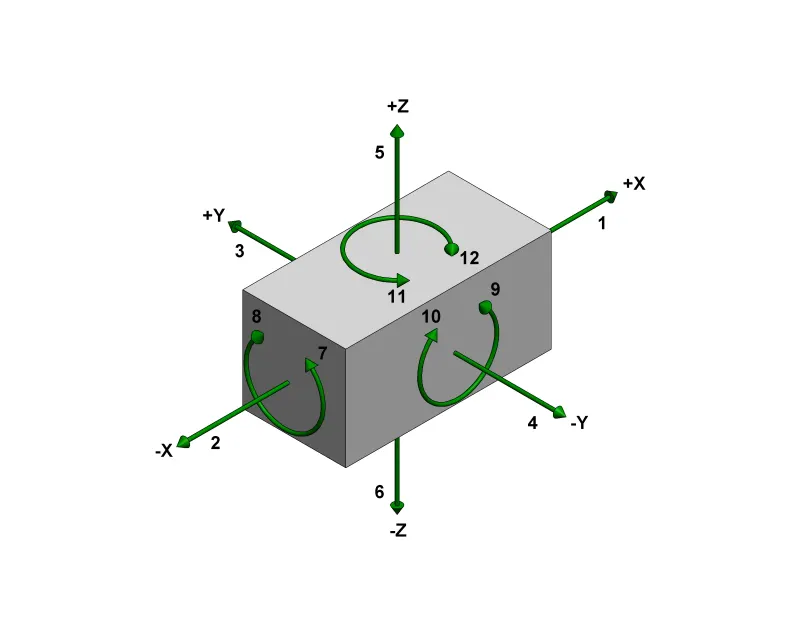
DEGREES OF FREEDOM
5.) Elaborate types of BIW station?
In assembly line where the different types of panels are joined together in each specified zones. Each panel categories will have individual zones as under body zone, door zone, hood zone etc. Each zone has different stations.
Mainly stations are divided as follows
- TOOLS STATION- Tool is a fixture which consists of number of units together to hold a car part in general.
TYPES OF TOOLS
- GEO TOOL- A geo tool is a fixture in which the geometry of the panel which is welded together is defined accurately. The pin tolerance for the geo pin will be of closer tolerance i.e. -0.15 in general.
Ex: consider panel hole size 20mm, the pin diameter should be 19.85mm.
2. RE-SPOT TOOL- A re-spot tool is a fixture in which the remaining weld spots which are not achieved in geo-tool are welded for the pre-welded panel from the geo tool. The pin tolerance for re-spot pin will be of tolerance with -0.28 in general.
Ex: consider panel hole size 20mm, the pin diameter should be 19.72mm.
3. MARRIAGE OR HEMMING TOOL- A marriage or a hemming tool is a fixture in which the inner panel assembly and outer assembly are joined together.
4.CHECKING STATION TOOL- A checking station tool is a fixture which is used to check the automotive parts or assemblies, ensuring all the coordinates, relative dimensions and positions as per the tolerances.
- GRIPPER STATION- A gripper is a device or a fixture which holds the car panel and is fixed to the manipulating end of a robot or an end effector, also known as EOAT- End of arm tooling.
TYPES OF GRIPPERS
MATERIAL HANDLING GRIPPER- Material handling grippers are designed for handling the car panel from one station to another station.
2. PROCESS GRIPPER- Process gripper are designed for handling the car panel from one station to other station and in addition to that it under goes process like pedestal welding, pedestal riveting, gluing sealing etc.
3. COMBO GRIPPER- Combo gripper are designed for handling the car panel from one station to another station also with combination of weld gun at another side of the gripper for welding.
GRIPPER + WELD GUN
4. DUAL GRIPPER- Dual grippers are designed for handling the car panel from one station to other station with two sided gripper.
GRIPPER + GRIPPER
- STAND STATION- These stations are used for hold and mount the work-piece.
1. GLUING/SEALER STAND- Gluing gun or sealer gun is fixed to a welded or a standard stand which is grounded to the floor permanently.
2. DOCKING STAND- When robots are selected for manufacturing like material handling and welding, which cannot carry both due to some limitations ( payload capacity of robot or space constraint) the robot will drop the and pick the gripper or gun after completing the respective operation with the help of docking stand.
3. DATE STAMP STAND- The panel gets the date embossed on to it with the date stamping device mounted on this date stamp stand.
4. PEDESTAL GUN STAND- Weld gun is mounted to a fixed stand which is grounded to the floor permanently, where the process gripper carries the car panel to weld the spot with fixed weld gun.
- MISCELLANEOUS STATIONS- Curing, Buffer stand, Racks, Pallets, Takeout trolleys, Conveyors etc.
Conveyors maybe of belt/chain type to transport from one station to another station.
Takeout Trolley is used to take the car panel out of the robotic working cell between the cycles for inspection purpose.
Curing stations helps in curing time of assembly operation like gluing and cooling down the component that came out after processing.
Buffer station is for storing the components so that no overflow or lacks of flow to be happen during assembly.
6.) What are the basic terminologies used in the BIW fixture?
The basic terminologies uses in BIW fixtures are as follows
|
TERMINOLOGY |
EXPLANATION |
|
Mylar/ Fingers |
The part holding the panel from top and bottom. Upper part is called clamping Mylar and lower part is called resting Mylar. |
|
PLP- principle location points |
These points come in use to locate the pins in panel to maintain geometry. |
|
Blade |
Blades are plate like structure which are mounted to the riser. |
|
Riser |
Riser is a structure which gives certain height to work piece. |
|
Shims |
To rectify/balance the tolerances in fixture we use thin plate like structure called shims. |
|
Rough locators |
It gives the rough idea or guide to keep the work-piece in between certain limits. |
|
Hardware |
Bolts, faster and nuts called hardware. |
|
CMM |
Coordinate measuring machine is used for measuring the dimensions as per given data. |
|
Units |
A fixture is assembly of different parts. Each part is called as unit. |
|
Number plate |
To identify the unit easily in assembly of fixture number is embossed on that. |
|
Co-ordinate plate |
Coordinate plates are coordinate measuring tool where the CMM measures the coordinate from and it takes that as origin and check all the other holes accordingly. |
|
Name plate |
A plate where it is mentioned the date, type, panel number, company name etc. is mentioned. |
|
Clamp arm |
The rotating/ movable structure in clamp. |
|
Class A surface/ skin surface |
The surface which is visible to end customer ( without dent/mark) |
|
Reed switches |
These are magnetic reeds that are mounted on cylinders and electronic switches which are operated by sensors. |
|
Sensors |
These are used for knowing the positioning/accuracy of unit in their respective place by giving Input to them. |
|
Pivot |
The point with respect to clamp arm moves. |
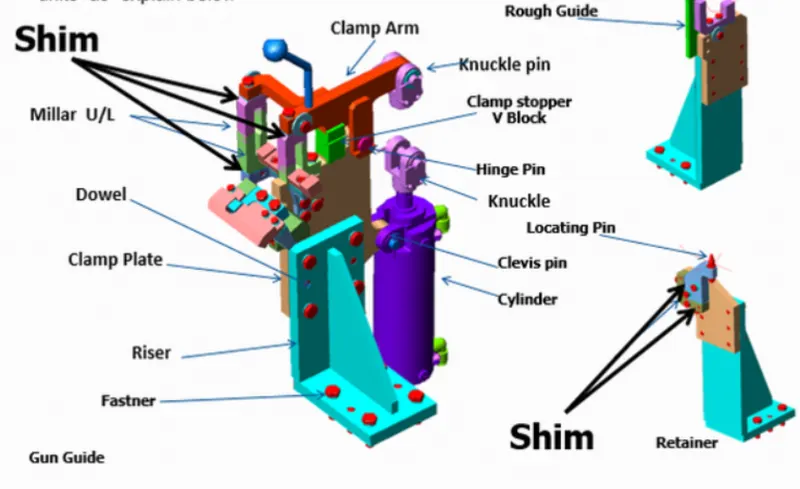
TERMS IN BIW FIXTURE