Week 1:- Introduction to BiW and Fixtures Challenge
Week 1:- Introduction to BiW and Fixtures Challenge
Body in white (B.I.W.)
Body in white (B.I.W.) refers to the welded sheet metal components which form the Vehicles structure to which the other components will be married, i.e., engine, chassis, exterior and interior trims.
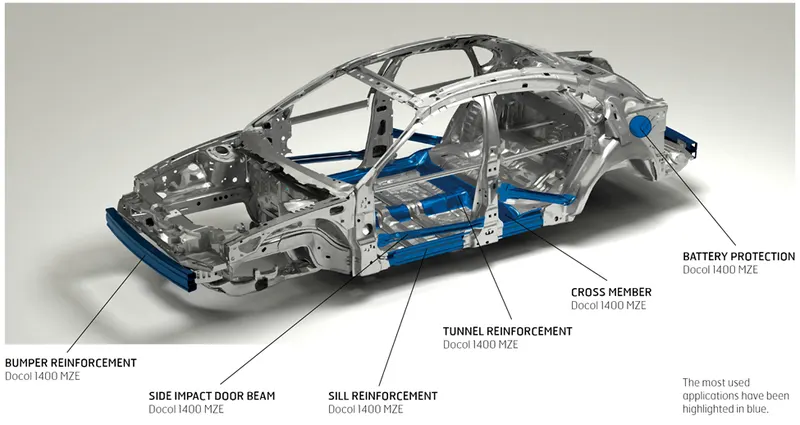
In the BIW stage, the car's body is typically made up of various metal components, such as panels, beams, pillars, and supports. These parts come together to form the structural framework of the vehicle. The BIW stage is crucial as it provides the foundation for the overall vehicle assembly process.
BIW parts are mainly categorized as below:
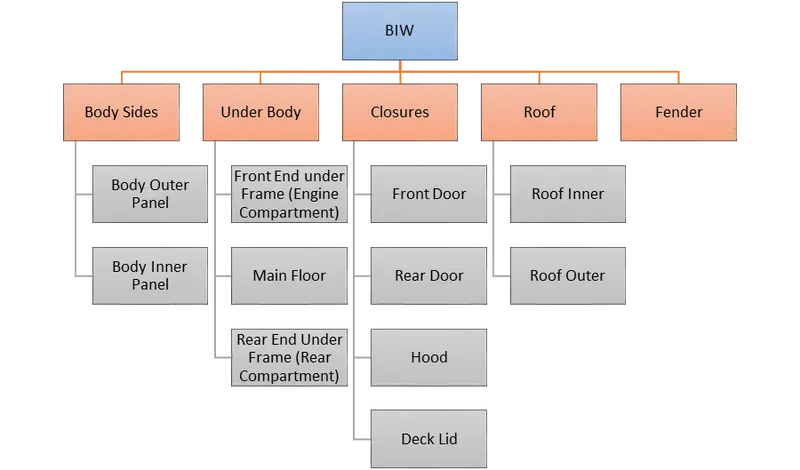
BIW Nomenclature
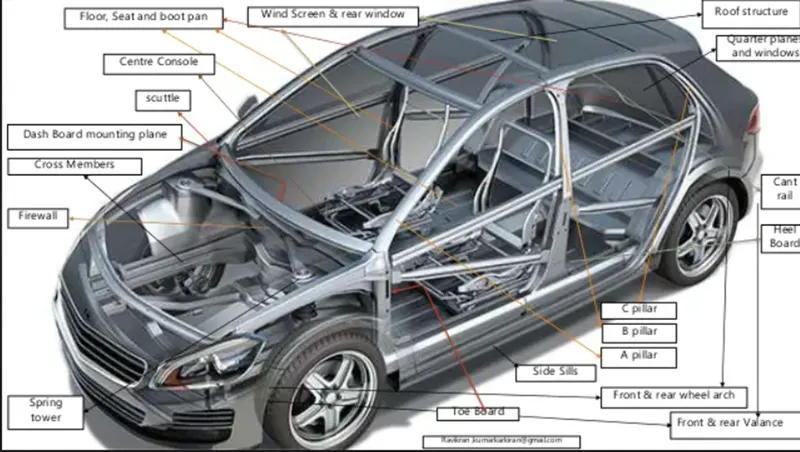
|
Item No. |
Description |
|
A |
Inner Wing Panel |
|
B |
Upper Wing Member |
|
C |
Suspension Tower |
|
D |
Upper A Pillar |
|
E |
Windscreen Header Rail |
|
F |
Roof Stiffener |
|
G |
Rear Parcel Tray |
|
H |
Can trail |
|
I |
Backlight Frame |
|
J |
C Pillar |
|
K |
D Pillar |
|
L |
Rear Quarter Panel |
|
M |
Boot Floor Panel |
|
N |
Rear Seating Ring |
|
O |
Rear Seat Panel |
|
P |
B – Pillar |
|
Q |
Floor Panel |
|
R |
Sill |
|
S |
Lower A pillar |
|
T |
Dash Panel |
|
U |
Engine (Longitudinal) Rail |
|
V |
Front Bumper |
|
W |
Spare Wheel Well |
|
X |
Centre (Longitudinal) Rail |
|
Y |
Rear seat cross Beam |
|
Z |
Rear Suspension support beam |
What is Fixture and its type?
Fixture is a device which holds the work piece to be processed welded, glued, fastening etc, by 3-2-1 principle.
Factors to be considered for fixture
Work piece Design: The design, shape, size, and material of the work piece are crucial factors to consider when designing a fixture. The fixture should be compatible with the work piece geometry and provide adequate support and clamping points.
Stability and Rigidity: The fixture should provide stability and rigidity to the work piece during machining or assembly operations. It should be able to withstand the forces, vibrations, and pressures generated during the process without excessive deflection or movement.
Alignment and Positioning: The fixture should accurately position and align the work piece in the desired orientation and location. It should ensure precise positioning of critical features and allow for consistent and repeatable operations.
Accessibility: The fixture should provide easy access to the work piece for machining, inspection, or assembly. It should allow for efficient loading and unloading of the work piece and provide clear visibility for operators or inspection equipment.
Clamping Mechanism: The choice of clamping mechanism should be appropriate for the work piece material, shape, and size. The clamps or holding devices should securely hold the work piece without causing damage or distortion.
Tooling and Tool Access: The fixture should accommodate the required cutting tools, probes, or other equipment necessary for the operation. It should allow for proper tool access and clearance to perform the required machining or inspection tasks.
Ergonomics and Safety: Consideration should be given to the ergonomic aspects of the fixture design, ensuring operator safety and comfort. The fixture should minimize any potential hazards or risks associated with the manufacturing process.
Cost and Efficiency: The fixture design should strike a balance between cost-effectiveness and efficiency. It should be designed to optimize production time, minimize scrap or rework, and maximize the utilization of resources.
Maintenance and Durability: The fixture should be designed for easy maintenance, cleaning, and repair. It should be durable and able to withstand the demands of the manufacturing environment, including wear, corrosion, and repetitive use.
Future Flexibility: Whenever possible, the fixture design should allow for adaptability or flexibility to accommodate future changes in work piece design, process requirements, or production volume.
Types of Fixtures:
- Production Fixtures: A production fixture is a specialized type of fixture used in manufacturing processes to aid in the efficient and repeatable production of a specific part or product. It is designed to securely hold and position the work piece during various stages of production, such as machining, assembly, testing, or inspection. Production fixtures play a crucial role in improving productivity, reducing errors, and ensuring consistency and quality in mass production.
- Pre-Production operation fixtures: Pre-production operation fixtures are a type of fixture used in manufacturing processes before the actual production phase begins. These fixtures play a crucial role in setting up and preparing the production line, ensuring efficient and accurate manufacturing operations.
- Checking Fixtures: A checking fixture, also known as a inspection or gauging fixture, is a specialized tool or device used in manufacturing to verify the dimensional accuracy and quality of a workpiece or part. It is typically used in quality control processes to ensure that the produced parts meet the required specifications.
Basic Principle of Fixture Design
The basic principle of fixture design revolves around providing secure and accurate positioning and holding of a work piece during manufacturing processes.
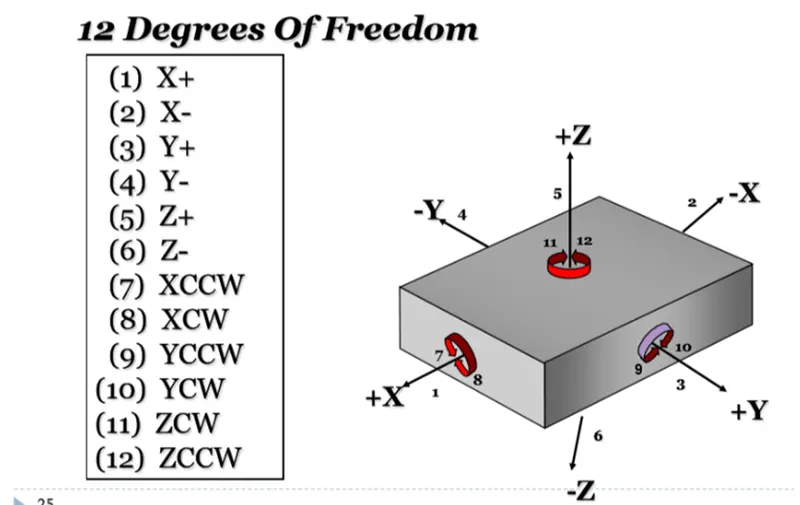
Fixing the 12 degrees of freedom in fixture design provides the foundation for achieving precision, accuracy, repeatability, and safety in manufacturing operations. It ensures that the work piece is held securely in the desired position and orientation, enabling efficient and controlled manufacturing processes.
Types of BIW Stations
BIW (Body in White) stations are specific workstations in automotive manufacturing that are dedicated to the assembly and welding of the vehicle's body structure. The types of BIW stations can vary based on the specific processes and operations involved in the assembly line. Here are some common types of BIW stations:
- Sub-Assembly Stations
- Welding Stations
- Body Framing Stations
- Closure and Joining Stations
- Underbody Stations
- Sealing and Adhesive Stations
- Inspection Stations
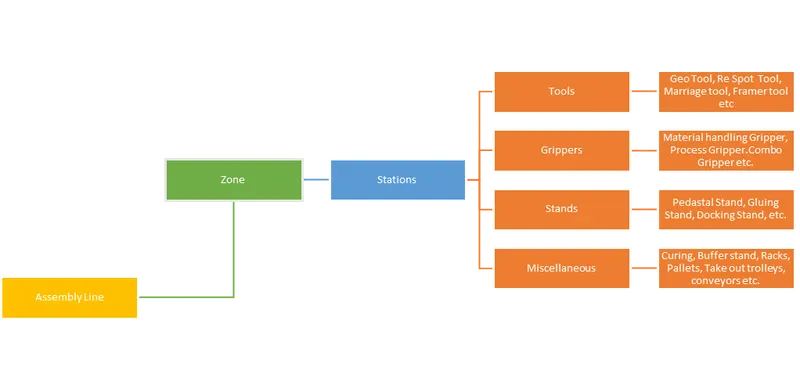
Types of Tools
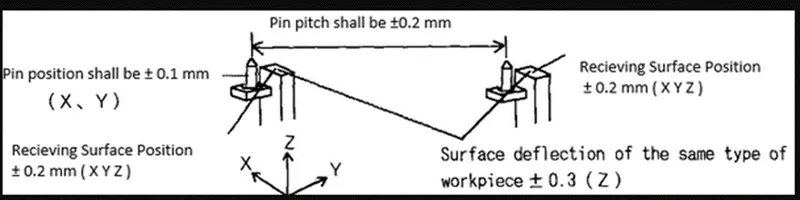
Geo Tool
A geo tool is fixture in which the geometry of the panels which are welded together is defined accurately. The pin tolerance for the geo pin will be of closure tolerance i.e., 0.15 in general.
For example:
Consider the panel hole size 20mm, the pin diameter should be 19.85mm.
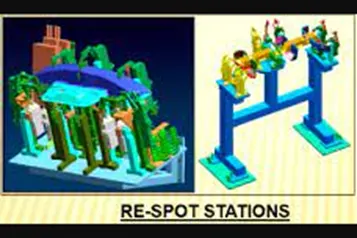
Re-Spot Tool
A re-spot tool is a fixture in which the remaining weld spot which are not achieved in geo tool are welded for the pre-welded panel from the geo tool.
The pin tolerance for the re-spot pin will be of tolerance of -0.28 in general.
For example:
Consider panel hole size is 20mm, the pin diameter should be 19.72mm.
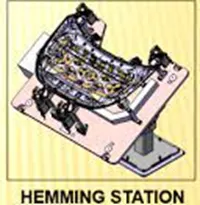
Marriage or Hemming Tool
A marriage or a hemming tool is a fixture in which the inner panel assembly and outer panel assembly are joined together.
These are done by welding or by hemming in case of closure panels.
Checking Stations
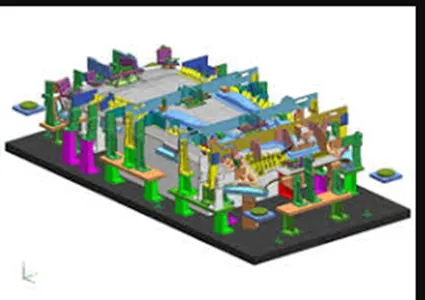
A checking station tool is a fixture which is used to check the automotive parts or assemblies, ensuring all the coordinates, relative dimensions and positions as per the tolerances. A checking station can be a gauge type, fixed type and automated checking fixtures.
A checking gauge is a tool where work piece is hold and various measuring gauges are introduced to ensure the dimensions and repeatability.
A fixes type checking fixture is used where the work piece is fixed with clamps and pins and a CMM machine is used which measure the coordinates of different points of the panel or assembly, compares it with the nominal values and gives a report
Grippers
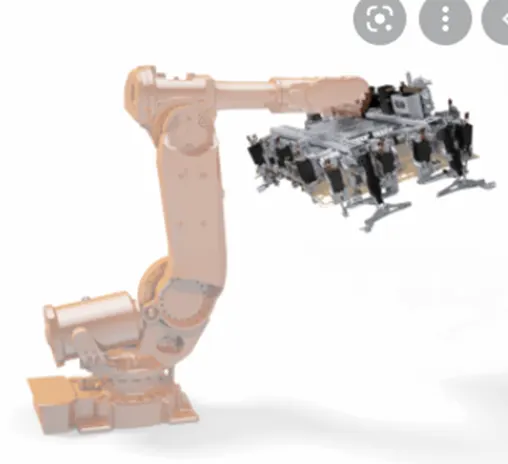
A gripper is a device or a fixture which holds the car panel, and is fixed to the manipulating end of a robot or an end effector. Also known as EOAT – End of Arm Tooling.
Types of Grippers
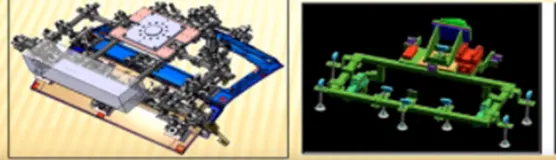
Material Handling Gripper (MH)
Material Handling Gripper are designed for handling the car panel from one tool (station) to other tool (station).
Process Gripper
Process Gripper are designed for handling the car panel from one tool (station) to other tool (station), and in addition to that it under goes process like pedestal welding, pedestal riveting, Gluing, sealing, etc.
Combo Gripper
Combo grippers are designed for handling the car panel from one tool (station) to other tool (station), also with the combination of weld gun at another side of the gripper for welding.
For example: Gripper + Weld Gun.
Dual Gripper
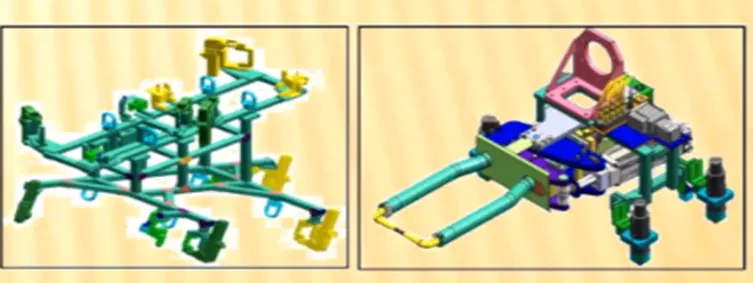
Dual gripper are designed for handling the car panel from one tool (station) to other tool (station), with two-sided gripper.
For example: Gripper + Gripper.
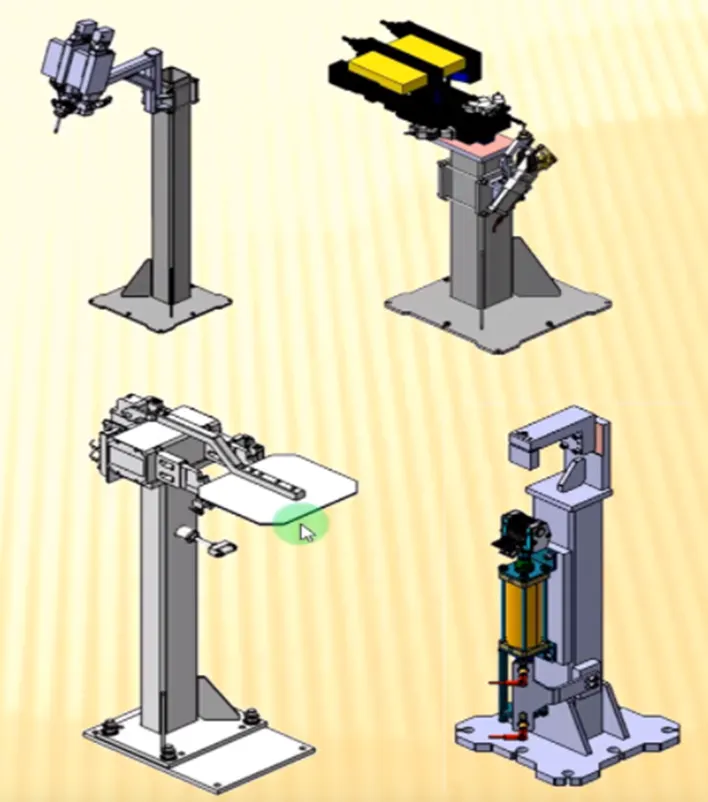
Stands and Types of Stands:
Gluing and Sealer Stand
Gluing gun or sealer gun is fixed to a welded or a standard stand which is grouted to the floor permanently.
Docking Stand
When robots are selected for multitasking like material handling and welding, which cannot carry both due to some limitations (pay load capacity of the robot or space constraint) the robot will drop and pick the gripper or gun after completing the respective operation with the help of Docking stands.
Date Stamp Stand
The panel will get the date embossed on to it, with the date stamping device mounted on this date stamp stand.
Pedestal Gun Stand
Weld gun is mounted to a fixed stand which is grouted to the floor permanently, where the process gripper carries the car panel to weld the spot with this fixed weld gun.
Miscellaneous:
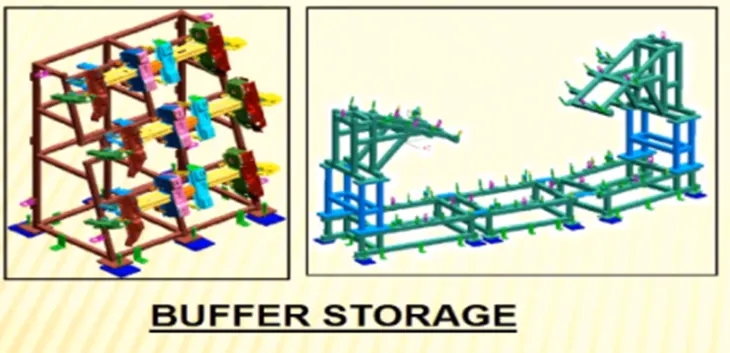
Buffer Storage
After some operation, we can put the no. of assemblies in this stand which is buffer stock & it can be transported to another station in easy they are also used to store the inventory while the machine is undergoing some maintenance.
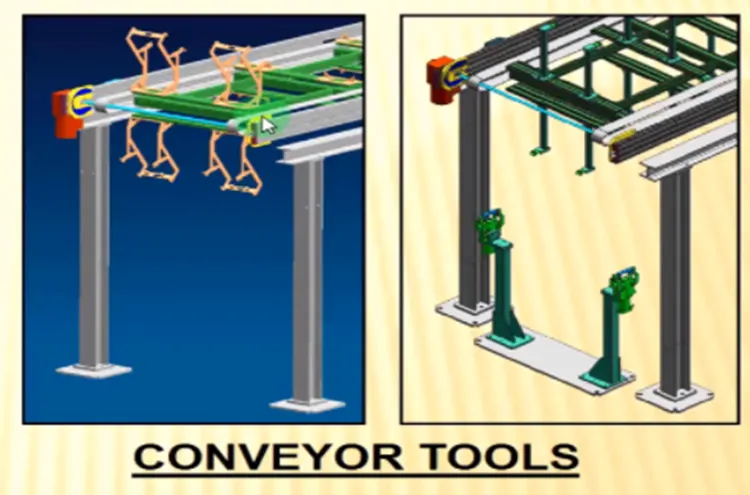
Conveyor Tools
The conveyor id the rotating path that transports the parts to the next station which kept over it.
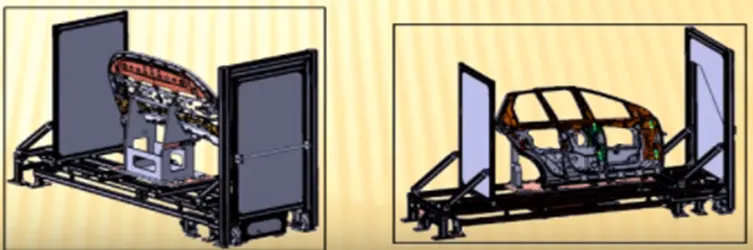
Take Out Trolley
Take out trolley is used to take the car panel out of the robotic working cell between the cycles for inspection purpose.
Curing
After gluing it needs some time to cool sown, so we put the assembly on some belts and ot will take the panel to another station and meanwhile gluing will cool down
Basic Terminology used in Fixture Design
Mylars
Mylars are thin, flat sheets typically made of durable materials like plastic or metal. They are used in fixture design as templates or overlays to assist in the positioning, alignment, and verification of parts or components. Mylars are often cut or shaped to match the contours or features of the work piece, providing a visual reference for accurate placement within the fixture. They can be used to ensure proper alignment, clearance, or dimensional checks during the assembly or manufacturing process.
Fingers
Fingers, also known as clamps or locators, are protruding components in a fixture that are designed to hold or support the work piece. They are typically adjustable to accommodate different part sizes or configurations. Fingers can be used to apply clamping force, support the work piece from underneath, or provide precise positioning and alignment. They are often designed with specific contours or shapes to match the features of the work piece, ensuring secure and accurate placement.
Principle Locating Point (PLP)
Principle Locating Point (PLP) is a term commonly used in the field of fixture design and manufacturing. It refers to a specific point or feature on a work piece that is designated as the primary reference for positioning and aligning the work piece within a fixture.
Risers
Risers refer to the components or elements that are used to elevate or support a work piece or assembly within the fixture. These risers are typically adjustable in height and allow for proper positioning and alignment of the work piece during assembly, welding, or other manufacturing processes.
Shims
Shims are thin pieces of material used to fill gaps or provide precise adjustments in the positioning and alignment of components within the fixture. Shims are commonly used to ensure proper fit, alignment, and clearance between various parts of the work piece or assembly.
Rough locators
Rough locators are components used to provide initial positioning and alignment of the work piece or assembly within the fixture. They are designed to quickly and roughly position the work piece in the approximate location before final adjustments and clamping take place.
Hardware
Hardware refers to the various components and elements that are used to assemble, secure, and operate the fixture. These hardware components play a crucial role in the functionality, adjustability, and durability of the BIW fixture.
- Clamps
- Bolts and screws:
- Nuts and washers
- Locating pins
- Sliding or adjustable components
- Handles, knobs, and levers
- Support structures
CMM
CMM stands for Coordinate Measuring Machine, and it is a measurement device commonly used in manufacturing and quality control processes. In the context of BIW (Body in White) fixtures, CMM can be incorporated to enhance the accuracy and precision of dimensional measurements and ensure the quality of the fabricated components.
Unit
Unit" refers to a specific section or module within the fixture that is designed to hold and locate a particular component or assembly of the automotive body structure. A unit in a BIW fixture is typically dedicated to a specific task or operation in the assembly process.
Number plates
Number plates refer to the identification or marking plates that are attached to various components or sub-assemblies during the manufacturing process. These plates typically contain alphanumeric codes, labels, or other identification marks that help in tracking and identifying the components throughout the assembly line.
Nameplate
A nameplate refers to a metal or plastic plate that displays important information about the fixture itself. It typically includes details such as the fixture's identification number, manufacturer's name or logo, serial number, model or part number, and any other relevant information related to the fixture.
Clamp Arm
A clamp arm is a component used to secure and hold the work piece or component being worked on in the fixture. It is designed to provide a secure grip and prevent movement or displacement of the work piece during the manufacturing or assembly process.
Pivot
A pivot is a component or mechanism that allows for rotational movement or adjustment of certain parts of the fixture. It provides a point of rotation around which the fixture or specific components can move or pivot.
Class A Surface/Skin surface
In product design and automotive industry, the term "Class A Surface" or "Skin Surface" refers to the outermost visible surface of a product or component, which is designed to have a high level of aesthetic quality and finish. It is the surface that is directly exposed to the viewer or end-user and is intended to be visually appealing.
Reed switches & sensors
Reed switches and sensors are electronic components that can be used in BIW (Body in White) fixtures for various purposes, such as position sensing, proximity detection, or limit switching. They play a vital role in providing feedback and control signals in the fixture system.