Week 1:- Introduction to BiW and Fixtures Challenge
1. Body in White (BIW), is a grey sheet metal body, joined together as a structure by various joining techniques such as welding, riveting, clinching, bonding, laser brazing, etc.
Parts of a BIW:
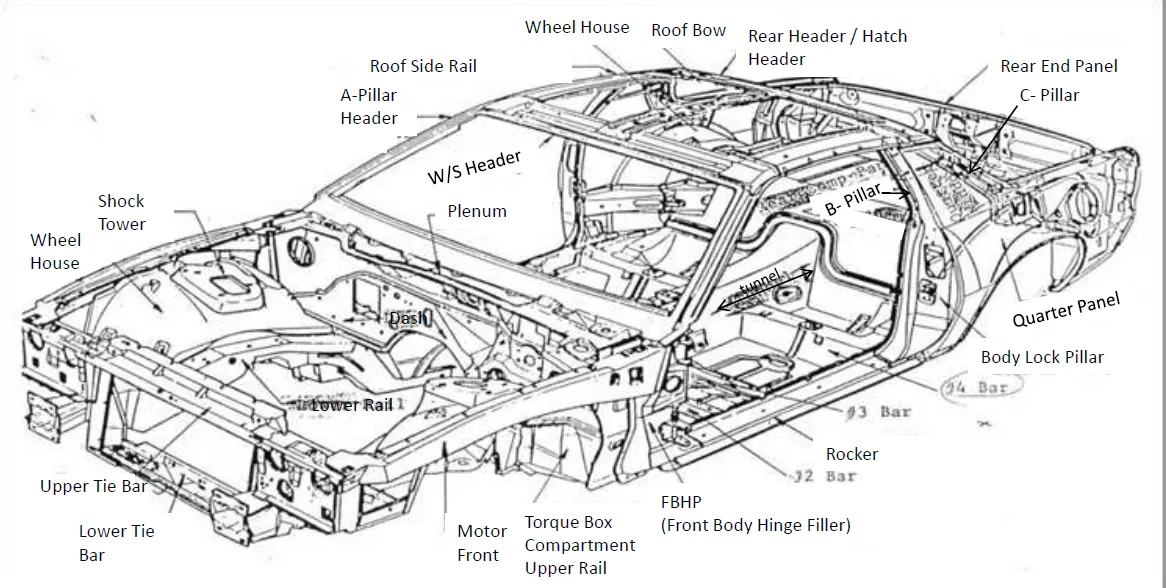
- Body side (Bodyside inner and Outer)
- Underbody (Front and Rear end underframe, Main floor)
- Closures (Front door, Rear door, Hood, and Decklid)
- Roof side (Roof inner and outer, roof rails)
- Fender
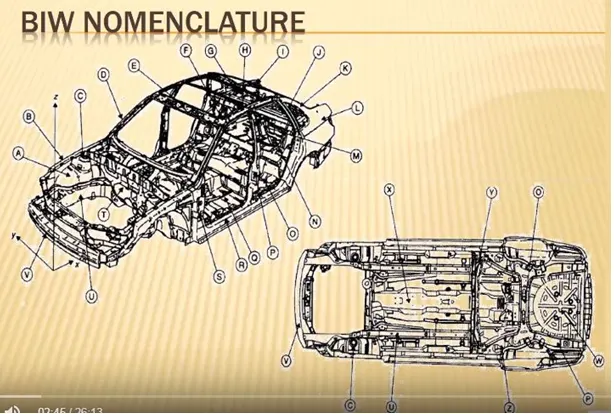
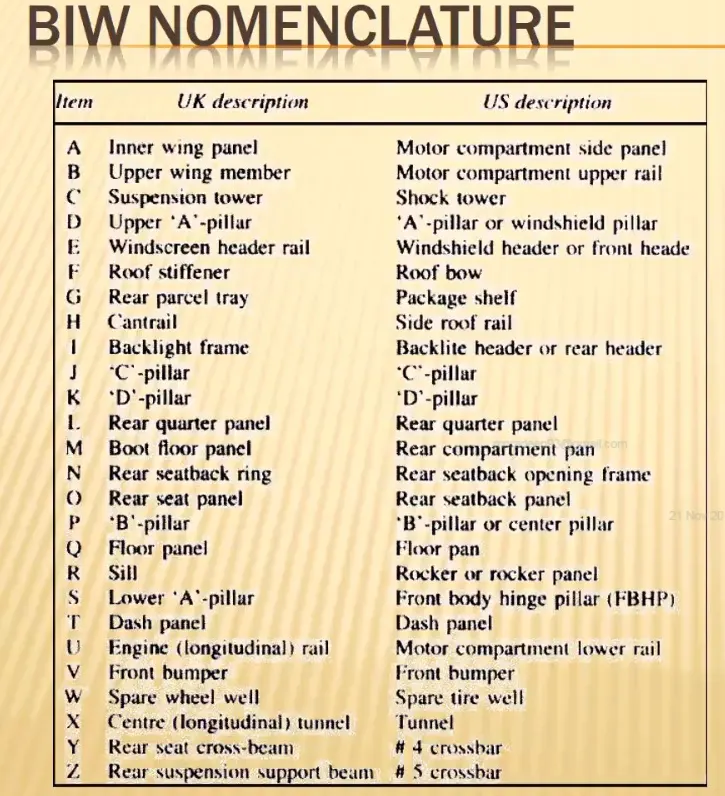
2. BIW Nomenclature:
Nomenclature in common means assigning names. Here is BIW nomenclature, the BIW parts are designated with specific names according to their regions, names may vary with the region but the parts remain the same.
3. Fixture and its types :
The fixture is a device that holds the workpiece to be processed by the 3-2-1 principle. The welding fixtures are designed to hold and support the various components in the assembly to be welded. The dimensions of the fixture should be the same as in the design to make weld and assembly precise. The fixture should be rigid and stable enough to withstand the welding stresses.
Types:
- Production Fixture
Production fixtures are used for mass production, it has to pass many numbers of cycles in their lifetime, the fixture should have a better build, dimensions, and tolerance throughout its lifetime. The fixture assembly should be easy to maintain. As maintenance time may lead to a drop in production.
- Pre - Production Fixture
A pre-production fixture is a prototype fixture, where the initial batch production begins and that is used for studying the defects and errors made that need to be rectified before the mass production starts.
- Checking Fixture
In checking fixtures, no joining operations were done. Instead, gauges were introduced to check the geometry and dimensions were within the tolerance limit as per the design.
4. Principle behind Fixture design:
For a free body, there are 12 degrees of freedom considering the negative translations and rotations about their respective axis. To hold any part these DOFs need to be constrained.
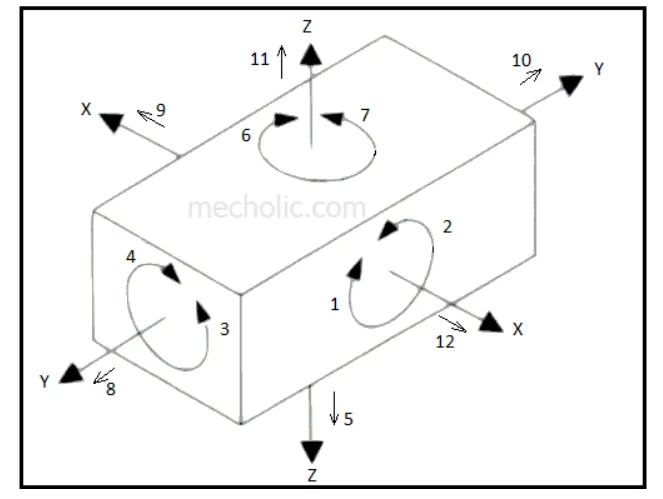
These are constrained by the 3-2-1 locating principle,
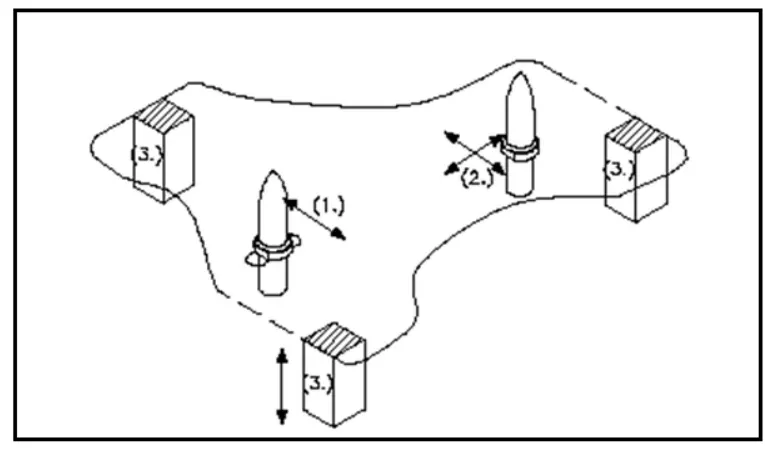
Here 3 blocks below the workpiece define the part plane. This restricts the translation below the part plane and 4 rotational freedoms. total of 5 DOFs.
Then a round location pin constrains the 4 translation DOFs.
Then a round location pin constrains the 2 DOFs.
5. BIW stations:
BIW stations are:
- Tool Stations
- Gripper Station
- Stand station
- Miscellaneous station
Tool Stations:
1. Geo Tool Fixture:
In this fixture, the geometry of the panels is welded together accurately. The pin tolerance will be - 0.15.
2. Re-Spot Tool:
The weld spots that are not achieved using the geo tool are welded in the Re spot tool. The pin tolerance in re spot toll will be -0.28
3. Marriage or Hemming Tool :
Hemming / Marriage tool fixture is where the inner and outer sheet metal parts were joined by the rolling process.
4. Checking stations:
A checking station that is used to check the automotive parts or assemblies (Coordinates, relative dimensions & Positions). Checking stations can be gauge type, fixed, or automated checking fixtures.
Grippers:
EOAT- End of Arm Tooling.
Material Handling Gripper (MH):
It is used for handling panels from one tool station to another tool station.
Process Gripper:
In addition to material handling grippers from handling one to another station, these grippers undergo processes like pedestal welding, riveting, gluing, sealing, etc.
Combo Gripper:
These are used for transporting and also have a welding gun on the other side for welding.
Dual Gripper:
These are used for transporting car panels from one station to another with grippers on both sides.
Stand stations:
1. Gluing / Sealer stand:
Gluing/sealer gun is fixed to a welded or standard stand which is grouted to the floor.
2. Docking stand:
When robotic arms are used for multitasking like material handling and welding, then the arm cannot hold both due to the payload constraints of the robotic arm. So the arm will drop the gripper and pick up the weld gun after their respective operations are done.
3. Date stamping stand:
The panel will be embossed with the date on which it is manufactured with the help of a stamping device mounted on the date stamp stand.
Miscellaneous stations:
1. Curing:
The station where the workpieces are held after gluing or welding is done so that the glue or weld undergoes curing.
2. Buffer stand:
A buffer stand is used to store the workpieces for the continuous flow of workpieces in the assembly line and to reduce the waiting time.
3. Conveyors: Conveyors are rotating belts that help in transporting the workpieces among stations.
Terminologies in BIW Fixture:
Shim is a set of thin plates (2 mm, 1mm, 0.5 mm, 0.25mm) that are used to adjust the gap or used for a better fit. Shimming can be of a thickness of 5mm, 8mm, or 10mm. in case no proper fitting between mylar and Panel due to manufacturing errors then this error can be removed using shims. Shims are placed in the carline position so that gap can be adjusted in the required direction like X, Y, or Z.
MYLAR :
MYLAR is one kind of block that touches the panel and holds or clamps the panel. Mylars are always designed in CAR LINE. Mylar is also called NC(Numerically Controlled)Block. Mylars are mounted on any block or plate with Shimming, So that height of the mylar can be adjusted accordingly at the assembly level. For A-class surfaces Nylon mylars are used. So that surface can be saved from scratches.
Shimming can be 1 directional, 2 directional, or 3 directional as per the NC cut.
PIN:
Pins are used to lock the rotational movement of the panel. Generally, there are two types of Pins, one is Round Pin and one is a Diamond pin. We use two and three-directional shimming for pins as per the angle of the pin w.r.t. the carline. In some cases, we use a collared pin, when the pin is supposed to support the panel as well. For this kind of pin, we provide 3 way shimming irrespective of pin angle to the carline.
BLADE :
The plate which connects Riser to the Clamp cylinder is named Blade. This plate plays an important role in building the unit. The plate can be of any shape. But we need to keep in mind that the plate should be as compact as possible.
L BLOCK :
A plate-shaped L is called an L block. This part is used as a connection between mylar and Blade. Generally, L blocks are used to provide shimming. It is not necessary that L blocks are only used for shimming, its uses change as per the requirements, At some places, it is used just to connect one part to another. Similar to the L block one more block is used which is in the shape of a T. So this block is called a T Block.
PIN BLOCK :
Pin Block is also called Pin Retainer. This block holds the pin and restricts the rotational motion of the pin. Pin Block can be either manufactured or Standard.
RISER :
The part which is mounted on the base plate and holds a clamp or pin cylinder on it is called Riser. Riser can be a Standard Part or manufactured part, it varies from project to project. A riser can be a Single part or welded part. Standard risers also have various shapes and sizes.
WELDMENT :
Weldment is the assembly of two or more parts that are joined by welding. To make a weldment it is the thumb rule to have a 5 mm overlay on each other plates so that space can be provided for welding. A weldment can be of any size and any number of plates.