Week 1:- Introduction to BiW and Fixtures Challenge
1. What is BIW & define its parts?
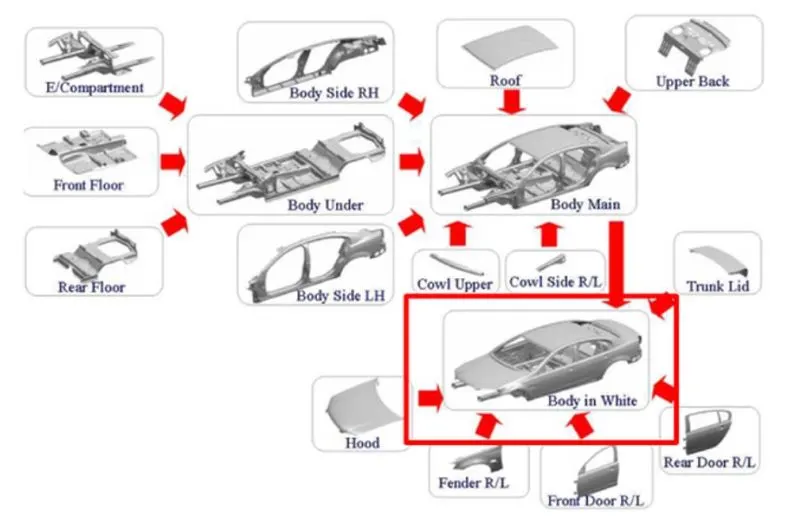
Body in White (B.I.W.) refers to the welded sheet metal components that form the vehicle's structure by using different techniques i.e Welding, Riveting, etc. to which the other components are attached i.e engine, chassis, exterior, and interior trim. Whereas, BIW will not have any engine, doors, or moving parts.
In automobile production, where all sheet metal parts such as the roof, body sides, underbody, tailgate and cross members, etc. are welded and dipped in a primary solution that is greyish in color. This is how BIW is created after welding and before painting.
BIW design also needs to be lightweight structure so that there can be a possibility of reduced fuel consumption
The structure is made from Steel or Aluminium panels(0.7 - 2.0 mm Thickness). The panels are stamped and welded together
BIW constitutes 27% of a car's weight.
COMPONENTS:
- Bodysides
- Underbody
- Closures
- Roof
- Fender
- Reinforcements
SHOWING BIW COMPONENTS:
- What do you understand by BIW nomenclature?
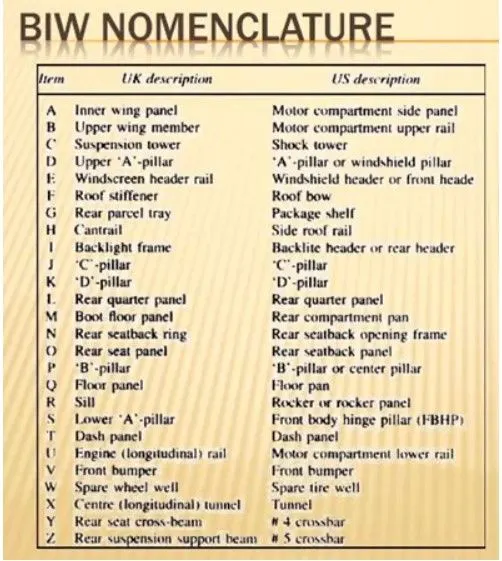
Nomenclature is large a selection of names for things. BIW has a variety of components in it. All parts have totally different names The automotive industry is unfolding worldwide. each nation has its own language. therefore the same part of the BIW has different names in its region.
For example, one component of the BIW is known as the inner fender panel in the UK specification, and another side, the same component = the BIW, is known as the engine compartment side panel in the US specification.
BIW NOMECLATURE:
- What is fixture & its types?
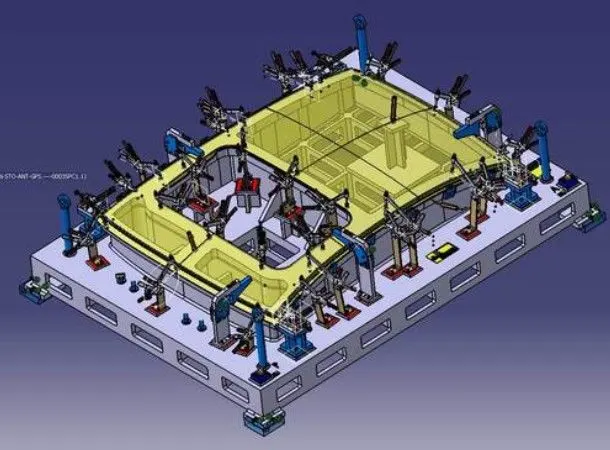
The fixture is a device that holds and supports the workpiece to be machined. In general, fixtures are designed according to the 3-2-1 Principle.
Fixtures must hold the workpiece firmly without causing vibration, distortion, or stress in the workpiece, and the fixture must not interfere with the machining of the workpiece
TYPES OF FIXTURES:
1. Production Fixtures :
These fixtures are used for mass production, they ought to be simple, rigid, and hard. This style of fixture should be in such a way that it should be simple to load and unload the piece of work in a short time to increase productivity.
- Pre-production fixtures:
These fixtures are used for the initial batch production of the new products, These may be complex manual and heavily based on the application. These can be referred to as the prototype fixtures because to improve, make them simple and reliable during production.
- Checking fixtures:
These fixtures are used for checking and inspection purposes. No processing is done in these fixtures. These fixtures consist of gauges for checking the dimensions, tolerances, and accuracy and in some cases, CMM devices check geometrical accuracies.
FIXTURES HOLDING A PART:
4. What is the basic principle of fixture design?
ANS: The principle used for the design of BIW fixtures are 3-2-1 principle.
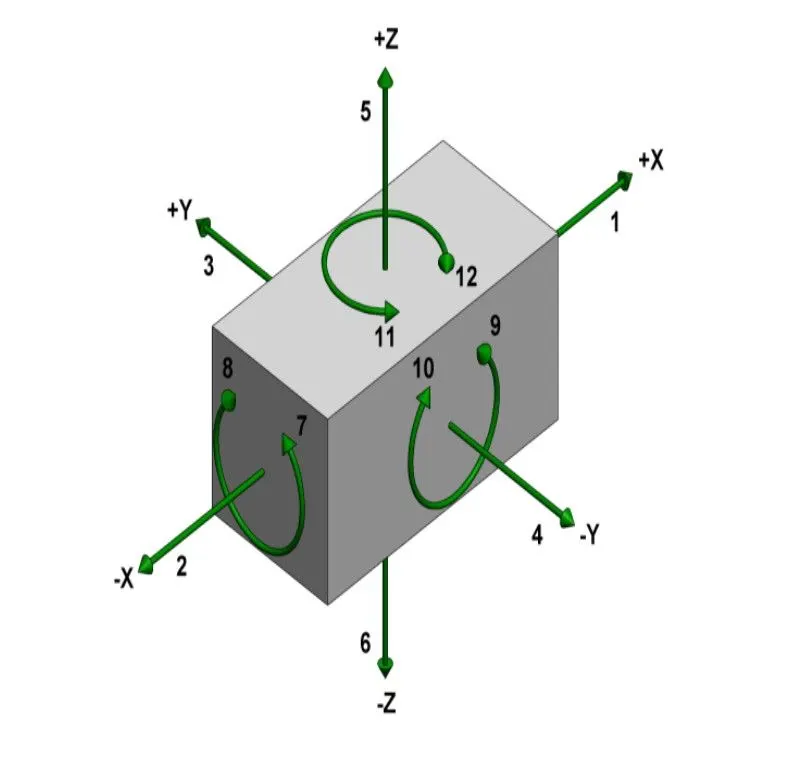
As we know that a free body has 12 Degrees of freedom(DOF) as mentioned below,
6 Translational degrees of freedom:
+X, -X
+Y, -Y
+Z, -Z
6 Rotational degrees of freedom:
- Clockwise around X-axis (CROT-X)
- AntiClockwise around X-axis (ACROT-X)
- Clockwise around Y-axis (CROT-Y)
- AntiClockwise around Y-axis (ACROT-Y)
- Clockwise around Z-axis (CROT-Z)
- AntiClockwise around Z-axis (ACROT-Z)
REPRESENTATION OF 12 DOF:
5. Elaborate types of BIW Stations?
BIW Station: In between process of the BIW Assembly line.
BIW Assembly line is divided into zones and stations.
BIW stations are further divided as mentioned below,
- Tool stations
- Gripper stations
- Stand station
- Miscellaneous stations
1. Tool stations:
A tool is a fixture that consists of no. of units together to hold a car part in general. There are some tools such as
- Geo Tools
- Re-spot tools
- Marriage/Hemming Tool
- Framer tool
2. Gripper stations: It is a device/ a fixture that enables the holding of an object to be manipulated by attaching it to an end of a robot. where the weight of the gripper should be less. Some grippers are mentioned below
- Material handling grippers
- Process grippers
- Combo grippers
- Dual grippers
3. Stands Stations:
Stands are fixed to the floor and used to mount some parts on it.
Different BIW stations:
- Pedestal stands
- Gluing & sealer stand
- Docking stand
- Date stamp stand
4. Miscellaneous stand: These stands can be used for multiple purposes as given below
- Part can be transported from one unit to another unit by storing some panels.
- Inspected panels can be stored or damaged panels can be stored to reuse for other parts.
The miscellaneous stands are of different types:
- Curing
- Buffer stand
- Take out trolleys
- Conveyors
- Pallets
- Racks
6. What are the basic terminologies used in the BIW fixture?
Basic terminologies used in the BIW fixture:
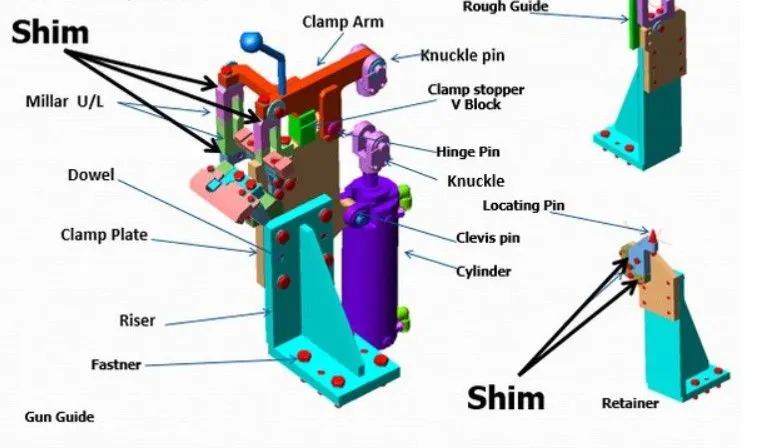
- NC/Mylars/Fingers: The component that holds the panel or object. This hold part consists of two fingers i.e the Top finger is known as Clamping Mylars and the Base finger is known as the Resting mylars. It doesn't allow any deformation on the part during the process.
- Principle loading points: These points are used for the accurate location of the part to maintain the geometry of the part. Dimensions should be very precise in stamping and fixtures.
- Risers: The part which is mounted on the base plate and holds a clamp or pin cylinder on it. Risers are of different types like Square tube risers, and L-type risers.
- Blade: The plate which connects Riser to the Clamp cylinder
- Rough locators/Locating pin: Rough locators are also known as guide points to the operator. The operator can place the panel in a correct way with help of these rough locators.
- CMM: Coordinate measuring machine. It measures the geometry of the object and generates the report by comparing the data with CAD file data.
- SHIM: Body coordinates to be maintained within tolerances for good quality, productivity, safety, etc.
- Units: Different units like Pin unit, Base unit, Clamping unit, etc.
- Nameplate: The data like date, company name, measurements, part Identity number, etc. are mentioned on it.
- Class A surface: The outer panel i.e visible parts, should be rid of scratches and damage, and the material should be soft with no fingerprint marks. Most fixtures are made of PU, Nylon material is to avoid such dents.
- Sensors: These are automated and operated by an applied magnetic field to detect whether the panel is loaded or not.