Week 1:- Introduction to BiW and Fixtures Challenge
1) What is BIW and define its parts?
ANS:-
Body In White (BIW) is a term used in automotive sector, where automotive structural body parts, made of sheet metal, join together by variuos joining processes. These joining processes are mainly welding, crimping, hemming, etc. It is called Body In White because after construction of the body it is coated with white primer or looks white in colour.
From the above BIW is refers to the welded sheetmetal components which form the vehicles structure to which the outer components will be married i.e. engine chasis, electrical wire harness, interiour trims, etc.
BIW is defined as " The stage in automotive design or automobile manufacturing in which car body sheet metal components are been assembled by welding or other joining processes."
BIW consist of following parts;
- Body sides (inner/outer).
- Front end under frame(engine compartment).
- Main floor.
- Rear and underframe
- Doors (front and rear).
- Hood.
- Decklid.
- Front fender (LH/RH).
- Roof (inner/outer).
2) What do you understand by BIW nomenclature?
ANS:-
BIW sturucture is constructed by assembling many small sheet metal stamped parts and joinig them together by welding and other joining methodes.
- To identify these parts individualy, they are named by their locations in BIW sturcture, functions of individual part or its shape. This is known as BIW nomenclature.
for diffrent countries and companies BIW parts are named diffrently as per their culture such as in UK and USA same functional parts are named diffrent.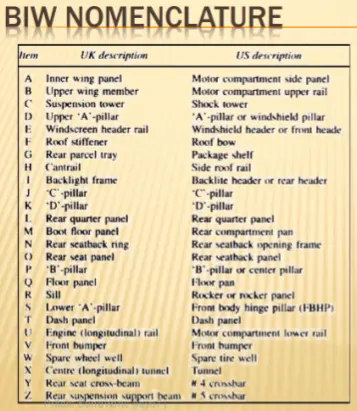
3) What is fixture and its types?
ANS:-
Fixture:- It is a work holding device, which holds up the work piece in place and locats it for machining or checking purposes. Fixture reduces the cost and time for manufacturing and increases the accuracy of the final product. Increased accuracy means the less no of rejcted parts. It is a usefull tool for mass production.
Some examples of fixtures are milling fixtures, Tapping fixtures, Welding fixtures, etc,.
Fixtures have following types:
- Production Fixtures :- Production fixtures are for mass productions where manufacturer have to produce more number of parts in less time. Here accuracy and timing to operate the fixture are importent. Time required to engagement and disengagement of a fixture should be less. Operater should have easy access to every component. Easy and quick placing of work piece.
- Pre Production Operations Fixtures :- These fixtures are used in development phase of a product or for initial batch production to study feasibility. These fixtures should have high accuracy and tolerances.
- Checking Fixtures :- These fixtures are used for geometric inspection purposes. These fixtures should be constructed on high tolerence accuracy and should be keep neet and clean. checking fixtures are made for checking purposes to maintain quality of product and and measure its accuracy.
4) What is the basic principle of fixture design?
ANS:-
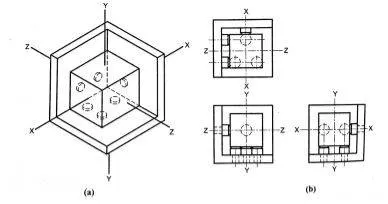
Every fixture is designed by using 3-2-1 principle. This pinciple states that work piece should be positioned in a machine by resticting its all degrees of freedom.
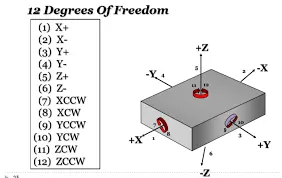
Degrees of freedom:- there are 12 degrees of freedom in X, Y and Z direction to move an object, that are 6 linear and 6 rotational.
- +ve and -ve X direction
- +ve and -ve Y direction
- +ve and -ve Z direction
- Clock wise and counter clock wise X axis
- Clock wise and counter clock wise Y axis
- Clock wise and counter clock wise Z axis
3-2-1 principle is applied by following steps-
Step 1:- By placing 3 points at the bottom of the work piece will restrict rotationl movemet along X and Y axis.
Step 2:- By placing 2 points at the one of the side of work piece will restrict linear movement along X or Y axis and rotational movement along Z axis.
Step 3:- By placing 1 point at front or back of the work piece will restict linear movement along X or Y axis.
Step 4:- Remaining linear movements along X, Y and Z axis will be restricted by using clampings.
3-2-1 principle explained in following imeges.
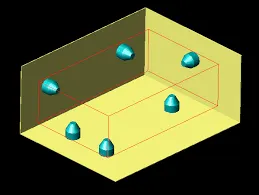
a 3D view for 3-2-1 principle and object placing
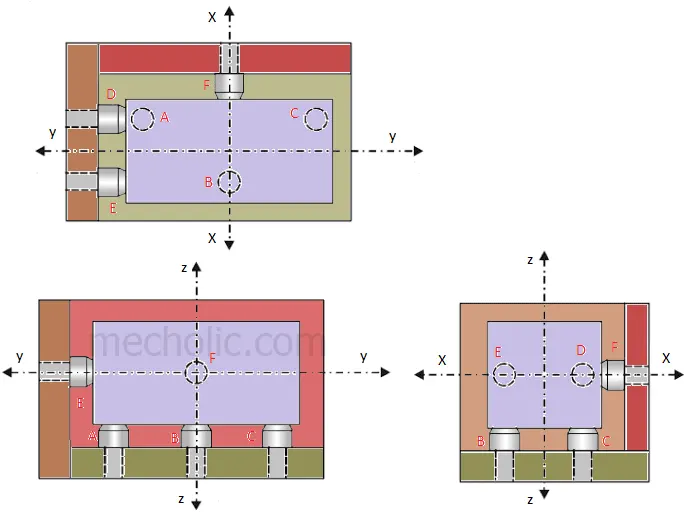
a 2D representation of 3-2-1 principle.
5) Elaborate types of BIW stations?
ANS:-
In BIW assembly all parts could not be assembled at once,so the BIW assembly divided in various zones. These zones are made in various assembly stations and then assembled at a common station. For assembling of these zones, assembly satations are made. There are various types of BIW stations.
- Tools - Geo tools, Respot tools, Marriage tool, etc,.
- Grippers - Material handling gripper, Proccess gripper,combo gripper.
- Stands - Pedestal stand, Gluing stand, Docking stand.
- Miscelleneous - Curing, Buffer stand, Racks, Pullets, Tack out trolleys, Conveyer, etc,.
Tools - Tools are stations where assembly made by welding. tools have types whiche are Geo tools, Rspot tools, Marriage tools, etc,.
Geo tools- A geo tool is a fixture in which the geometry of the panels which are welded together by welding only primery weld spots and which will define its geometry of BIW panel.
Respot tools- After defined geometry in Geo tools the remaining weld spots are made at respotind tool. This dividation of spoting stations will save time in production, since all the load will not be concentrated on one tool.
Marriage tools - Final welded panels are brought toghether to form a BIW structure at marriage tool. where these panels are welded together.
Grippers - Grippers are stations for material handeling, proccessing, etc,. Material handeling grippers are used to pick and place actions which are exchanging of finish panels and raw panels. Some grippers are cobination of weld spot gun and a material handeling gripper these are called combo grippers.
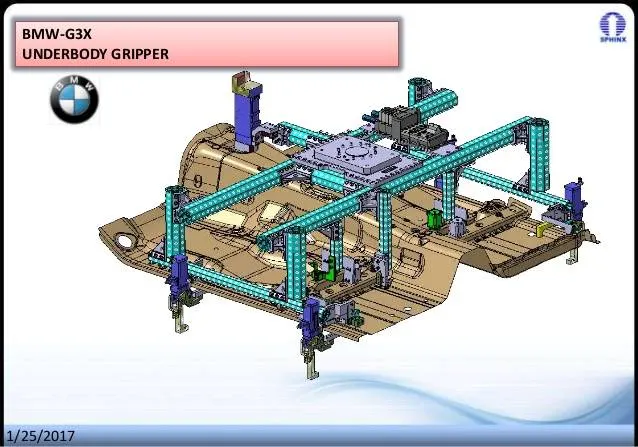
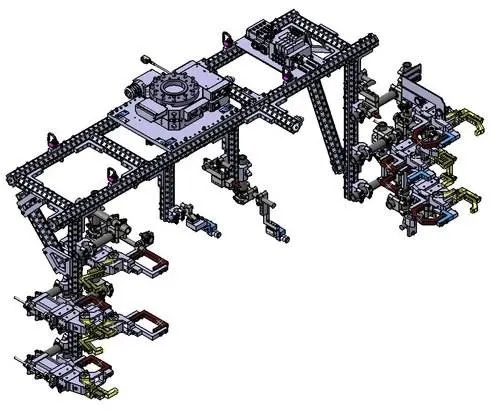
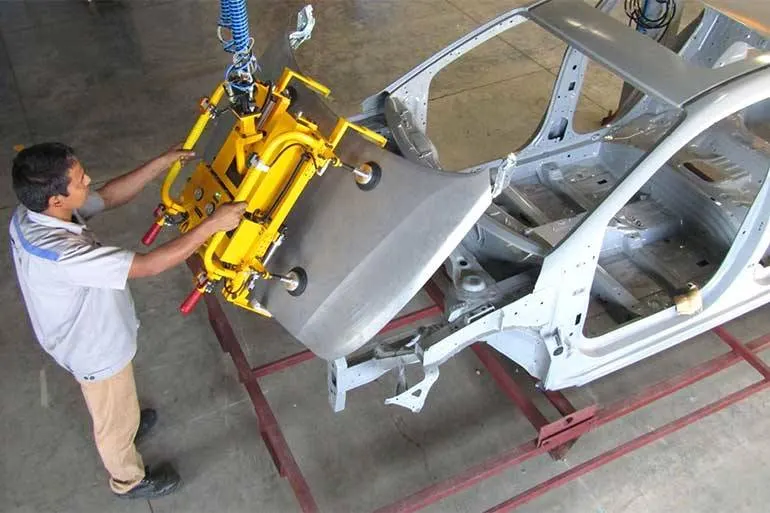
Stands - In BIW welding fixture stands are used for storing buffer panel, placing weld gun, gluing or gripper positioning.
Mislleneous - This inclued conveyors to carry panels from one station to another, curing conveyor which used to settle glue, Buffer stands which used to store extra panels for time being,Racks, pullets, Take out trolly which used to take ramdom selected part for inspection.
6) What are the basic terminologies used in BIW fixtures?
ANS :- A BIW fixture is made by assembling some components which are as follows;
- NC/Mylers/Finger
- Principle location point pin ( PLP Pin).
- Riser- L type, Welded square type.
- Clamps- Pneumatic, manual.
- Table
- Eye Bolts for lifting the fixture.
- Wheels.