Week 1 - Free Falling
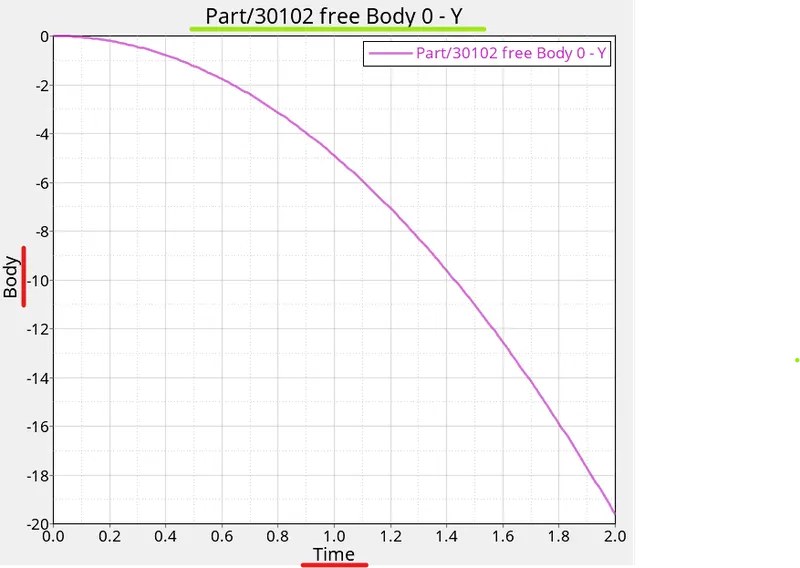
AIM: To simulate and plot a free falling body(point mass) of mass 1kg and inertial properties 1 kgm^2 in the Y-axis(gravity should be 9.81m/s^2 in teh negative Y-Direction use dimension of length in meters not mm)
A screenshot of the entire interface must be attached including the plot for all simulated cases.
QUESTION 1
software - Hperworks Desktop
Step-1: Select Motionview fromthe listof the dialoue box.
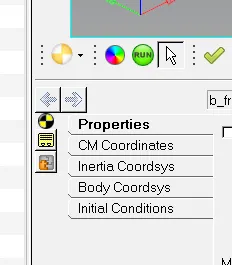
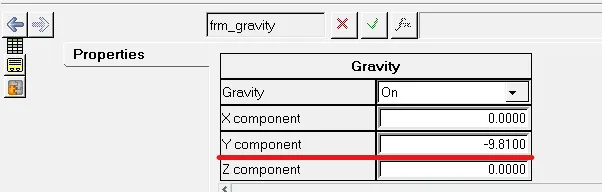
Step-2: Check wheather the gravity effect is enabled and set it to -9.81 m/s^2(negative Y direction)
Step-3: Set up the units for simulation from millimeter to meter as directed in the question

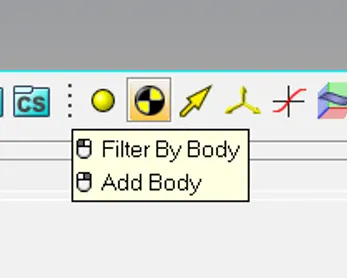
Step-4: Select the ADD body option as shown and rename it as free body for reference.
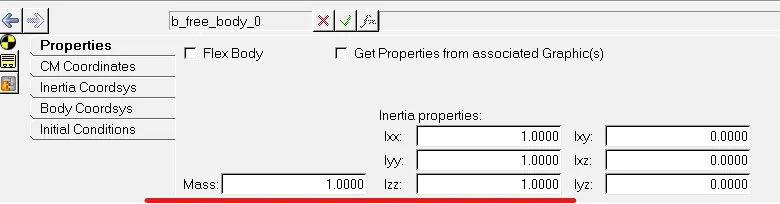
Step-5: Assign te mass and ineria values a directed in the question.
Step-6:Use center of mass coordinate system and select origin point from unresolved to global origin.

Step-7: Go to the RUN solver panel set th siulation time as 2 sec an save the mode and then click RUN.

Step-8: Click the plot button and selct he appropriate parameters to visualize te graph.
QUESTION 2
Equation of free falling object h = 1/2 x g x t^2
where
h = Displacement in meters(m)
g = Gravity of the body(m/s^2)
t = Time for simulation(sec)
hence if we assign values g=9.81 and simulation time t=2sec
where h = 19.62m

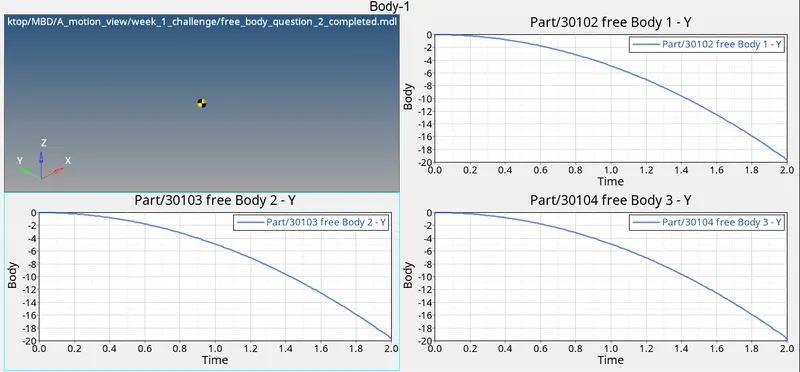
Since the body in free fall considering no characterstic only gravity the rate of fall doesnot depend on mass and inertia since inertia depends on the mass.
Please see the image below for free body_1 having mass 10Kg , free body_2 having mass= 50Kg , free body_3 having
mass = 100Kg
Results shows there is no change of free falling body with respect to change in mass.
QUESTION 3
When a body falling freely there will be drag when we consider the air resistance hence there will be opposite reaction force.
As drag increases rate of falling decreases.Drag is directly related to surface area of the object. More the surface area more the drag and viceversa.and also on density of material , velocity of fall.
Rate of falling depends on its mass,surface area and the acceleration due to gravity.