Week - 1 - Consistency of Units
Introduction
A unit of measurement is a definite magnitude of a quantity, defined and adopted by convention or by law, that is used as a standard for measurement of the same kind of quantity. For example, a length is a physical quantity. A meter is a unit of length that represents a definite predetermined length. When we say 10 meters (or 10 m), we actually mean 10 times the definite predetermined length called "meter". In simulation software like ANSYS, ABAQUS units are predefined and hence users need to just select and use it. LS Dyna doesn't have a predefined unit system. Hence it is necessary for the users to provide units based upon the industrial standards and requirements. This study is mainly focused on the unit and its conversion.
Conversion of kg/m/s to gm/mm/ms
Mass
1kg=1000g
Length
1m=1000mm
Seconds
1s=1000ms
Force
1N= 1 kg.m/s2=(1000*1000)/(1000*1000)g.mm/ms2= 1 g.mm/ms2
Stress
Stress=force/area= N/m2=(g.mm/ms2)/(10^6mm2)=10^-6 (g/mm.ms2)
Energy
Energy= force*distance= (g.mm/ms2)*(1000mm)= 1000(g.mm2/ms2)
Density
Density=mass/volume= kg/m3= (1000g)/(10^9 mm3)=10^-6(g/mm3)
youngs modulus
The unit of youngs modulus is similar to stress which is 10^-6 (g/mm.ms2)
Given E=210*10^9 pa
hence 210*10^9*10^-6 (g/mm.ms2)=210*10^3(g/mm.ms2)
Velocity
Velocity(km/hr)=(1000/3600)m/s=0.278m/s
given V=56.33km/hr=(56.33*0.278*1000mm)/(1000ms)=15.65(mm/ms)
Gravity
Gravity=m/s2=(1000mm)/(10^6)ms2=10^-3(mm/ms2)
g=9.81m/s2=9.81*10^-3(mm/ms2)
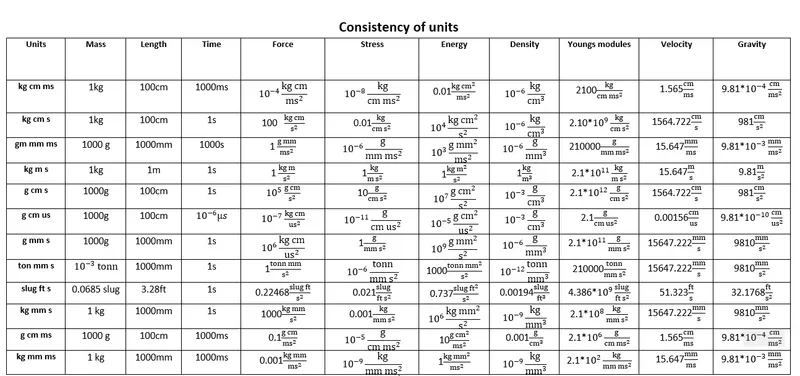
The above table is created by using excel software
Conclusion:
This work is about different types of unit and its conversion