Week 1- Mixing Tee
Introduction:
Tee value is used in the air conditioning system to regulate the room temperature. It works on the principle that by maintaining the mass flow rate of the cold fluid inlet the outlet fluid temperature can be controlled.
Aim:
To compare the mixing effectiveness of longer and shorter mixing tee valve under steady-state simulation.
Objectives:
- To perform mesh independent study and select the optimum element count.
- To compare the results for both the K epsilon and K omega SST model.
- To determine the outlet fluid temperature for longer and shorter mixing tee at the momentum ratios of 2 and 4.
Boundary condition:
Hot fluid inlet velocity= 3m/s
Hot fluid temperature= 36 C
Cold fluid inlet velocity= 6m/s and 12m/s
Cold fluid temperature= 19 C
Theoretical calculation:
By solving the conservation of energy equation the following equation is obtained

At the cold fluid inlet velocity=6m/s
The value of temperature obtained is=30.368 C
At the cold fluid inlet velocity=12m/s
The value of temperature obtained is=27.526 C
Analytical solution:
Although theoretical calculations provide accurate results it is difficult to implement the theoretical method for the complex phenomenon. Numerical analysis can be used to solve such complex problems with limited accuracy. ANSYS FLUENT uses FVM(Finite volume method) approach to solve the mixing Tee problem.
Model Geometry
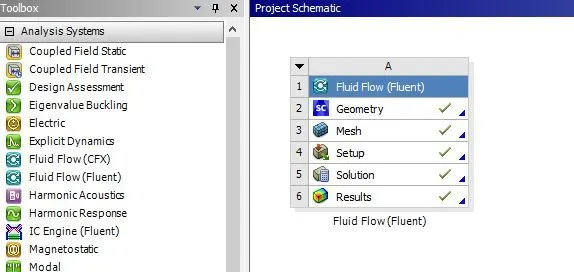
Following procedures needed to be followed for extracting the model of mixing tee
- In the Workbench platform right click on the Fluid Flow (Fluent).
- A fluid flow dialogue box appears on the screen.
- Right-click on the geometry and select the import option.
- Click on the Geometry, Space claim window that appears on the screen.
- In space claim window select prepare at the top of the screen and select volume extract.
- Select the fluid flow domain and click the 'tick' sign.
- Hide and suppress the remaining part which is not necessary for the simulation.
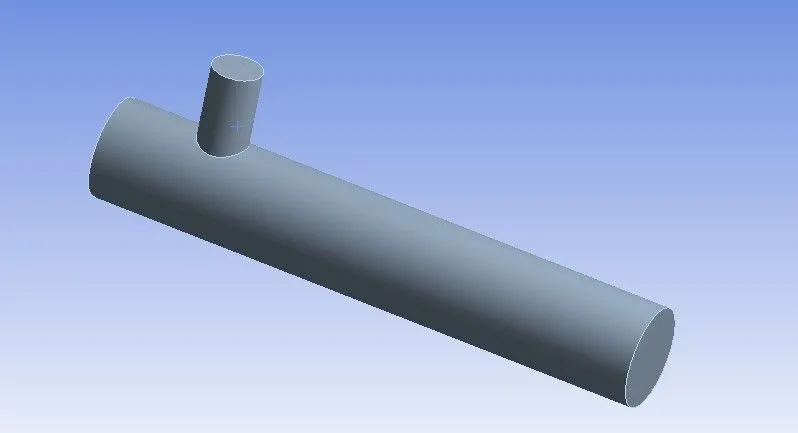
Meshing
After importing the geometry click on the 'Mesh button'.The Meshing window appears on the screen. Right-click on the model and provide the named selection like Inlet x, Inlet y, Wall, Outlet x and Fluid domain. Specify the element size under the mesh option and click generate the mesh.
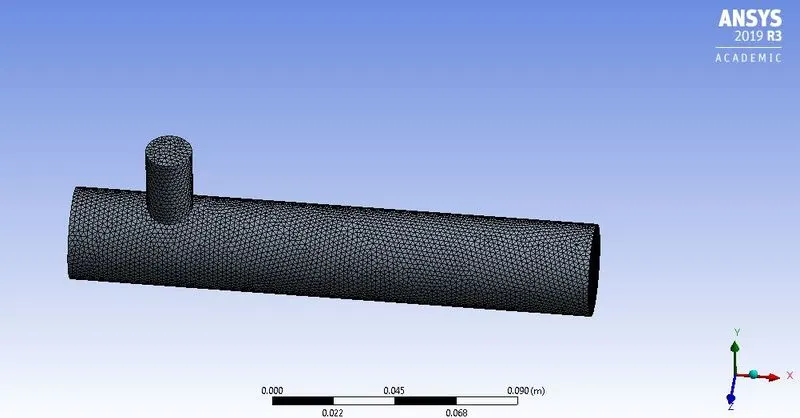
After meshing right-click on mesh and select update. If the meshing is successfully generated 'tick' mark appears on the workbench screen.
Preprocessing:
After meshing click on the setup button. Setup window appears on the screen.
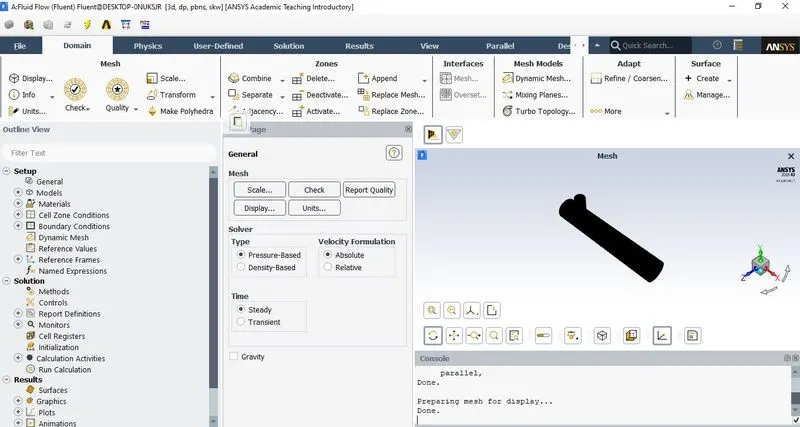
- Complete details about the mesh will be displayed on the Console window.
- For studying the heat transfer for the part the Energy equation should be turned on under Models.
- Since the flow is 'Turbulent' Click on K Epsilon or K omega SST under viscous.
- Define the boundary condition.
|
Boundary |
Type |
Parameters |
|
Inlet_x |
Velocity inlet |
Velocity=3m/s Temperature=36 C |
|
Inlet_y |
Velocity inlet |
Velocity=6m/s or 12m/s Temperature=19 C |
|
Outlet |
Pressure outlet |
Gauge pressure=0 |
|
Wall |
Wall |
No-slip |
- Under initialization select 'hybrid initialization'.
- After initialization click iteration and mention the number of iterations as 1000 and click 'Run'
Solutions:
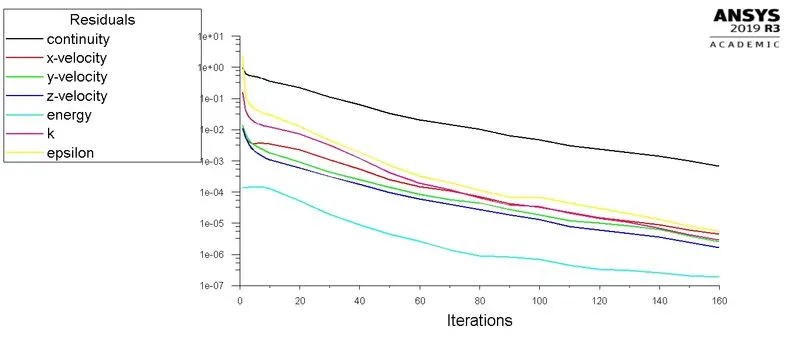
As the iteration number increases the residue decreases and at an iteration no=160 the solution gets converged
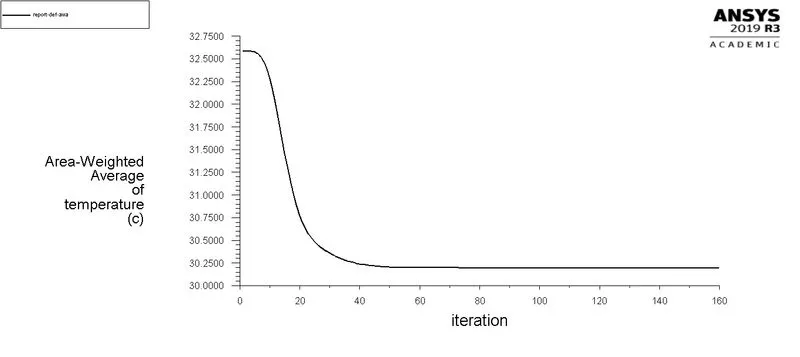
From the graph, it can be inferred that at the initial iteration the outlet temperature is above 32.5 C. when the iteration no increases the temperature value decreases and attains a constant value.
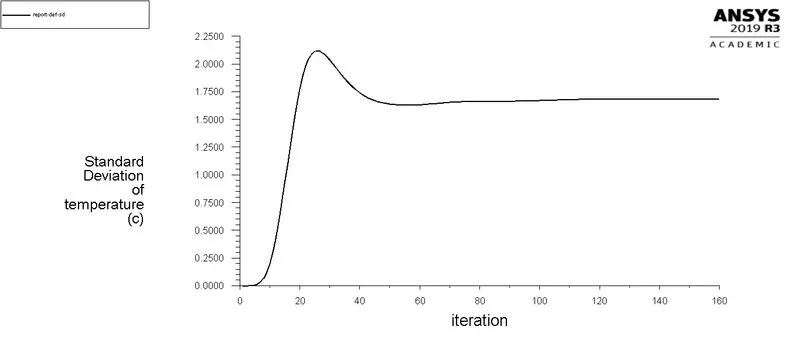
From the iteration and Standard deviation graph, it can be concluded that during the iteration process initially Standard Deviation values steeply increases attain a maximum point and ends with a constant value.
Mesh independent study:
|
|
Elements |
Nodes |
No of Iteration |
Outlet temperature |
|
1 |
12602 |
2814 |
110 |
30.19 |
|
2 |
22092 |
4762 |
160 |
30.23 |
|
3 |
106222 |
21413 |
180 |
30.29 |
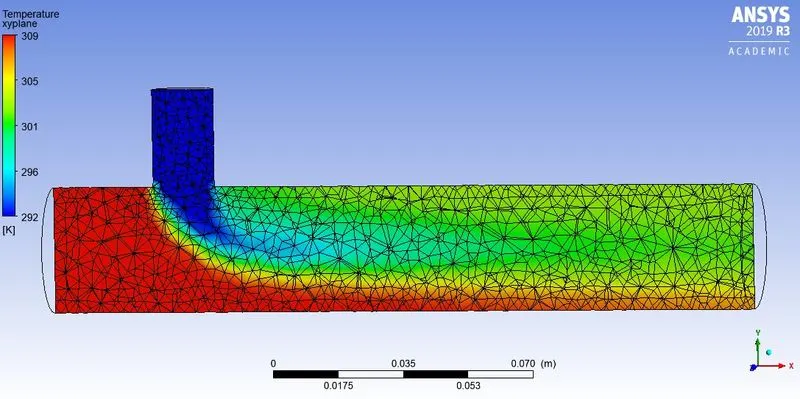
From the table, it can be concluded that as the number of elements increases deviation between theoretical and analytical solution decreases and an accurate solution can be obtained. Element count also has a direct relationship with computational time. As element count increases computational time will also increase. Hence optimum element count should be selected to reduce time as well as minimizing error.
Element count=12602
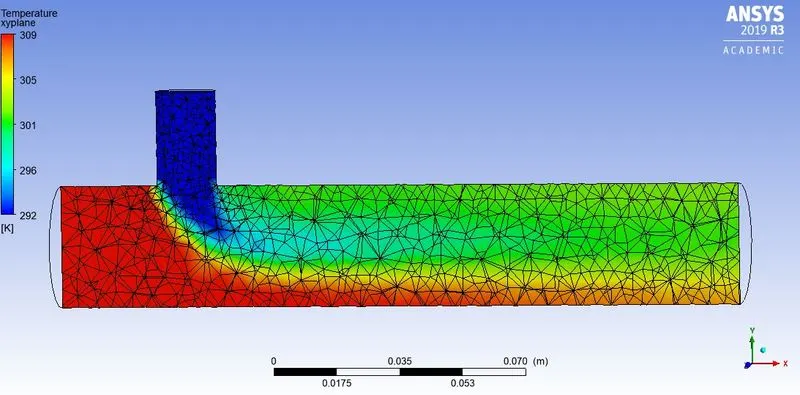
Element count=22092
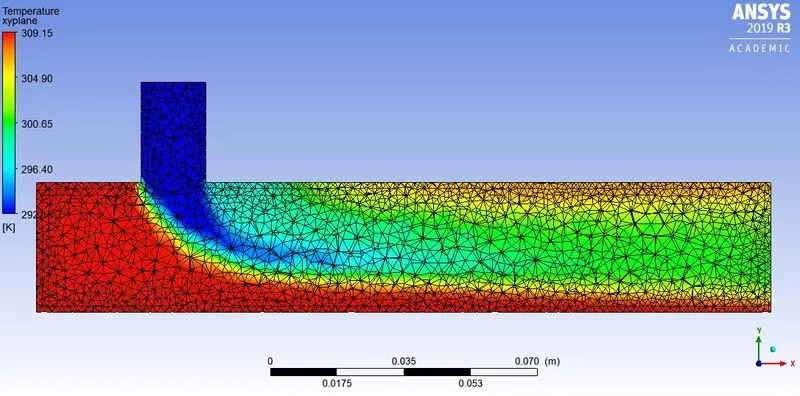
Element count=106222
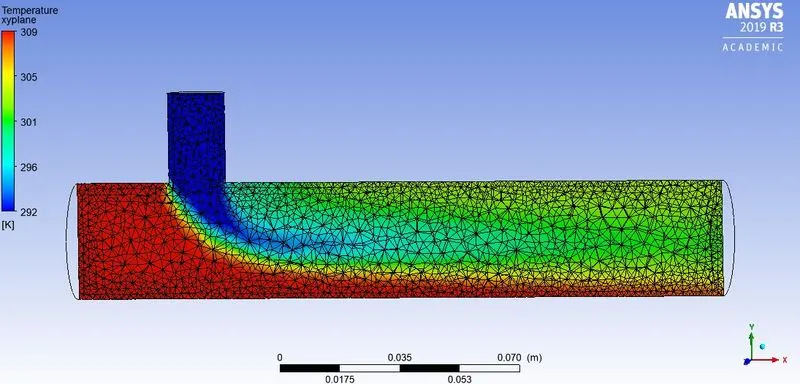
From the three graphs, it can be concluded that as the number of elements increases a better solution can be obtained.
Models K epsilon Vs K omega:
|
Model |
No of Iteration |
Temperature |
Error |
|
K Epsilon |
180 |
30.29 |
0.08 |
|
K omega |
220 |
30.41 |
0.05 |
K omega
K Epsilon
The temperature value obtained by using the K omega model is 30.41 C and the temperature value from the K epsilon model is 30.29 C and the error values are 5% and 8%. Both the models provide almost similar values but the number of iteration for the K omega model(280 iterations) is more compared to K epsilon model(180 iterations). Hence K omega model is not preferred for solving this problem.
For shorter tee valve
Momentum ratio=2
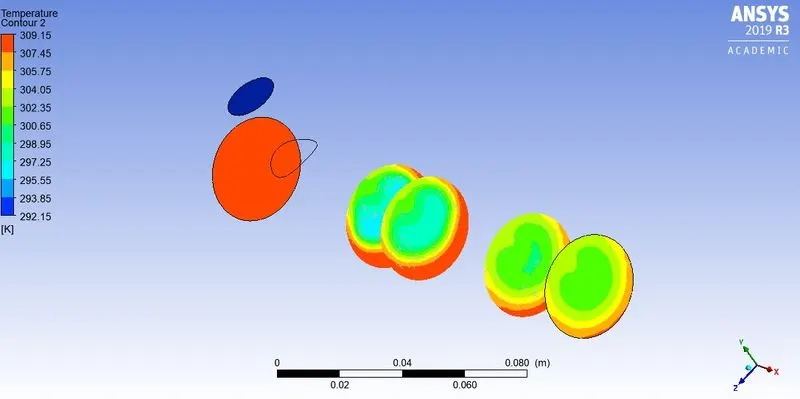
The Average outlet temperature for the momentum ratio 2 is 30.29 C
Temperature distribution along the length of the tube
Temperature distribution across the length of the tube
Velocity distribution along the length of the tube
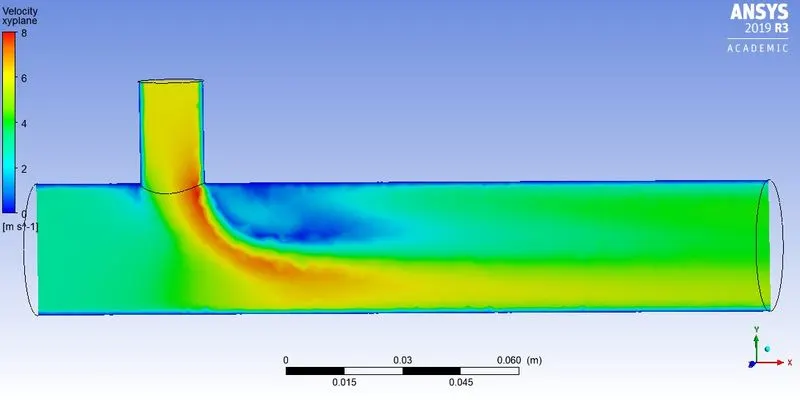
Velocity distribution across the length of the tube
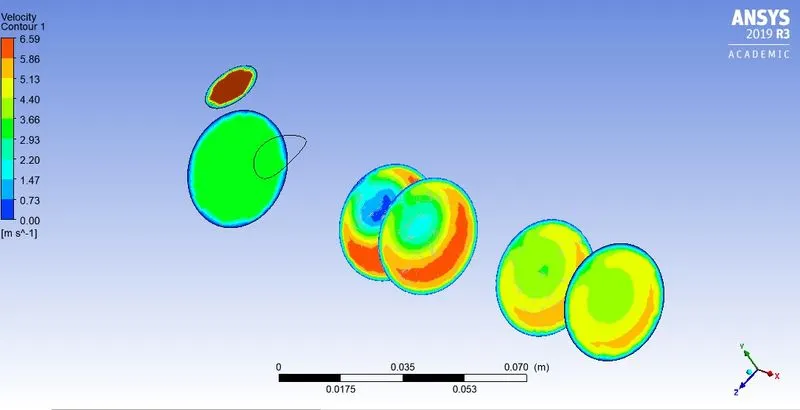
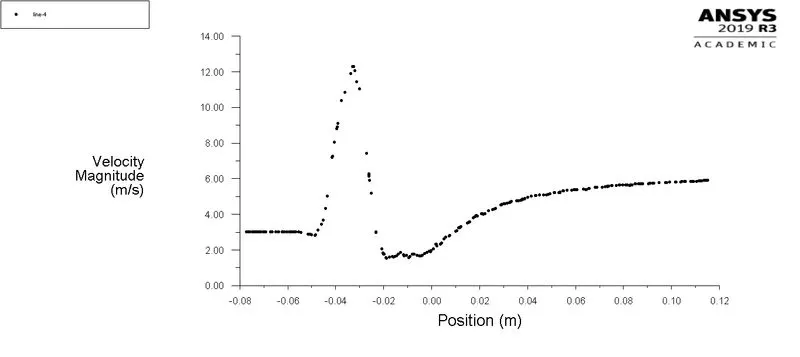
Line plot for Velocity and tube length
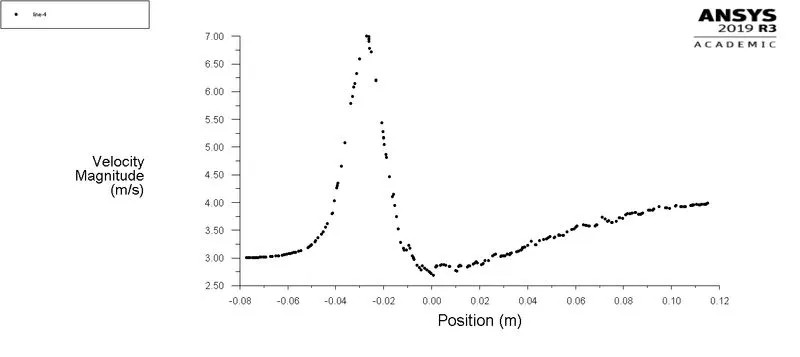
Line plot for Temperature and tube length
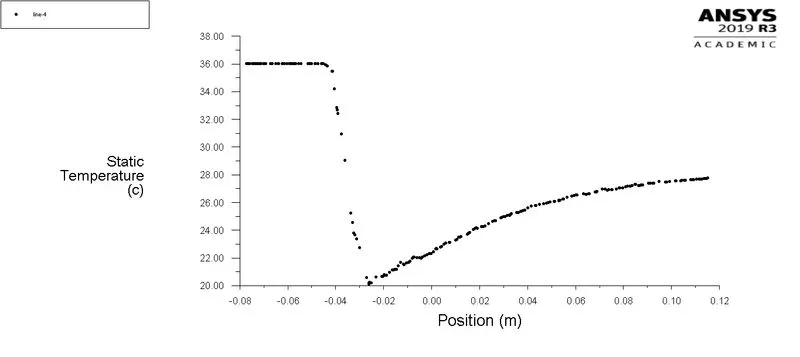
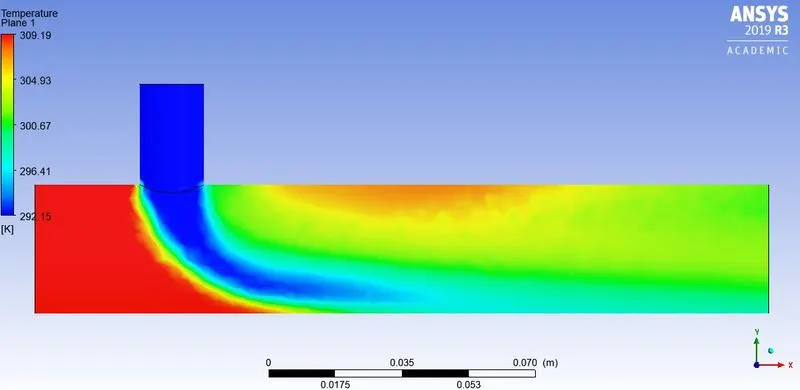
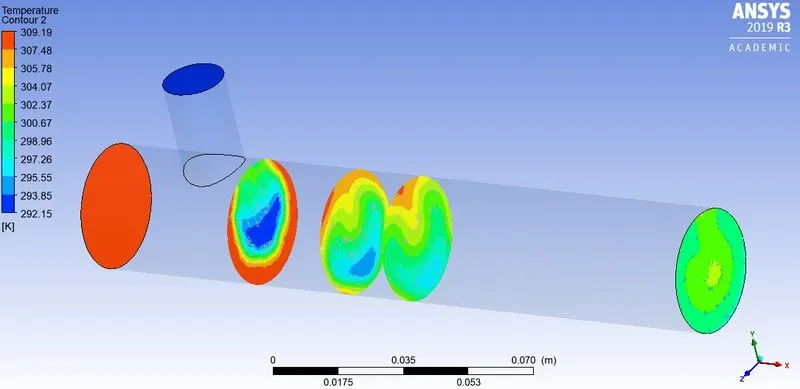
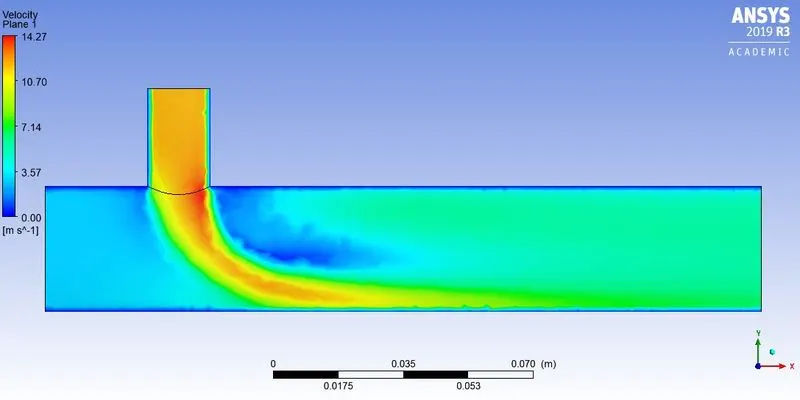
For Momentum ratio=4
The Average outlet temperature for the momentum ratio 4 is 27.55 C
Temperature distribution along the length of the tube
Temperature distribution across the length of the tube
Velocity distribution along the length of the tube
Velocity distribution across the length of the tube
Line plot for Velocity and tube length
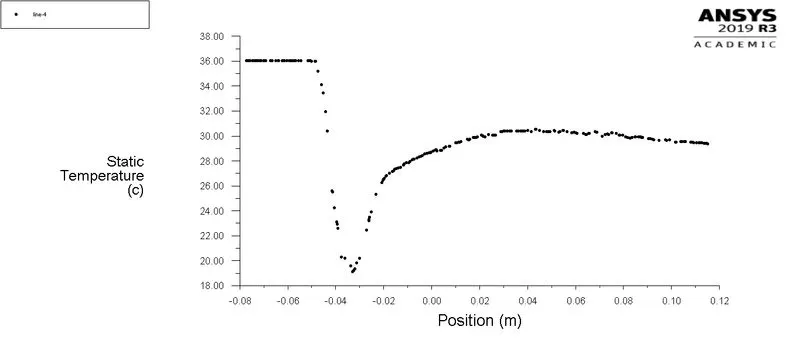
Line plot for Temperature and tube length
Inference
The outlet temperature obtained for the cold inlet velocity 6m/s is 30.29 C and for the cold inlet velocity of 12 m/s the outlet temperature obtained is 27.55 C . Hence velocity of cold fluid is the major factor in determining the outlet temperature of the fluid.
For longer Tee valve
Momentum ratio=2
The average outlet temperature obtained is=30.401 C
Momentum ratio =4
The average outlet temperature obtained is=27.421 C
Convergence plot
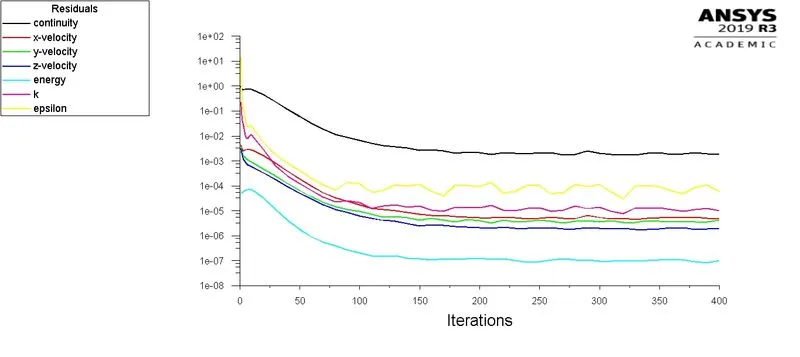
The solution is not converged and the residue values lie in the range between 1e-3 to 2e-3
Inference:
The length of the Tee valve doesn't affect the outlet fluid temperature