Week 1 Challenge
1. What is the full form of OEM ?
Ans - OEM- original equipment manufacturer
2. How the Design Responsibility goes in Automotive?
Ans- As an Automotive designer, you will draft layouts of automotive components, assemblies and system using sketches, models and prototypes. You will also determine factors that may affect design praposals by using previous car models, understanding manufacturing limitations and collaborating with automotive engineers.
3. Name some Tire 4 Supplier and what they Manufacture?
Ans- a. Tata Steel
Product-Tata Steelium & Tata Steelium Neo (CR), Galvano (Coated), Tata Astrum (HR), Tata Structura (tubes), Tata Astrum (for fabrication), GalvaRoS, Galvanova & Colornova (Coated) for Appliance segment, Galvanova (AlZn) & Tata Astrum Solar for Solar segment, Tata Kosh (coated sheets), Tata Steelium Super.
4. When was the first car made?
Ans- On January 29, 1886, Carl Benz applied for a patent for his “vehicle powered by a gas engine.” The patent – number 37435 – may be regarded as the birth certificate of the automobile. In July 1886 the newspapers reported on the first public outing of the three-wheeled Benz Patent Motor Car, model no. 1.
5. What kind of Seats are used in the first Car?
Ans-The seats in cars evolved from buck board seats. All seats evolved from the first ones used on chariots or other forms of primitive transportation.
6. Define 3D reference System?
Ans- It is a 3D coordinate system that usually helps to determine point positions from a certain reference axis's distance, the direction from the axis to the certain reference axis, and the distance from a certain reference plane perpendicular to the axis.
7. Why 3D reference System is needed ?
Ans- The 3D coordinate system allows us to represent a quantity in a space that contains three mutually perpendicular axes. Through the 3D coordinate system, we can now visualize points and surfaces with respect to three axes.
8. What is X Plane and in a Car what is positive “x”?
The X-axis is the longitudinal axis of the Automotive. The positive-X means the axis system towards the rear from the driver seat to the front portion is called the positive-X.
9. What is “Zero Plan”?
Ans- The Zero Plane is a plane where one of the coordinates is 0.
10.Define Point of origin?
Ans- The origin is the point where the axis of the system intersect. The origin divides each of these axes into two halves, a positive and a negative semi axis. Points can then be located with reference to the origin by giving their numerical coordinates that is, the positions of their projections along each axis, either in the positive or negative direction. The coordinates of the origin are always all zero, for example (0,0) in two dimensions and (0,0,0) in three
11. Where Most OEM Point of Origin keep ?
Ans- Most OEMs will take the Bumper as the point of origin.
12. Difference between Work Line and Grid Lines ?
Ans- The grid lines are there to show the divisions between cells. Borders reside on these divisions. Grid lines rare only have shown when a table is active.
13. Are Work Line and Grid Lines are inter connected?
Ans- No
14. What is Body Position?
Ans- Body position is referring where all the components should be located in to the vehicle wrt to human body.
15. When a Car comes out of OEM Yard ,Seat will be at what position?
Ans - Body position
16. How Center Line is used in terms of Car Design ?
Ans - The Center Line is the longitudinal axis of the vehicle that divides it into two halves.
17. Usually Center Line is Placed at _________?
Ans- The center of the vehicle, dividing the console in half.
18. What is Positive Z Direction ?
Ans- Positive Z is the direction above the Z Plane
19. What is Positive Y Direction ?
Ans- Positive Y is the direction to the right of the Centerline (as viewed from the perspective of the driver in the driver’s seat facing forward).
20. What is LHD and RHD?
Ans- LHD – Left Hand Drive – the steering wheel is on the left side of the vehicle (negative Y).
RHD – Right Hand Drive – the steering wheel is on the right side of the vehicle (positive Y).
21. A Driver driving a Car in US will be sitting which side of Car?
Ans- Left Hand Side.
22. Driver in US is in __Y Direction..
Ans- Negative
23. A Indian Cab Driver went to USA and started driving a Car, which side of the Car he will be sitting?
Ans- Left.
24. I opened the Door of my Car and saw my room keys on center console , so my keys are _____ against the Door.
Ans- Inboard
25. Belt Buckle attached on the _____Side of the Seat.
Ans- Inboard
26.The Recliner handle is placed ______side of the seat.
Ans- Outboard
27. Inboard/Outboard is a _______ based system.
Ans- Center Line
28. IB:______, OB _______
Inboard/Outboard
29. Going from rear bumper to forward is _____ Movement.
Ans- Fore
30. C- Pillar to B – Pillar movement is _______ Movement.
Ans- Fore
31. A aft movement of seat is_____ X Movement
Ans- Positive
32. Volume wise which country produce max number of Cars ?
Ans- China
33.Volume wise production please place all OEM in global?
Ans- Volkswagen,Toyota,GM,Hyundai,Kia andFord
34. Which country India will replace in next 10 year in term of Volume production ?
Ans- China
35. Volume wise production please place all OEM in India?
Ans- Maruti Suzuki,Tata Motors,Mahindra and Mahindra,Hyundai and Honda
36. Name Countries which follow LHD Drive ?
Ans- USA, Canada, France, Germany, China
37. Name Countries which follow RHD Drive ?
Ans- UK, India, Singapore, Japan
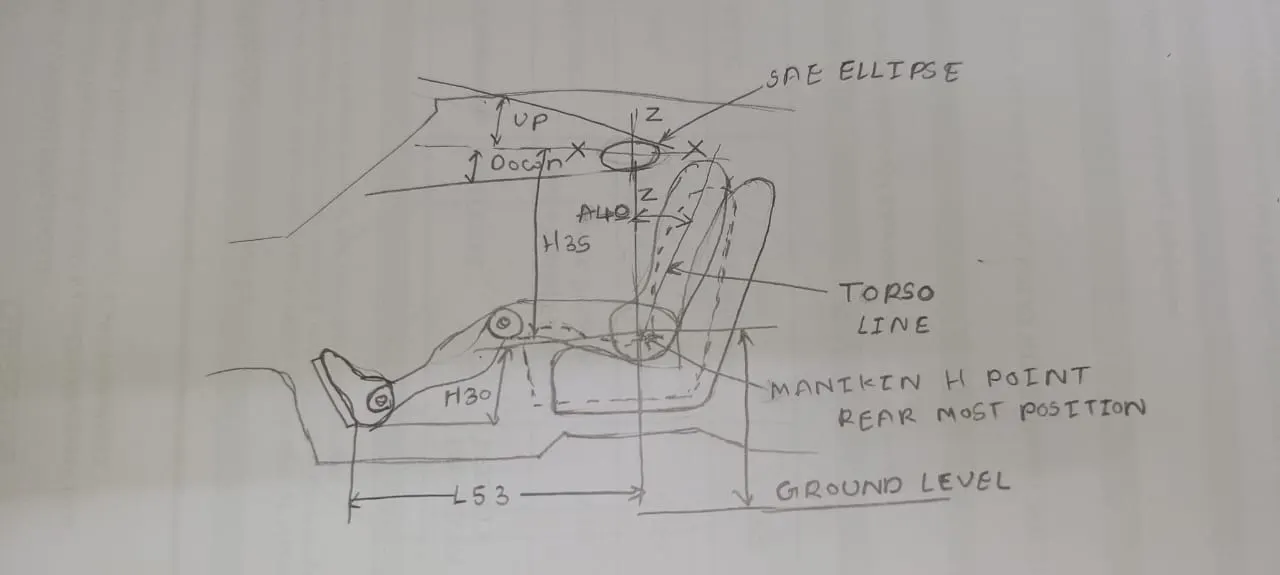
1.What is Eyellipse and how it important from OEM purpose ?
Ans- Eyellipse represents both the driver's interior and exterior visibility environment. Eyellipse combines the words eye and ellipse. Eyellipse is very basic for an automotive car design.
3.What is E – Point ?
Ans- E point refers left and right eye of the driver it’s vital thing to calculate eyellipse and there will be a 65 mm of gap between of both and this value will be match with 95% of population of the world then each eye will have the own representation.
4.What is P – Point ?Ans- This also used by oem’s to calculate the eyellipse so this point refers the pivot point of neck which is mark over the neck exactly from the between of e point 98 mm down. And it does have 4 varieties.
5.Correlation between E Point and P Point ?
Ans- Both these point helps to calculate the eyellipse of the occupant.The P-Point is generally 98mm behind the P-point(s).
6.Eyellipse calculation as per E – Point and P – Point ?
Ans- For a 95 percentile of the driver's population, the E-point are spaced at 65mm apart and the P point for the same is space below a normal line drawn from the middle centroid of the Points at a distance of 98 mm.
7.What is full form of “SgRP” ?
Ans- Seating reference point.
8.What is H – Point ?
Ans-The H-point (or hip-point) is the theoretical, relative location of an occupant's hip: specifically the pivot point between the torso and upper leg portions of the body — as used in vehicle design, automotive design and vehicle regulation as well as other disciplines including chair and furniture design.
9.Difference between “SgRP” and “ H – Point “ ?
Ans- The H-point is the theoretical, relative location of an occupant's hip. It is the pivot point between the torso and upper leg portions of the body.
SgRP point seating reference point means a design point defined by the vehicle manufacturer for each seating position and established with respect to the three-dimensional reference system. It is also called R-point.
10.What is heel point ?
Ans- A Heel point is a point of contact of the occupant's heel with the floor of the vehicle. A heel point for a driver is called an accelerator heel point or for a passenger is called a passenger heel point.
11.What is Oscar ?
Ans- Oscar is GM’s three-dimensional, mannequin-like simulation tool comfort engineers used early in the product development process of Malibu to determine the overall dimensional layout of the car’s interior. Before the interior was designed and engineered, Oscar first provided the key measurements engineering and design needed to create optimal interior space and comfort.
Technically known as a “Comfort Dimensioning System,” Oscar is assembled in 18 removable parts weighing up to 170 lbs., and is made of steel, plastic and aluminium.
12.Difference between Oscar and Oscar Templet?
Ans- Oscar is 3d machine and Oscar template is 2D device.
12.What is the purpose of Oscar?
Ans- It does give the designer idea of how the occupant will sit into the vehicle
From that approximation a point will determine that is pivot point of torso and thigh angle this is called design H point this value should be match with sgrp which is given by OEM.
And the seat can be adjusted fore and after up and down at any time through H- point so it can be done with in window this is called as H-point window.
Once the Oscar placed according to the O packaging drawing requirement the seat can be ready design around the Oscar.
13.What is Design H – Point and Actual H - Point?
Ans- It is pivot point of torso and thigh angle this is called design H point this value should be match with sgrp which is given by OEM.
Actual H-point can be recorded through the 3D Oscar machine.
14.What is H-Point Window?
Ans- the seat can be adjusted fore and after up and down at any time through H- point so it can be done with in window this is called as H-point window.
15.Type of Oscar?
Ans- There're two types of Oscars are there one is 2D Oscar template and other one is 3D Oscar machine.
Small woman 104 lbs. 5% of drivers
Midsized man 169 Lbs. 50% of drivers
Large sized man 226 Lbs.95% of drivers
16.What is the weight (in Kg) of 95 % Oscar?
Ans- 102.512 kgs
17.What is the Importance of H – Point?
Ans- Seating design is directly created effect to the occupant’s relationship to controls
And careful measurements should’ve taken while positioning the seats and adheres with specs of OEM.
And H-point might vary because of deterioration of seats notably the foams.
18.How the tolerance of H – Point Given ?
Ans- It is given as a 2D map showing the direction of the H-Point Movement over time.
19.What is D – Point regarding a Seat ?\
Ans-The bottom point of the buttocks on the seat.
20.What is the full form of AHP ? Define its usage for seats ?
Ans- AHP = Accelerator Heel Point. It is the point on Oscar’s shoe on the un-depressed accelerator pedal with foot angle at a minimum of 87-degrees. It is used in seats to establish adequate legroom for the driver.
21.What is Hand Reach Envelop ?
Ans- The reaching distance from the driver to controls, for a specific driver population, and with safety restraints employed.
22.Types of Hand Reach Envelop ? And how it is categories ?
Ans- Primary DHC -
- Steering Control
- Gearshift Control
- Turn Signal Control
- Ignition Control
- Audible Horn
- Headlamp Control
- Hand Break
- Wiper/Defroster Control
Secondary DHC
- Climate Control
- Radio Control
- Accessory Control
-
23.What is Back/Cushion Angle?
Ans- The back angle is the angle of recline of torso line relative to vertical
Then the cushion angle of incline for the cushion relative to horizontal this helps to find the amount of thigh support the occupant will have.
24.What is Ischium?
Ans- The ischium is a paired bone of the pelvis that forms the lower and back part of the hip bone, as well as the posterior and inferior boundary of the obturator foramen.
25.What is Tail Burn?
Ans- This condition will happen when driver sits on seat for long time so seat should be designed to prevent this condition.
26.How lumber help driver?
Ans- Lumber origin is lowest vertebrae in spinal column located between ribs and the pelvis
27.During RFQ what is expected from OEM?
Ans- Seat reference point
Foot angle
Knee angle
Heel point
Hip point
Back angle.
1.What is the function of a seat?
Ans- Support the occupant
Provide comfort to the occupant
Protect the occupant
Position the occupant
2.How the seat Support the Occupant?
Ans- Support the occupant is essential thing of seats because improper support will affect the comfort and safety of the occupant.
3.How the seat Position the Occupant?
Ans- There’re three essential key factors are there when it comes to seat design that are
- Hand, arm, and leg room:
Hand arm and leg room is vital for safety and control to the occupant
- Field of vision:
This one calculated by eyellipse driver should've minimal abstraction by steering wheel, instrument panel, roof line and he should be able to see clearly through the side mirrors as well.
- Driver proximity to hand controls:
Occupant must’ve been able to reach appropriate controls when the vehicle is moving condition.
4.How seat provide comfort for the occupant?
- Ans- Determine the amount of seat padding
- Avoiding hard points on seat
- Determine angle seat back and cushion
- Deciding the lumber and thigh support
- Establishing seat height and width
5.What is the full form of ILD? And how it is defined?
Ans- Indentation load defection (ILD)
The load required to compress seat pad 50% of its original thickness so there’s a load which required to compress the foam is hardness of the foam.
If a seat is too firm it will be uncomfortable and if it's too soft occupant will contact with hard point or fatigue.