Section Modulus calculation and optimization
SECTION MODULUS CALCULATION AND OPTIMIZATION
Aim- Calculation of section module of car hood and optimization using software NX cad.
section Moudulus-
The moment carrying capacity of an object is directly dependent on geometrical property (I) and material property (E) of an object,which is collectively termed as flexural rigidity(EI).Geometry of an object plays an important role in load bearing capacity of an object which is indicated by moment of inertia of a section. Therefore section modulus is the predominant factor which evidences the strength of an object and is defined as the ratio of the moment of inertia of the object about its centroidal axis to the distance of the extreme fibers of the object from the neutral axis.
Significance of section modulus
- Section modulus is the important factor for design of beam and flexural member
- Higher the value of section modulus, higher will be the resistance of member to bending
- It is required to calculate stresses in beams.
- It is used to calculate strength of the steel structure
- More the section modulus, it can withstand more load and it is also considered to be more tougher.
- Cross section Shape
Types Of Section Modulus
1) Elastic section modulus-
Elastic section modulus is the ratio of moment of inertia about a neutral axis (I neutral axis)and the maximum distance between the neutral axis and outermost fiber of beam (Ymax).
The formula of elastic section modulus is given by,
S= I / Y
Where,
I = Moment of inertia (m^4)
Y = Distance between neutral axes and outermost fiber (m)
2) Plastic section modulus-
The Plastic section modulus is used for materials where (irreversible) plastic behavior is dominant. The majority of designs do not intentionally encounter this behavior.The plastic section modulus depends on the location of the plastic neutral axis (PNA). The PNA is defined as the axis that splits the cross section such that the compression force from the area in compression equals the tension force from the area in tension. So, for sections with constant yielding stress, the area above and below the PNA will be equal, but for composite sections, this is not necessarily the case.
The plastic section modulus is then the sum of the areas of the cross section on each side of the PNA (which may or may not be equal) multiplied by the distance from the local centroids of the two areas to the PNA:
where:
- Mp - Plastic moment of the section
- Z - Plastic section modulus
- σY - Yield strength of the member materia
Moment of inertia (I) -
The moment of inertia of an object is a determined measurement for a rigid body rotating around a fixed axis. The axis might be internal or external, and it can be fixed or not. However, the moment of inertia (I) is always described in relation to that axis.
Moment of inertia also known as the angular mass or rotational inertia can be defined w.r.t. rotation axis, as a quantity that decides the amount of torque required for a desired angular acceleration or a property of a body due to which it resists angular acceleration. The formula for the moment of inertia is the “sum of the product of mass” of each particle with the “square of its distance from the axis of the rotation”.
The formula of Moment of Inertia is expressed as
I = Σ miri2.
Section Modulus Calculation-
- Section 1:- Calculation Of the hood modulus section to increase strength.
S = I/y
Where,
S = Section Modulus
I = Moment of Inertia
y = distance between the neutral axis and the extreme end of the object
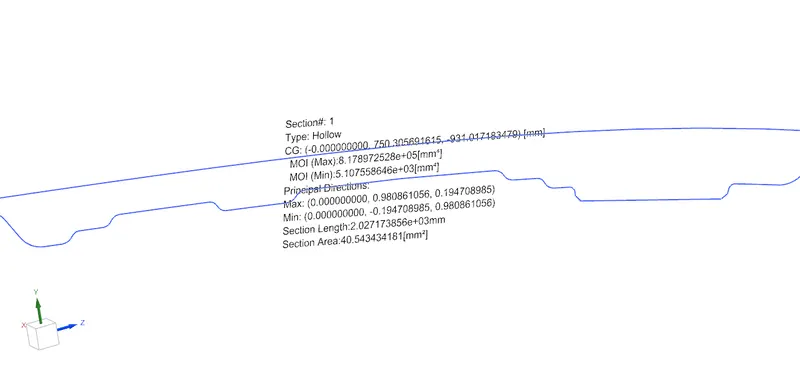
- MOI (max) = 8.178972528e+05[mm^4]
- MOI (min) =5.107558646e+03[mm^4]
- The total distance of the hood Y =487.49 mm
- Disance between the neutral axis to the extreme end = (487.49/2) = 243.745mm
To find section modulus, we have to calculate
S=I/y
S= 5.107558646x10^3 / 243.745
S=20.954mm^3
- Section 2:- Calculation of the hood section modulus for better optimization and to increase more strength offseting depth by 1mm.
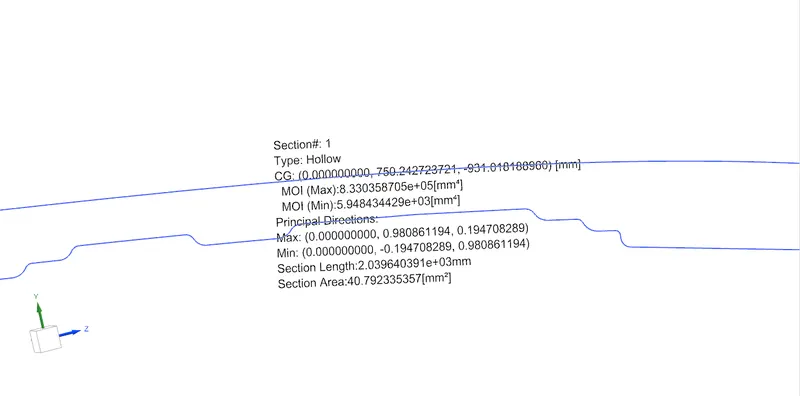
- MOI (max) = 8.330358705e+05[mm^4]
- MOI (min) = 5.948434429e+03[mm^4]
- The total distance of the hood Y =489.5 mm
- Disance between the neutral axis to the extreme end = (489.5/2) = 244.75mm
To find section modulus, we have to calculate
S=I/y
S= 5.948434429x10^3 / 244.75
S=24.304 mm^3
Conclusion- From above section modulus calculation we found that we can increased the strength of hood by 3.35mm^3 just by offseting a body depth by 1mm without changing material and it's grades. hence increase in sectional area there is have increase in overall mass of an object and have increase in strength.