Week 1 Challenge
Aim and Introduction:
- To explain the different types of foundations and to explain the selection of foundation type based on the requirement.
- To name the components of a reinforced concrete bridge that is resting on an open foundation, subjected to seismic loading.
- And to brief about three-span continuous bridge subjected to a different type of loadings having two different carriageway of 12m and 7.5m width.
- To give a brief explanation of forces acting on shallow foundations with pier and abutment subjected to various loading conditions.
- To apply the load and to show force distribution in footing.
- Foundation: A foundation is a lower part of a building structure that transfers its loads to the earth. Foundations are classified into two categories: shallow foundations and deep foundations
- The function of a foundation is to distribute the weight of the structure over a large area and to provide structural stability of the building that helps to avoid any overloading on other parts of the structure.
Elaboration:
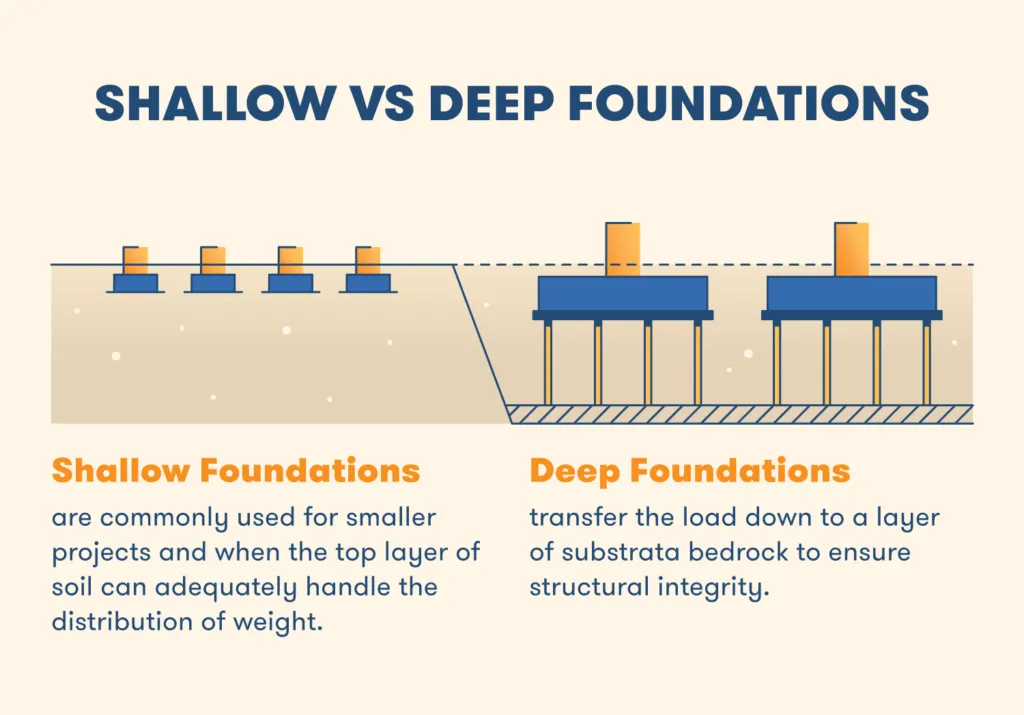
Fig. 1
- Foundation: 1. shallow foundation, 2. Deep foundation.
- shallow foundation:
-
- The foundation which is placed near the surface of the earth that transfers the loads at shallow depth is called the shallow foundation, where foundation width is greater than or equal to its depth.
- A shallow foundation is a type of building a foundation that transfers the structural load to the earth very near to the surface, rather than to a subsurface.
- Based on load mechanism Shallow foundations transfer loads by end bearing.
- The advantage of a shallow foundation is construction materials are available, less labour is needed, construction procedure is simple at an affordable cost.
- The disadvantage of this type is the possibility of a settlement, applicable for lightweight structure, weak against lateral loads.
- The shallow foundation is also called the open foundation.
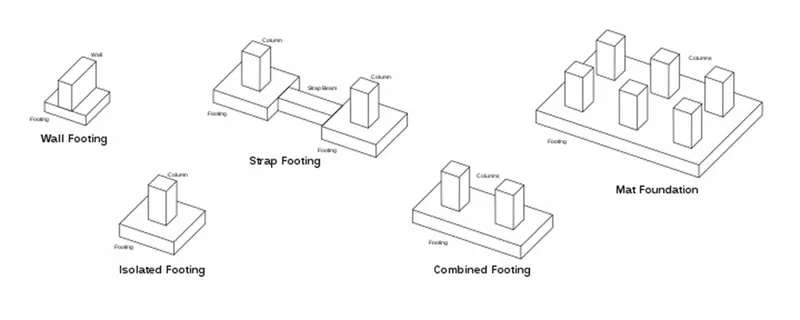
- Shallow foundation types :
1. Strip:
-
Foundations extending below the walls of the building.
- Isolated:
-
Footings provided separately under the columns, each footing takes the concentrated load of the column and distributes it over a larger area so that the stresses on the soil does not exceed the safe bearing capacity of the soil.
- Combined:
They are footings installed under every two or more columns of a building, each footing takes the concentrated load of two columns and distributes it over a larger area so that the stresses on the soil do not exceed the safe bearing capacity of the soil.
- Mat:
Foundation that is placed on the entire surface of the ground beneath the building and serves as a single base on which to build the structure.
-
- Fig. 2
- 2. DEEP FOUNDATION:
-
- Foundation which is constructed at a greater depth that transfers the loads to deep strata is called the deep foundation, where foundation depth is more than or equal to its depth.
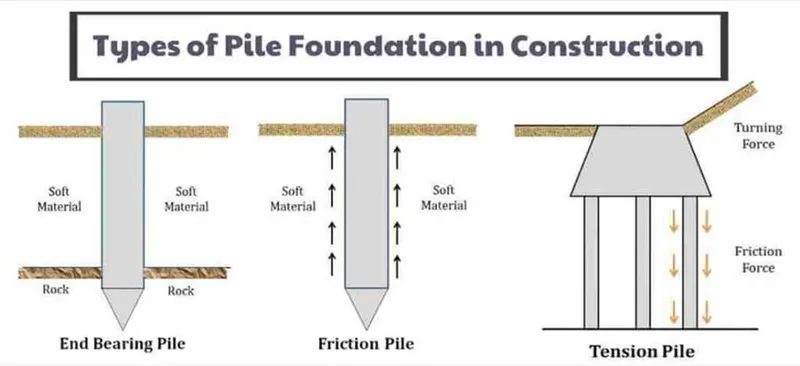
- Deep foundations depend both on end bearing and skin friction, with few exceptions on the end-bearing piles.
- Deep foundations are more expensive than shallow foundations.
- The advantages of the deep foundation are the foundation can be provided at a greater depth, Provides lateral support and resists uplift, can carry a huge load.
- The disadvantages of a deep foundation are expensive, requires skilled labour, complex construction, time-consuming and some types of deep foundations are not very flexible.
-
- Fig. 3
- Piles
-
A pile is as a long cylinder or squared of a strong material that will be pushed into the soil so that structures can be supported on the top of it.
Piles are usually used in the following cases:
- The soil is so weak, so we use the piles below the reinforced bases of the superstructure to carry their load to a layer of soil at great depth with the ability to carry loads of the superstructure.
- When a building has massive, concentrated loads, such as in high-rise buildings.
- Caissons and Pier :
They are huge deep foundations of different shapes and dimensions
- SELECTION OF FOUNDATION: Based on the below conditions the type foundation can be selected.
- Building height:
The higher the height of the building, the more concentrated the loads on the soil, and the type of foundations suitable for buildings with low elevations is not suitable for buildings with high elevations.
The purpose of the building:
The purpose of the building determines the number of loads in it, and therefore the loads transferred from it to the foundations. For example, warehouse buildings and multi-story car parks are considered to have greater loads than administrative buildings, which in turn are considered to be greater loads than residential buildings.
Soil type:
-
There are so many types of soil that can bear high stresses, such as stone or rocky soil, and other types that bear fewer stresses, such as sandy or clayey soil. The suitable foundation for the building varies according to the type of soil at the site.
RCC GIRDER BRIDGE and its components:
- A structure is built over an obstruction like water, a low place, or a railroad so people can cross over the obstruction.
- Bridge components play an important role in maintaining the stability and functional requirements of the bridge.
- The bridge component types and functions vary as per the site conditions, design and functional requirement.
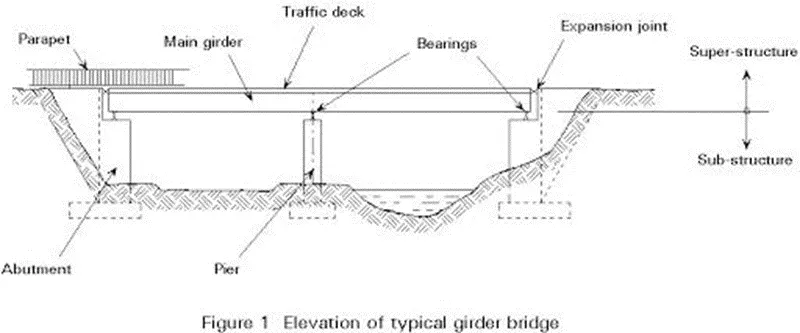
Fig. 4
- The components of the bridge are:
Substructure and Superstructure
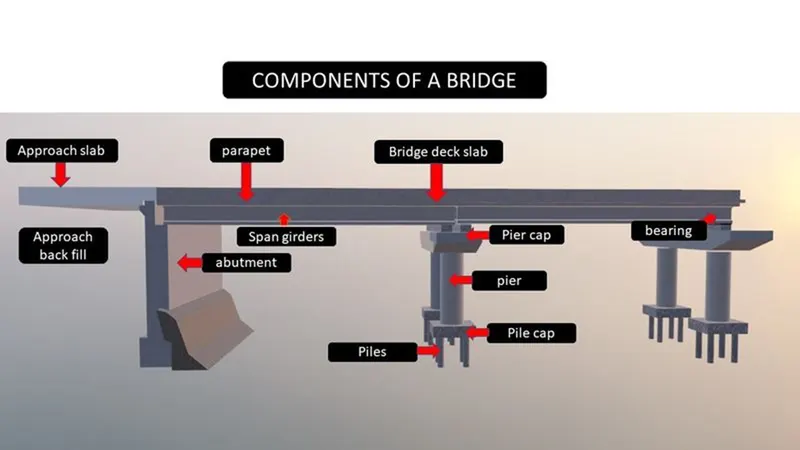
Fig. 5
- The substructure components are:
a) Abutments: The support provided at the two ends of a bridge is known as an abutment.
b) Wing walls and return walls: the wings walls are near to the abutments that act as retaining walls.
c) Piers: Pier is the compression member which stays above the pile and makes the structure stable. Piers provided for span at intermediate points.
d) Pier cap: Pier cap is the component which transfers loads from superstructure to the pier.
e) Pile: The Pile is a fundamental component. A pile-type foundation is generally needed when the upper soil layer is loose. Pile depth depends on the soil layer. To find the hard soil layer which will make the structure stable, the pile is usually extended to some depth into the hard soil layer.
- SEISMIC EFFECTS ON BRIDGE: Earthquakes damage bridges by shaking it and causing structural damage, in an RCC bridge Bearings gets damaged, a bridge may fall down, it cracks severely.
- As per IRC clause 218 (GUIDELINES FOR SEISMIC DESIGN OF ROAD BRIDGES).
- a) Bridges more than 150 m span.
b) Bridges with piers taller than 30 m in Zones IV and V
c) Cable supported bridges, such as cable-stayed and suspension
bridges.
d) Arch bridges having more than 50 m span. - Loads to be considered on the bridge :
- Dead load
- Live load
- Impact load
- Wind load
- Longitudinal forces
- Centrifugal forces
- Snow load.
- Effect of water current
- Temperature load effects
- Seismic loads
- Barge impact load.
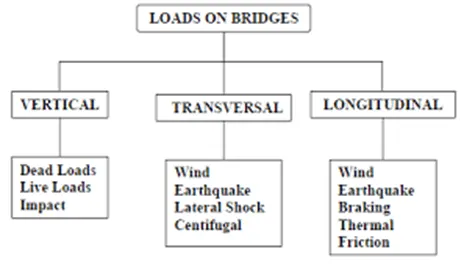
Fig. 6
- Forces on the shallow foundation :
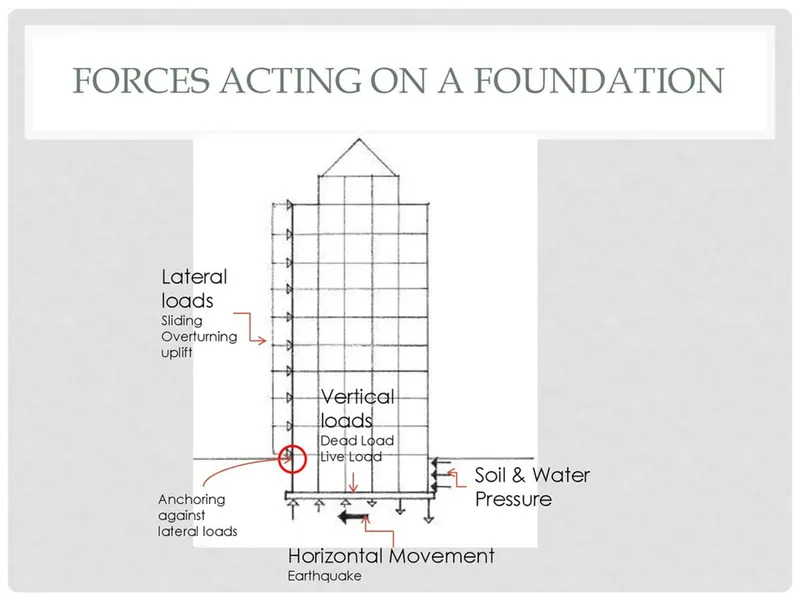
Fig. 7
- Sliding: if the depth of the foundation is small or the sub-soil below the foundation is of a sliding nature it may slip away under the loads and cause the failure of the foundation.
- Overturning: Due to some loads the structure may overturn that causing failure.
- uplift, soil and water pressure are the loads acting the shallow foundation.
FUNCTIONS OF PIER AND ABUTMENT:
- A abutment is a structure which connects the deck of a bridge to the ground at the ends of a bridge span, supports its weight both horizontally and vertically.
- Abutments at each end provide vertical and lateral support for the span, as well as acting as retaining walls to resist lateral movement of the earthen fill of the bridge.
- To transfer the superstructure vertical loads to the foundation and to resist all horizontal and transverse forces acting on the bridge.
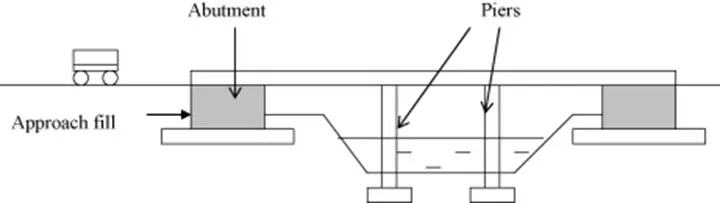
Fig. 8
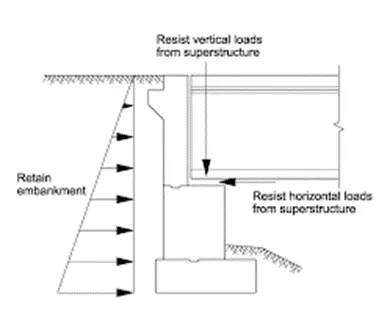
Fig. 9
Distribution of forces in footings :
- Loads from the structure are transferred to the soil through the footing, soil exerts upward pressure on the bottom surface of the footing which is known as pressure distribution.
- Distribution of soil force under a footing is based on the type of soil, the relative rigidity of the soil and the footing, and the depth of foundation at the level of contact between footing and soil.
RESULTS:
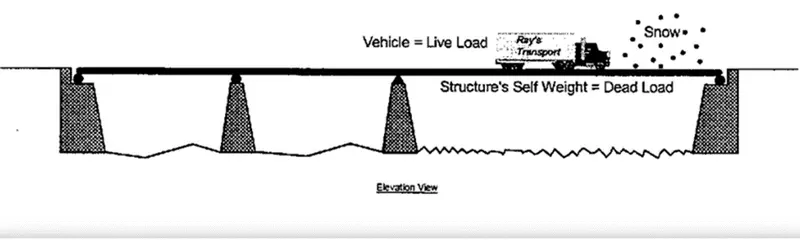
Fig. 10
- The above diagram shows the types of loading acting on the bridge
- The bridge and its components and the types of loading acting the bridge are elaborated above, The foundation and its type, selection of foundation based on requirement, distribution of loading are elaborated above in a detailed manner.