Week 1 Challenge
1.Original equipment manufacturer.
2.They are responsible for the cost of production, the timeframe of completion, vehicle type and use, and finalizing the draft of the design. They create the final design using computer-aided technology and AI tech
3.Tier Four refers to the raw material source, such as the farm that grew the cotton plant or raised the livestock. Fashion relies on agriculture for the production of cotton, wool, leather, the feedstocks for man-made cellulosics, silk, furs, hemp, linen, and many more materials.
4.January 29, 1886.
5.Wooden seat.
6.The 3D reference System is used to locate all component in the vehicle
7.There are many parts in a car it is defeclute to find if ther is no system so the 3D reference system needed.
8. i. x plain reprecent the length of the vehicle
ii. positive “x” qurtinate lies on rear of the vehicle
9.The plane of point where one of the co-ordinates "0".
10.The point of origin of the 3D system is the interection point of the three planeswhere all co ordinates are "0" zero.
11.i. pumber
ii. roof
iii. hood
12. Work Line
- Work Line are located on individual part.
- It is used for dimension ofr indujial parts.
- It is used to project view of the part at diffrent angels
Grid Lines
- Grid Lines are formed by interction of two planes located at 100 mm.
- It is used to locate an object in the vehicle.
- It is also refered as body lines.
13.no Work Line and Grid Lines are inter connected
14.The angle of your seat back should be a little greater than a perpendicular 90 degrees.
15. At 100 to 110 degrees, the seat will put the least pressure on your back.
16.The center line is the longitudinal axis of the vehicle that divides it into two haves
17.It runs throgh frond bumber to rear side of vehicle
18.The y-axis is perpendicular on the x-axis and the positive direction is pointing to the right side of the wheel.
19.The z-axis is normal to the road, the positive direction being upwards.
20.RHS
A right-hand drive vehicle has the controls on the right side, and the vehicle is intended to be driven on the left side of the road
LHS
Left hand drive, a vehicle with the driving controls mounted on the left side of the cabin. Used in most countries where traffic travels on the right-hand side of the road
21.Left hand drive
22.negative
23.Left hand drive
24.Center
25.right to left (or other vise) left to right
26.Left (or other vise) Right
27. Seat
28.IB:Inboard
OB:Outboard
29.positive longitudinal
30.positive longitudinal
31.positive
32.China
33.
34.Germany
35.
36.US, All European countries except England
37.India, England, Ssouth Africa. Australia
1.To define drivers eye position. To define Vision angle for pedestrian safety, to minimise vision angle by optimising BIW Design
2.
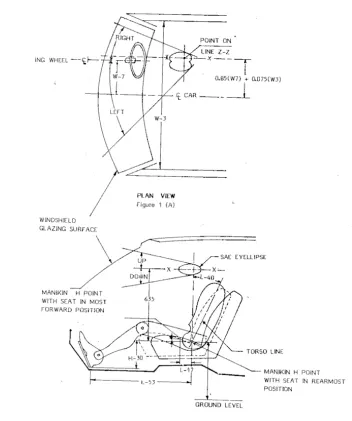
3.Drivers eye position for 95% Manniquin.They are 65mm apart from each other
4.Neck pivot point
5.For 95% Manniquin, Eye points are 65mm apart from each other and P Point at a ditance 98mm from the centroid of Eyepoints
6.For 95% Manniquin, Eye points are 65mm apart from each other and P Point at a ditance 98mm from the centroid of Eyepoints
7.Seating Reference Point
8.Hip Point onwhich maniquin placed on Seats for Ergonomy evaluation
9.Both are same. From the Supplier point of View, H-Point will be considered as Seating Reference Point
10.Point of Contact of Foot of the Occupant in the floor of the Vehicle. For the driver, Heel Point is Accelerator PedaL point and for the other occupants it will be considered as heel point
11.Its a dummy to measure vehicle seating accomodation.
12.
- 3D representation of Ddummy - Oscar
- 2D representation of Ddummy - Oscar Template
12.To evaluate Roominess and Ergfonomic constraints
13.
- Design Hpoint - H point determined through 2D (Ocar Template)
- Actual Hpoint - H Point recorded through Oscar machine
14.Zone in which H- Point can vary taking seat adjustments along the XYZ directions into consideration
15.
- Small women - 104lbs (5% drivers)
- Mid sized man -169 lbs (50% Drivers)
- Large sized Man - 226lbs (95% Drivers)
16.224lbs
17.
- Evalutae Ergonomie,design of seating Compenents.
- It influences other compenent design through Vision angle, head room,shoulder room etc
18.Its either a Circular or rectangular zone, most OEM's preffer Circular zone
19.Lowest point of Buttock contour of Manniquin
20.Accelerator Heel Point. Defines postion of the foot, when manniquin placed on H-Point.
Its normally 87 deg of foot angle.
21.Defines the zone, accesible by the maniquinn, when it is placed on H-Point.
22.
- Primary Hand envelop: Zone reached by the Maniquinn without any constraints or movement
- Secondary Hand envelop: Zone reached by the Maniquinn with allowable constraints or movement
23.Back Angle:
Angle of inclination of Torso with respect to Vertical
Cushion Angle:
Angle of inclination of Cushion with respect to Horizontal
24.Lowest point of the three major bones of pelvis. It is the point, where support of Maniquin sits on the seat
25.Condition when an occupant is seated for an extended period of time
26.Lumber helps support back of the Occupant
27.
- Seat Refference Point
- Foot angle
- Knee angle
- Heel Point
- Hip point
- Back angle
1.Provide Comfort, support and position for the occupant
2. providing position for the Occupant, enahancing cofortness through Cushion
3.
Roominess: To provide enough roominess to acess gadgets while driving
Vision angle: To provide enough vision of pedestrian and other acesories while driving
4.By means of Cushion(foam) optimized to be adjustable based on drivers body size
5.
- Indentation Load Deflection
- Defines how much load cushion can withstand, when the seat pad is reduced to 50% of its origial thickness