Section Modulus calculation and optimization
Section modulus
- Section modulus is a geometric property for a given cross-section used in the design of beams or flexural members.
- It may be defined as the ratio of total moment resisted by the section to the stress in the extreme fiber which is equal to yield stress.
- The section modulus depends upon the moment of inertia which again depends not only on the total area of the cross-section but also on the disposition of the area with respect to neutral axis.
- It is the ratio of moment of inertia and the distance of the topmost or the bottommost fiber from the neutral axis. (S=I/Y)
Where,
S = Section Modulus
I = Moment of Inertia
y = distance between the neutral axis and the extreme end of the object
There are two types of section moduli
1) Elastic section modulus
2) Plastic section modulus
1) Elastic section modulus
- For general design, the elastic section modulus is used, applying up to the yield point for most metals and other common materials.
- The elastic section modulus is defined as S = I / y, where I is the second moment of inertia and y is the distance from the neutral axis to any given fibre.
- It is often reported using y = c, where c is the distance from the neutral axis to the most extreme fibre.
- It is also often used to determine the yield moment (My) such that My = S × σy, where σy is the yield strength of the material.
2) Plastic section modulus
- The plastic section modulus is used for materials where elastic yielding is acceptable and plastic behavior is assumed to be an acceptable limit.
- Designs generally strive to ultimately remain below the plastic limit to avoid permanent deformations, often comparing the plastic capacity against amplified forces or stresses.
- The plastic section modulus depends on the location of the plastic neutral axis.
- The PNA is defined as the axis that splits the cross-section such that the compression force from the area in compression equals the tension force from the area in tension.
Procedure for finding the section modulus.
section:1
- Select the designed hood.
- Create the datum plane on the inner panel.
- Then create the intersection line on the hood.
- To create the intersection curve command is selected. Then select the outer panel ,inner panel and the plane.
- Then hide the hood panel the line has been created.
- Then select the sketch option and project curve.Then select outer panel of the outer line and inner panel of the outer line.
- Then join the line by profile command.Then the corner are joint by corner command.
- Then calculate the section inertia analysis.
- Then the value is calculated
section:2
- Select the designed hood.
- Create the datum plane on the inner panel.
- Then create the intersection line on the hood.
- To create the intersection curve command is selected. Then select the outer panel ,inner panel and the plane.
- Then hide the hood panel the line has been created.
- Then select the sketch option and project curve.Then select outer panel of the outer line and inner panel of the outer line.
- Then offset the inner panel and join by line.
- Then calculate the section inertia analysis.
- Then the value is calculated.
HOOD SECTION VIEW
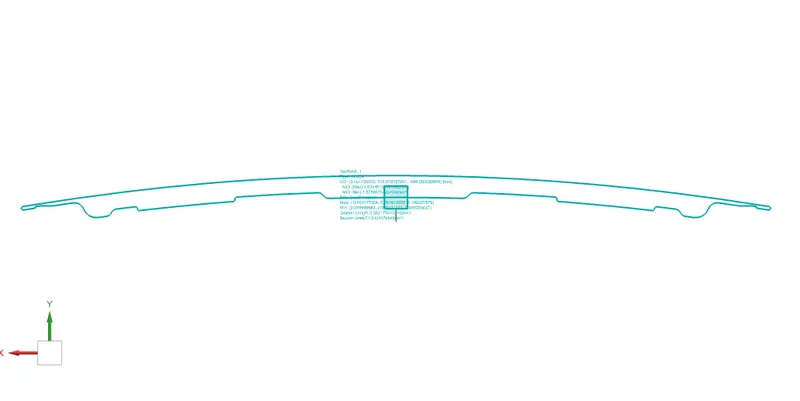
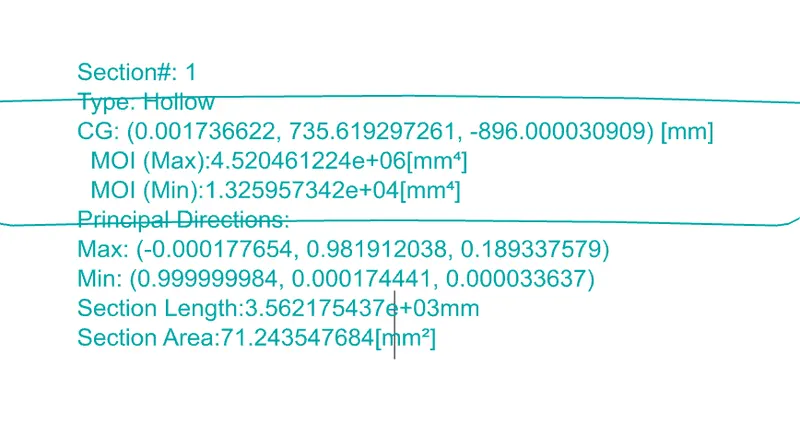
calculation:
S = I/y
Where,
I = 1.3259x10^4mm^4
y = 431.76 mm
s= 1.3259x10^4/ 431.76
s=30.709mm^3
MODIFIED SECTION oF THE HOOD.
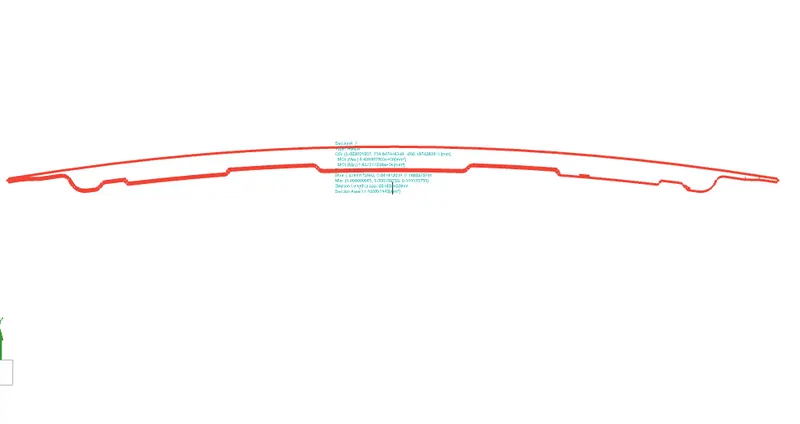
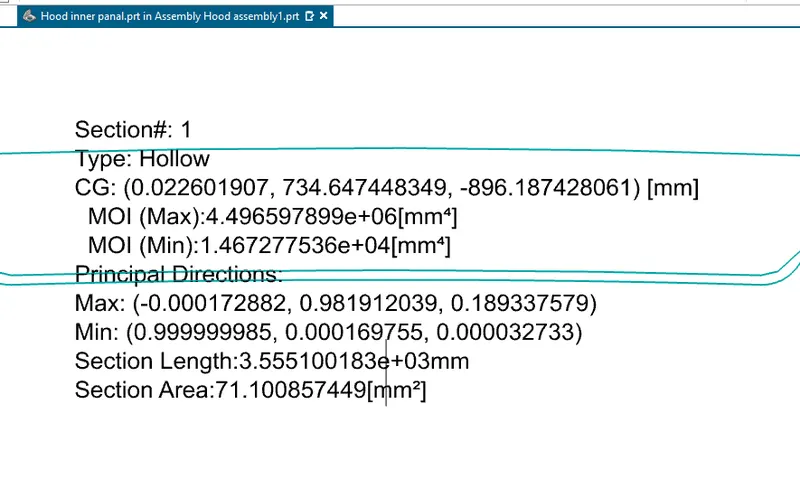
calculation:
S = I/y
Where,
I = 1.4672x10^4mm^4
y = 431.76 mm
s= 1.4672x10^4/ 431.76
s=33.981mm^3
Conclusion :
- The above calculation shows that section 2 has a greater section modulus than section 1.
- All these calculations are essential while designing to know the strength and load-carrying capacity of the given component.
- By increasing the area of the section the moment of inertia and the section modulus increases and load material also increases