Week 1 Challenge
1. Create a design summary report (DSR) for the following items for any highway you are aware of in your region. Mention the highway name, and location: -
- Category/Class of the road.
- Design speed of the road.
- Terrain classification.
- Travel Lane width.
- Typical min. cross slope.
- Horizontal curve radius without superelevation.
2 What is the typical roadway project life cycle workflow? List out in points. What is the typical roadway design workflow? Also, list out all the experts needed on a roadway project.
3. What are the important geometrical parameters of a horizontal alignment and vertical profile? When is a vertical curve needed? List the formula with a diagram for vertical curve. List all types of vertical curves with the diagrams.
4. When is superelevation necessary? Show diagrammatical presentation of super concept.
5. List out the typical set of submission needed for a roadway project.
6. Draw a typical cross section with following parameters –
- 12’ travel lane
- 10’ shoulder lane
- 2% cross slope
- 2’ berm
- End conditions with cut/fill of 6:1 and 4:1
- Ditch condition of front slope 4:1, back slope 4:1, 3:1
1. Create a design summary report (DSR) for the following items for any highway you are aware of in your region. Mention the highway name, and location: -
Name of the road: Mumbai-Nagpur expressway or nagpur-mumbai super communication expressway (maharastra samruddhi mahamarg)
Category/Class of the road. Super communication expressway/greenfield road project
The design speed of the road: 150km/hrs at plain terrian and 120km/hrs at hilly terrain
Terrain classification: plain and hilly
Travel lane width: 6 lane(expendable to 8) with paved and unpaved shoulders on both sides, with each lane width of 3.5m
Total ROW available: 120m(90m in hilly terrain) with a central median of 22.5m
Typical min cross slope: minimum cross slope of 2.5% would have been adopted as per IRC SP 99
Horizontal curve radius without superelevation: Generally maximum radius where no SE is need for 150kmph design speed and min cross slope of 2.5% is 4000m
2 What is the typical roadway project life cycle workflow? List out in points. What is the typical roadway design workflow? Also, list out all the experts needed on a roadway project.
The parameters that are included in roadway project workflow are as follows
1 Design summary report(DSR):
- Roadway(name,location,lenght,limits)
- Type of work(New construction,Reconstruction,Realignment,widening,overlay,milling)
- Class of roadway
- No of traffic lanes
- Lane width
- Shoulder width
- Median width
- Curb and gutter
- Bridge/Culvert data
- Stream data
- Railway and road crossing
- Intersections
- Right of way
- Utilities
- Type of terrain(topographical survey, typical sectionss, geometric design)
- Design speed limit
- Maximum horizantal curve
- Maximum superelevation rate
- K value (sag/crest)
- Maximum grade
- Typical cross slope
- Side walk/SUP width
- Side walk/SUP slope
- Horizontal
- Vertcial
- Ditch front slope(desirable/max)
- Ditch back slope(desirable/max)
- Fill height before(retaining wall)
- Clear Zone
- Vertical clearance for bridge/others
- Multiple agencies are involved in roadway design project
- Survey
- Roadway
- Drainage
- Bridge/structure
- Utilities
- Traffic
3. What are the important geometrical parameters of a horizontal alignment and vertical profile? When is a vertical curve needed? List the formula with a diagram for vertical curve. List all types of vertical curves with the diagrams.
Parameters of a horizontal alignment and vertical profile
Horizontal alignment:
- Basic elements of horizontal alignment
- Curv radius
- Superelevation rate
- General considerations
- Safe smooth,aethetically,pleasing facilities
- Flatter curves
- Caution in using compound curves
- Avoiding compoud curves infornt of flat simple curves
- If used, the radius of flatter curve should be less than 50% of the radius of sharper curve
- For intersections or other turning roadways, it can be increased to 100%
- Consistancy in alignment
- Sharp curves should not follow tangent or a series of flat curves
- Avoiding sharp curves in highway long fill areas
- Including interversing tangent at reverse curves on highspeed facilities
- Broken back curves should not be used
- Design speed should be consistent with design feature and topography
Vertical Alignment:
The curve between two lengths of a straight roadway that possess different gradients. The curve provides a gradual change for haulages from one inclination to the other. The curve leading to the top or brow of an inclined plane would be convex and at the bottom would be concave.
Basic elements of vertical alignment
- Grade
- Vertical curves
Vertical curves provided gradual chnages between tangents of different grades
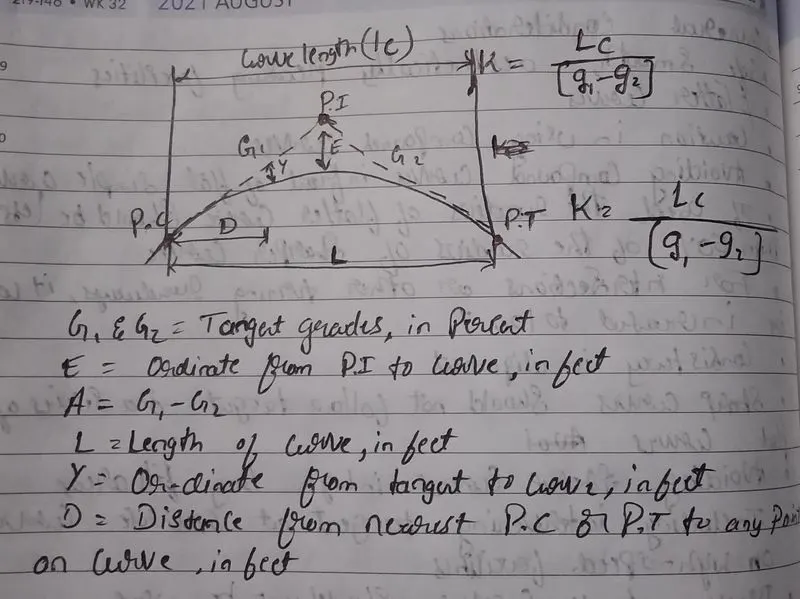
Types of vertical curve:
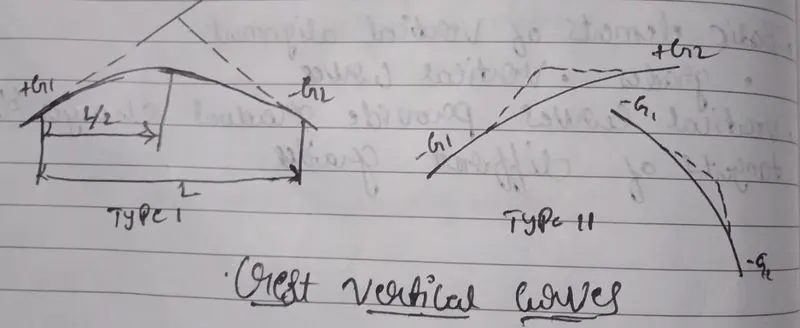
1.Crest curve/Hilly curve
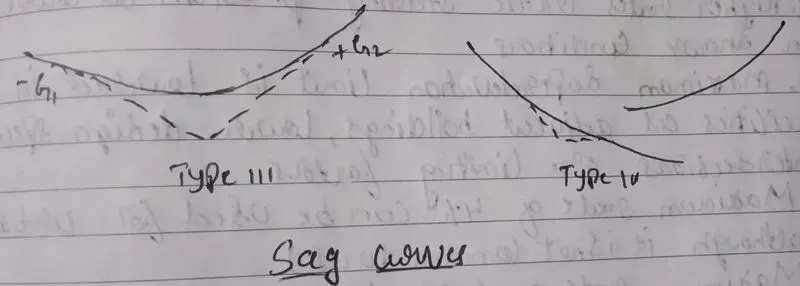
2.Sag curve/Vally curve
1.Crest curve:
Crest curve are vertical curves with gradient upwards when a vechical approaches a crest curve, the view of the road is cut off beyond the sumit. there fore, to secure the required sight diatance,the intersection of two grades should be cased off by providing a design vertical curve
2.Sag curve:
A sag curve is a vertical cruve with concaving upward and convexity downward.sag curve is visibility is not a problem during day time
However, during night time the design must ensure that the roadway is properly illuminated by vehical headlight to a sufficient lenght enabling the vehical to stop safely by applying brake
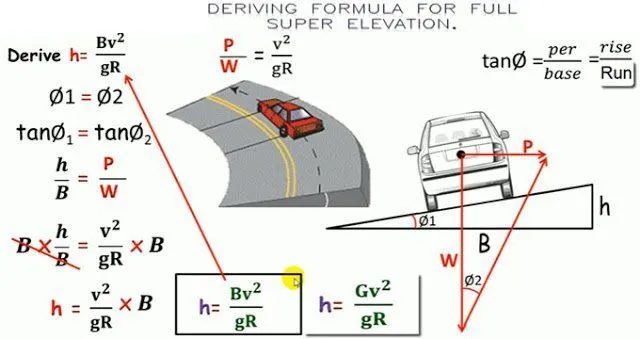
4. When is superelevation necessary? Show diagrammatical presentation of super concept.
Superelevation
Superelevation is the banking of a roadway along a horizontal curve so motorists can safely and comfortably maneouver the curve at reasonable speeds necessisty of superelevation. it facilities moving of vehical at highspeed on a curve path as on a straight path devoid of any risk pf overturning and thus results into elevated volume of traffic.the centrifugal force is counteracted by superelevation and friction, to prevent skidding, the surface of the road is given an inward tilt which is known as superelevation
When a road is superelevation,the component of weight of the vehical along with the surface aids friction i counteracting the centrifugal force.The rate of superelevation generaly increase with speed and sharper curvature
Advantage of superelevation
- It provides drainage for the whole width of road towards the inner side,thus there is no requirement of a side drain
- It permits running of vehicle at high speed on a curved path or a straight path without any danger of overturning and thus results into increased volume of traffic
- It also helps to keep the vehical to their proper sides on the poavement and thus prevents collisions of vehicles moving in opposite direction on a curved portion of the road
- Reduce the discomforts
- Reduce the chances of over turning of the vehicles
- Allows higher speed at curve
- Wear on running gears in reduce
5. List out the typical set of submission needed for a roadway project.
Plan sheet:
- coversheet
- Index sheet
- Project layout
- Typical sections
- Plan and profile
Cover sheet:
- Client's name
- Project name
- Project scope
- Project kay map
- Start and end limits
- Lenght
- Traffic ADT
- Speed
- Approaching authorities
- Submitting authorities
Index Sheet
- Content of the submisson package
- General drawing
- Roadway drawings
- Traffic drawings
- Drainage drawings
- Signing and pavement
- Bridge drawings
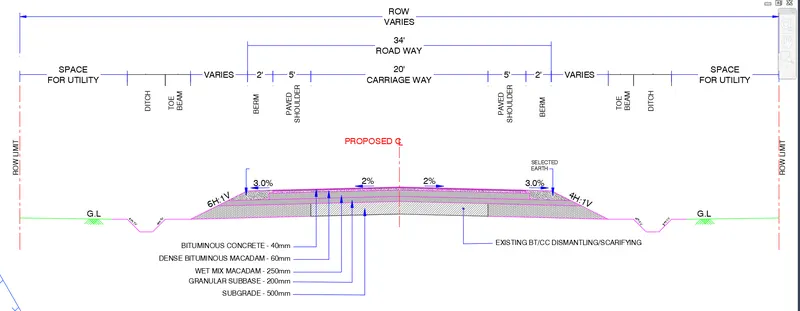
6. Draw a typical cross section with following parameters –
- 12’ travel lane
- 10’ shoulder lane
- 2% cross slope
- 2’ berm
- End conditions with cut/fill of 6:1 and 4:1
- Ditch condition of front slope 4:1, back slope 4:1, 3:1Ans