Week 1 Challenge
1.What are different type of foundation in bridges and how selection of type is made.
Foundation:- The lower most part of a structure which is in direct contact with the ground to transit all the type of loads is known as foundation.
- Functions of foundations-
-
Distribute the load of strucure on larger areas and on underlying soil evenly .
-
Provides a leveled surface for the super structure.
-
It resists sliding,overturning,or other forces like hydraulic, seismic etc.
-
It prevents lataral movement and ensure the safety of structure.
-
- Foundations are basically of two types.
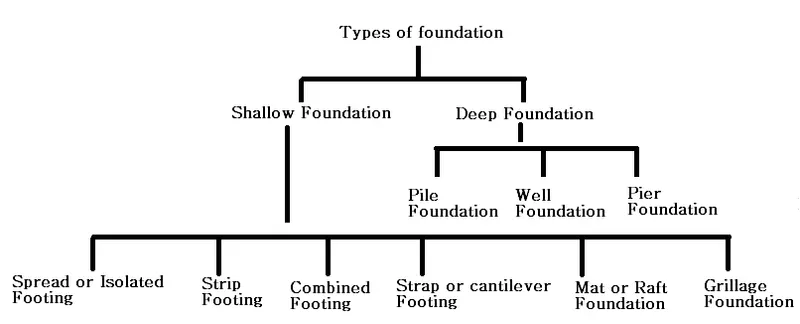
- Shallow foundation - The type of foundation in which the depth of foundation is less than or equal to the width of foundation is known as shallow foundation.
- Advantages-
- Comparatively economical.
- It's construction procedure is simple.
- Doesn't need expertise labour.
- Disadvantages-
- Larger settelment occur in shallow foundation.
- Advantages-
- Deep Foundation - The type of foundation in which the depth of foundation is greater than the width of foundation is known as Deep foundation.
- Advantages-
- Piles can be prefabricated off-site which allows efficient installation on the site.
- Induced piles displace and compact the soil which will increase the bearing capacity of the pile.
- Increase overall productivity.
- Disadvantages-
- Piles can undergo corrosion.
- Skilled labor is require.
- Advantages-
Types of Shallow Foundation:-
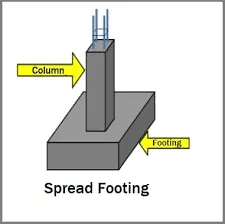
1.Spread Footing :- A footing that supports a single column or pier is known as spread footing / Isolated footing. It can be square, rectangular or circular type.
It is provided where the load coming on the foundation is less and trasmitted to the ground through one single column.
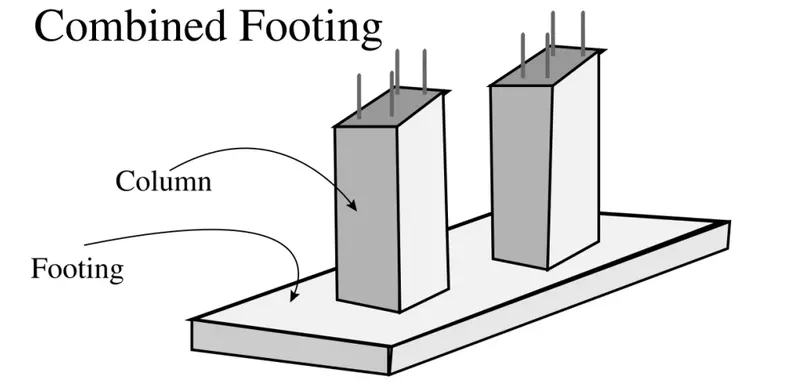
2.Combined Footing :- A footing that supports a two columns is known as combined footing. It can be rectangular or trapizoidal type.
It is provided basically where the impact of load distribution of a single column coincides with the nearest column.
C.G. of column load and cenroid of footing should coincide.
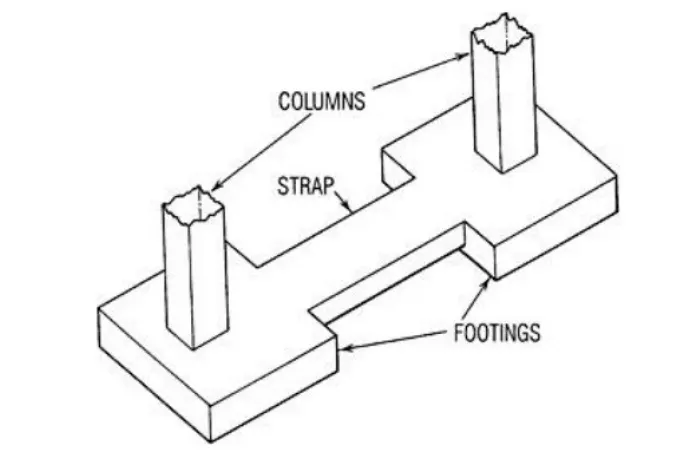
3.Strap Fooundation :-
Two isolated footing connected with a strap or beam connects in such a way that they behave as one unit.
The strap is designed as a single beam.
It is used to connect eccentrically loaded column used to transmit the moment.
It can be used when the distance between two footing is large insted of using combined footing.
It is comparatively economical than combined footing.
4. Mat or Raft Foundation:-
It is a type of combined footing where more no. pf column are to be provided.
Generally if the area of isolated footing is more than 50% of the construction area then raft foundation is provided.
Types of Deep Foundation:-
Deep foundations can be selected based on following criteria.
- Hard soil is at greater depth.
- Loading is concentrated on Hard soil starta.
- Soil is susceptible to liquifaction.
- Construction in very loose soil like black cotton or in swampy area.
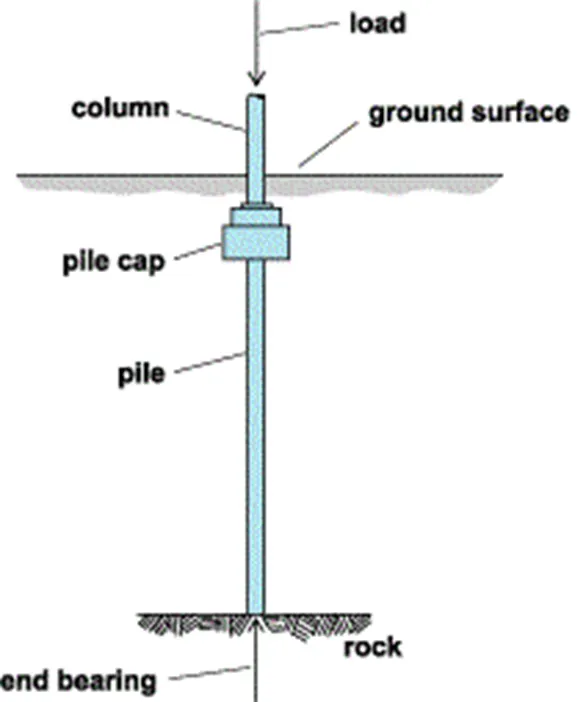
1.Pile Fooundation :-
The pile is a column capable of transferring structural loads to the underlying layers.
- Vertical piles are used to carry the vertical compressive load of superstructures such as bridges, buildings, etc.
- Use of piles to resist lateral loads in bridge and retaining wall structures.
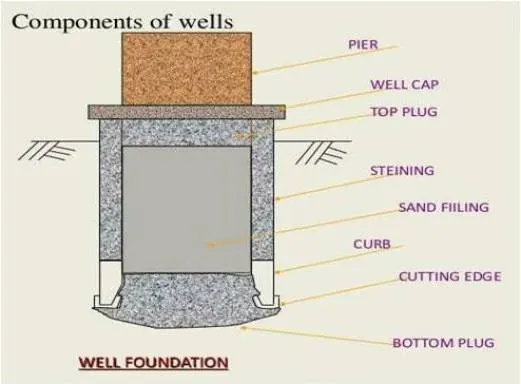
2.Well Fooundation :-
It is constructed in reference to excavation for the foundation of bridges, piers in rivers, dock structures etc.
- This foundation is more suitable for underwater foundations.
- These foundation has been built in connection with the excavation of the foundations of rivers and ponds, bridges, breakwater dock structures for the approach to rivers and ponds, ponds, deep houses, etc.
2.Name all the components of a RCC girder bridge resting on open foundation.
Bridge- A Bridge is a structure for carrying road traffic or other moving loads over a deep valley or obstruction such as a river, channel, road, or railway witthout obstructing the way beneath.
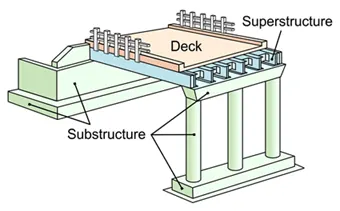
- The major parts of a bridge,
- Substructure
- Superstructure
1.SUBSTRUCTURE
The structure of the bridge below the level of bearings is known as the Substructure. It consists of the following.The function of the substructure is to support the superstructure components and transmit the loads safely to the ground soil.
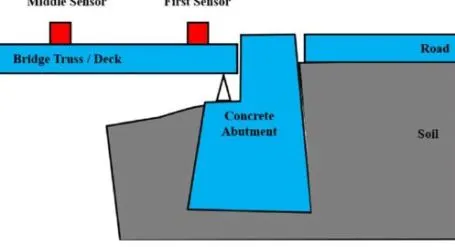
Abutments
It is a structure mostly used for bridges and dams as a substructure at the ends. This is a type of structure which retains the lateral movement of soil primarily. A bridge with a single span has two abutments that offer vertical and lateral support.
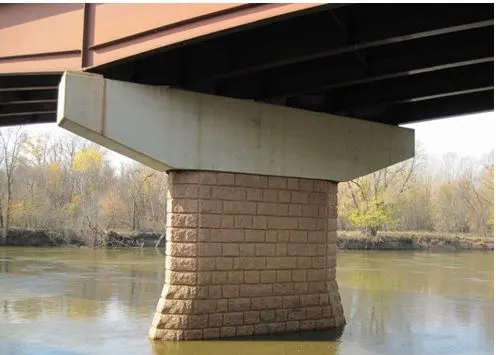
Piers
Piers provide intermediate support between two bridge spans. Bridge piers mainly support the bridge superstructure element and transfer the load to the foundation.
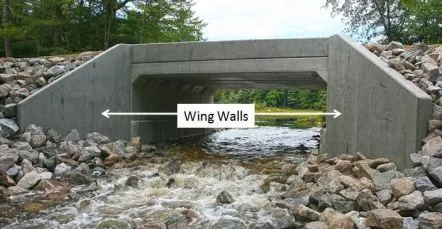
Wing Walls
It is one of the earth retaining structures in the bridge. They are located adjacent to the abutments and act as retaining walls. The wing wall retains soil for abutment, roadway, and approach embankment.
2.SUPER STRUCTURE
The components of the bridge above the bearing are known as superstructures.
i.Deck Slab:- The slab on the top of a bridge which inturn supports the carriage way is called as the Deck slab.
ii.Girders:- Girder is also one type of beam support. Where loads are heavy girders are used instead of beam support. These girders can be of various types according to the requirement as I girder, T girder etc.
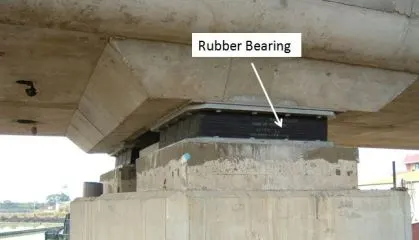
iii.Bearing-
A bearing is provided between the bridge girder and the pier cap. The main function of the bearing to allow free movement or vibration of the top superstructure and reduce effect stress to reach the bridge foundation.
iv.Parapet Wall/Crash Barrier
This is one of the safety components which prevent the vehicle from falling off where there is a drop.
what additional effects it will create if we have
a) seismic case 5
- Sites with sandy loose soils, poorly compacted clays, and fill materials should generally be discarded due to their excessive settlements during seismic vibrations. Also, sites with very high water table should be avoided. These recommendations are particularly important for seismic zones V .
- The co-ifficient for factor of safety against over turning, sliding & deep seated failure lesser than the case without considering the seismic force.
b)Clause of IRC 6 for Open Foundation to be checked during design.
- Check for Loss of equilibrium
- Verification against overturning
- Verification against sliding
- Verification for Bearing Resistance
- Partial factor for actions and combination of actions
- Partial factor on materials
- Calculation of bearing pressure for structural design of foundation
- Calculation of allowable bearing capacity
- Verification of uplift limit state
- Verification of Serviceability limit state
- Verification of contact area of base and bearing pressure
- Calculation of Settlement
- Allowable Settlement
- Special vehicle loading
What are the various forces acting on the shallow foundations. how they will be different in the case free pier, fix pier and abutment. Show a diagram and loads acting on it.
- Various type of forces acting on a shallow foundation. The details has been described below.
List of forces to be considered while designing a shallow foundation are as follows:
- Dead loads: it includes weight of superstructure + (pier/abutment) + self weight of foundation.
- Live loads: The design live loads incase of railway bridges are considered as wagon load and For road bridges, the live loads may be specified via standard specifications and code of practice for road bridges i.e. IRC-6.
- Impact loads: The impact loads only in the case of live load shall be considered.
- Wind loads: No wind load effect.
- Water pressure: The water pressure due to water current is acted on the portions of substructure that lies between the HFL and the maximum scour level.
- Uplift Pressure: The uplife pressure in the bottom of the foundation due to presence of water table at shallow depth.
- Longitudinal forces: longitudinal forces results from tractive and braking forces. The longitudinal forces depend on the type of vehicles and bearing. These forces get transferred/transmitted into the substructure via fixed bearings and friction in movable bearings.
- Earth pressure: The earth pressure due to the the retained soil in abutment and the overburden soil has an major impact on the foundation. The overburden soil acts vertically and the retained soil pressure acts as laterally.
- Temperature stresses: The longitudinal forces are resulted because of the temperature changes.
- Seismic forces: seismic forces are vital when the foundations are constructed in seismic zones. The seismic forces act on every members the superstructure. These may act in any direction but generally assumed to act in one direction at a time.
Fixed Piers
Fixed piers support a fixed bearing and subjected both to transverse and longitudinal forces. In case of fixed piers, the structure at the bearing location is fixed so the moment is resisted. So moment will generate at that location due to the application of the above forces.
Free Piers
Free piers support free bearings and transfer only axial forces from the bearing to the foundations. In case of free piers due to free bearings it acts as a simply supported beam where no moment will generate only horizontal and vertocal movements are allowed.
Abutment
Abutment is the component of a bridge which supports earth pressure. In case of abutment all of above forces will act along with earth pressure which is predominant. Due to this their might have chance to overturn the structure. All these loads and forces generally acts on abutments of bridge.