Vehicle Ride 2
Given:
Total Weight: 1900Kg (55% front weight distribution)
Sprung mass on front (Ms)f = 0.55*1900/2 = 522.5Kg
Sprung mass on Rear (Ms)r = 0.45*1900/2 = 427.5Kg
Unsprung mass front (Mus)f = 90Kg
Unsprung mass rear (Mus)r = 60Kg
|
Sr No. |
Parameter |
Front |
Rear |
||
|
1. |
Sprung mass |
(Ms)f |
522.5Kg |
(Ms)r |
427.5Kg |
|
2. |
Unsprung mass |
(Mus)f |
90Kg |
(Mus)r |
60Kg |
|
3. |
Spring rate |
(Ks)f |
20N/mm |
(Ks)r |
30N/mm |
|
4. |
Spring motion ratio |
(MR)f |
0.97 |
(MR)r |
0.85 |
|
5. |
Tire rate |
(Kt)f |
250 |
(Kt)r |
250 |
|
6. |
Sprung mass damping ratio |
(Es)f |
0.7 |
(Es)r |
0.7 |
|
7. |
Unsprung mass damping ratio |
(Eus)f |
0.2 |
(Eus)r |
0.2 |
|
8. |
Rebound ratio |
(Rr)f |
3 |
(Rr)r |
3 |
|
9. |
Knee speed |
(V)f |
50 |
(V)r |
50 |
Calculation:
Front
- Sprung mass critical damping [(Cc)s]f = sqrt(Kride / Ms)
Kride = Kt*Ks/(Kt+Ks) = 250*20/(250+20) = 18.52
[(Cc)s]f = sqrt(18.52/522.5) = 0.188
- Unsprung mass critical damping [(Cc)us]f = sqrt(Keq/Mus)
Keq = Ks + Kt = 250+20 = 270
[(Cc)us]f = sqrt(270/90) = 1.73
- Sprung mass initial damping co-efficient Cs = (Cc)s * Sprung damping ratio (Es)
= 0.188*0.7 = 0.1316
- Unsprung mass initial damping co-efficient Cus = (Cc)us*(Eus)
= 1.73 *0.2 = 0.346
- Low speed compression damping co-efficient (δ)l = Cs/2 = 0.1316/2 = 0.066
- High speed compression damping co-efficient (δ)h= Cus/2 = 0.346/2 = 0.173
- Low speed rebound damping co-efficient = (δ)l*Rebound ratio = 0.066*3 = 0.198
- High speed rebound damping co-efficient = (δ)h*Rebound ratio = 0.173*3 = 0.519
Rear
- Sprung mass critical damping [(Cc)s]f = sqrt(Kride / Ms)
Kride = Kt*Ks/(Kt+Ks) = 250*30/(250+30) = 26.78
[(Cc)s]f = sqrt(26.78/427.5) = 0.25
- Unsprung mass critical damping [(Cc)us]f = sqrt(Keq/Mus)
Keq = Ks + Kt = 250+30 = 280
[(Cc)us]f = sqrt(280/60) = 2.16
- Sprung mass initial damping co-efficient Cs = (Cc)s * Sprung damping ratio (Es)
= 0.25*0.7 = 0.175
- Unsprung mass initial damping co-efficient Cus = (Cc)us*(Eus)
= 2.16 *0.2 = 0.432
- Low speed compression damping co-efficient (δ)l = Cs/2 = 0.175/2 = 0.0875
- High speed compression damping co-efficient (δ)h= Cus/2 = 0.432/2 = 0.216
- Low speed rebound damping co-efficient = (δ)l*Rebound ratio = 0.0875*3 = 0.2625
- High speed rebound damping co-efficient = (δ)h*Rebound ratio = 0.216*3 = 0.648
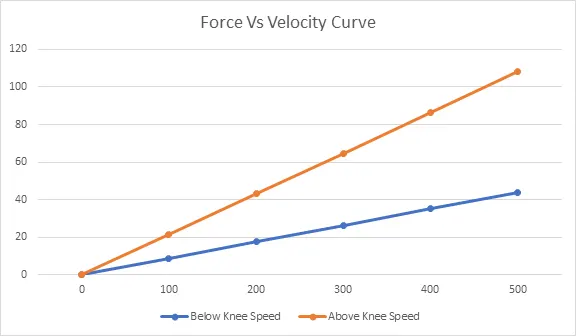
- Using the information calculated above, come up with a force vs. velocity shock curve for the front and rearsuspensions (velocity range = 0 to 500 mm/sec)
Below Knee speed
Compression force = Low speed compression damping * Damper velocity
= 0.0875 * 100 = 8.75
= 0.0875 * 200 = 17.5
= 0.0875 * 300 = 26.25
= 0.0875 * 400 = 35
= 0.0875 * 500 = 43.75
Above Knee Speed
Compression force = Compression force(n-1) + (Vn – V(n-1)) * High speed compression damping
= 0 + 100*0.216 = 21.6
= 21.6 + (200 – 100)*0.216 = 43.2
= 43.2 + (300-200)*0.216 = 64.8
= 64.8 + (400-300)*0.216 = 86.4
= 86.4 + (500-400)*0.216 = 108
Rebound force = Low speed rebound damping * Rebound ratio
= 0.2625 * 3 = 0.78