Understanding the concepts on Degrees of Freedom
Answer to the Question No. 1
Question:
1. A five storey structure with 5 translational DOF is shown here. Each storey has mass ‘m’. The eigenvalue problem has been solved and the 5 periods of vibration Tn and their corresponding mode shapes, φn has been derived.
Answer:
Aim: Aim to the question is to given five storey structure with 5 translational DOF is shown here. Each storey has mass ‘m’. The eigenvalue problem has been solved and the 5 periods of vibration Tn and their corresponding mode shapes, φn has been derived.
Objective & Introducton: Objective of the question:
- To understand modes of multi-storey building.
- Manually calculated the base shear for a story building in model analysis.
- Understand the terminologies involved in mdel analysis
Procedure:
Pseudo acceleration in terms of for vertical loading we have yet gravitational acceleration, we are analysis Horizontal load. Horizontal deformation Horizontal acceleration is required.
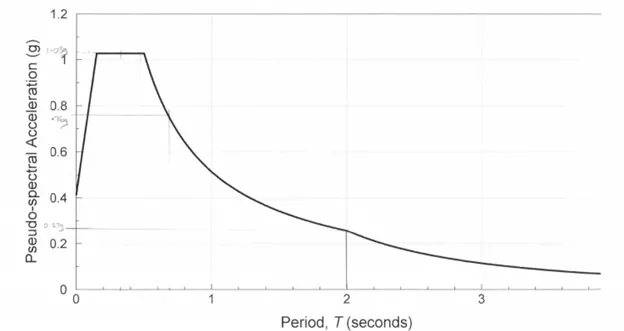
To convert the horizontal force into relative base shear for a particular high rise building we neec to convert Horizontal mass into force with the relative acceleration only it cannot be it suppose to be Downward direction for the horizontal mass we have to multiple acceleration factor that is called Pseudo Spectrum acceleration which will be shown of this graph show time period in the x direction nd Pseudo acceleration in the y direction.
Calculation:
Mass matrix (m) =`[[m,0,0,0,0],[0,m,0,0,0],[0,0,m,0,0],[0,0,0,m,0],[0,0,0,0,m]]`
Modifiedcmass matrix (M) = `Φnt . m. Φn`
For the First mode=
(n=1)
`[[0.334,0.641,0.895,1.078,1.173]][[m,0,0,0,0],[0,m,0,0,0],[0,0,m,0,0],[0,0,0,m,0],[0,0,0,0,m]] [[0.334],[0.641],[0.895],[1.078],[1.173]]`
M1 = 3.861m
Model Property (L) = `Φnt . m.l`
where `l` = influencer vector (Assuming 100% utilization of seismic force)= `[[1],[1],[1],[1],[1]]`
For the first mode=
(n=1)
`[[0.334,0.641,0.895,1.078,1.173]][[m,0,0,0,0],[0,m,0,0,0],[0,0,m,0,0],[0,0,0,m,0],[0,0,0,0,m]] [[1],[1],[1],[1],[1]]`
L1= 4.121m
Model participation factor = L/M
For the first mode, Model participation factor = `(L1)/(M1)`
(n=1)
Model participation factor-1 = 4.121/3.861m
= 1.067
similarly
Model participation factor-2 = -0.335
Model participation factor-3 = 0.177
Model participation factor-4 = -0.098
Model participation factor-5 = 0.045
Effective Model mass (M*) = `(Ln^2)/(Mn)`
For the first mode, M1 = `(L1 )/(M1)`
(n=1)
M1* = `(4.121m)^2/(3.861m)`
M1* = 4.398m
Similrly,
M1*= 0.436m
M1*= 0.121m
M1*= 0.038m
M1*= 0.008m
Model Mass participation Ratio = `(Mn)/(mj)`
Where , mj = Total mass of building = m+m+m+m+m= 5m
model mass participation ratio of first mode (n=1) = 4.398/5m= 0.88
Similarly,
Second mode (n=2) = 0.09
Third mode (n=3) = 0.02
Fourth mode (n=4) = 0.01
Fifth mode (n=5) = 0.002
Adding Firstt wo mode mass participation ratio we get 0.88+ 0.09 = 0.97 to achieve minimum 90% of model mass participation ration, First two modes are enough.

Base share can be calculated by multiplying effective model mass with pseudo acceleration. A
Base shear (VB) = `Mn**.An`
For the first mode , VB1 = 4.398m x 0.27g
(n=1)
VB1 = 1.187mg
similarly, VB2= 0.327 mg
VB3 = 0.126mg
VB4 = 0.039mg
VB5 = 0.008mg
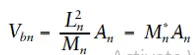
Average Base shear is calculated by the method of Square roott sum of square
= `√ (Vb1) + (Vb2^2) + (Vb3^2) + Vb4^2 + Vb5^2`
VB = 1.15g