Understanding the concepts on Degrees of Freedom
AIM:-
A five storey structure with 5 translational DOF is shown here. Each storey has mass ‘m’. The eigenvalue problem has been solved and the 5 periods of vibration Tn and their corresponding mode shapes, φn has been derived.
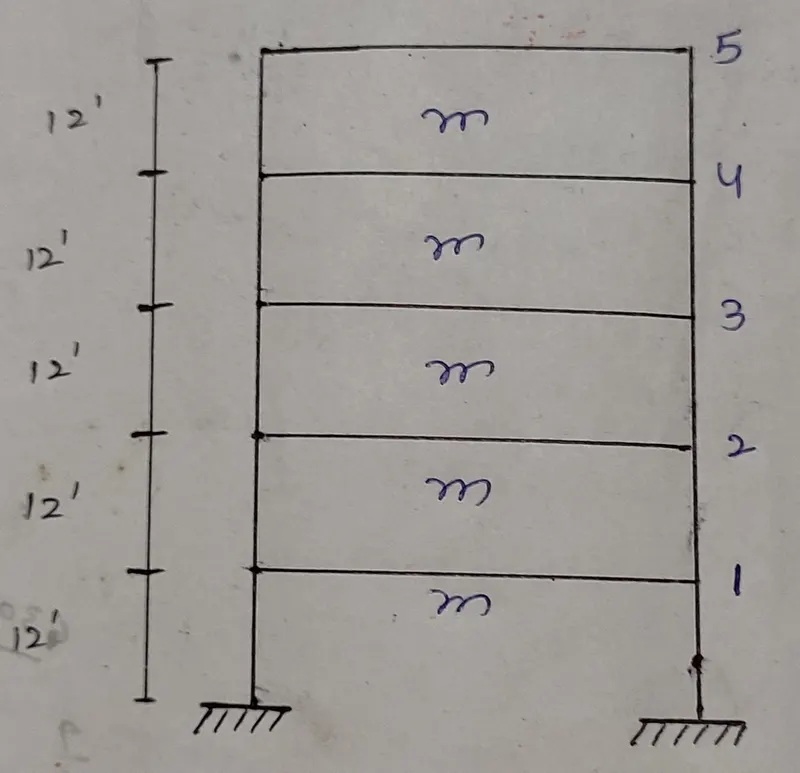
1.The fundamental period of vibration (T1 = 2 seconds) and its associated mode shape:
`phi1={(0.334),(0.641),(0.895),(1.078),(1.173):}`
- To Calculate Ln, Mn,& Tn For each of the five modes.
- To calculate the effective modal mass Mn* and the modal mass participating ratio for the five modes.
- To find the base shear for each of the 5 modes of vibration and the combined base shear as per SRSS rule.
1) To Find out the modal mass (Mn)of a given story.
A) For First Node - T= 2sec
i) We know that,
Modal Mass (Mn) = ønTmøn
Where,
m = Mass Matrix
øn =Mode shape @ nth Mode
ønT = Transpose of Mode Shape

ii) So, For First node (T1) =2 Sec
Since
`1.Mass Matrix m = [[m,0,0,0,0],[0,m,0,0,0],[0,0,m,0,0],[0,0,0,m,0],[0,0,0,0,m]]`
2. Since the degree of freedom move along the direction of the lateral force, the influence vector will be unity.
3.Infuence Vector, `iota =[[1],[1],[1],[1],[1]]`
1.Calculation of Ln:-
- Ln = `phi`nTm`iota`
For mode.1,
- L1 = `phi`nTm`iota`
- L1 = {(0.334),(0.641),(0.895),(1.078),(1.173):}` [[m,0,0,0,0],[0,m,0,0,0],[0,0,m,0,0],[0,0,0,m,0],[0,0,0,0,m]]``[[1],[1],[1],[1],[1]]`
- L1 =4.121m
For mode,2.
The second mode of vibration (T2 = 0.6852 seconds) and its associated mode shape:
`phi2={(-0.895),(-1.173),(-0.641),(0.334),(1.078):}`
- L2 = `phi`nTm`iota`
L2 ={(-0.895),(-1.173),(-0.641),(0.334),(1.078):}`` [[m,0,0,0,0],[0,m,0,0,0],[0,0,m,0,0],[0,0,0,m,0],[0,0,0,0,m]]``[[1],[1],[1],[1],[1]]`
L2 =1.297m
For mode,3.
The third mode of vibration (T3 = 0.4346 seconds) and its associated mode shape:
`phi3={(1.173),(0.334),(-1.078),(-0.641),(0.895):}`
- L3 = `phi`nTm`iota`
L3 ={(1.173),(0.334),(-1.078),(-0.641),(0.895):}`[[m,0,0,0,0],[0,m,0,0,0],[0,0,m,0,0],[0,0,0,m,0],[0,0,0,0,m]]``[[1],[1],[1],[1],[1]]`
L3 =0.683m
For mode,4.
The fourth mode of vibration (T4 = 0.3383 seconds) and its associated mode shape:
`phi4={(-1.078),(0.895),(0.334),(-1.173),(0.641):}`
L4 = `phi`nTm`iota`
L4 ={(-1.078),(0.895),(0.334),(-1.173),(0.641):}`[[m,0,0,0,0],[0,m,0,0,0],[0,0,m,0,0],[0,0,0,m,0],[0,0,0,0,m]]``[[1],[1],[1],[1],[1]]`
L4 =-0.381m
For mode,5.
The fifth mode of vibration (T4 = 0.2966 seconds) and its associated mode shape:
`phi5={(0.641),(-1.078),(1.173),(-0.895),(0.334):}`
L5 = `phi`nTm`iota`
L5 ={(0.641),(-1.078),(1.173),(-0.895),(0.334):}`[[m,0,0,0,0],[0,m,0,0,0],[0,0,m,0,0],[0,0,0,m,0],[0,0,0,0,m]]``[[1],[1],[1],[1],[1]]`
L5 =0.175m
2.Calculation of Modified Mass Matrix,Mn:-
- Mn = `phi^Tn^mphin`
For mode,1.
- M1= `phi^T1^mphin`
`M1=(0.334),(0.641),(0.895),(1.078),(1.173)``[[m,0,0,0,0],[0,m,0,0,0],[0,0,m,0,0],[0,0,0,m,0],[0,0,0,0,m]]``[[0.334],[0.641],[0.895],[1.078],[1.173]]`
M1 =3.861m
For mode,2.
- M2= `phi^T2^mphin`
`M2=(-0.895),(-1.173),(-0.641),(0.334),(1.078)``[[m,0,0,0,0],[0,m,0,0,0],[0,0,m,0,0],[0,0,0,m,0],[0,0,0,0,m]]``[[-0.895],[-1.173],[-0.641],[0.334],[1.078]]`
M2 =3.861m
For mode,3.
- M3= `phi^T2^mphin`
`M3=[1.173 0.334 -1.078 -0.641 0.895]``[[m,0,0,0,0],[0,m,0,0,0],[0,0,m,0,0],[0,0,0,m,0],[0,0,0,0,m]]``[[1.173],[0.334],[-1.078],[-0.641],[0.895]]`
M3=3.861m
For mode,4.
- M3= `phi^T2^mphin`
-
1.The fundamental period of vibration (T1 = 2 seconds) and its associated mode shape:
`phi1={(0.334),(0.641),(0.895),(1.078),(1.173):}`
- To Calculate Ln, Mn,& Tn For each of the five modes.
- To calculate the effective modal mass Mn* and the modal mass participating ratio for the five modes.
- To find the base shear for each of the 5 modes of vibration and the combined base shear as per SRSS rule.
1) To Find out the modal mass (Mn)of a given story.
A) For First Node - T= 2sec
i) We know that,
Modal Mass (Mn) = ønTmøn - - - - - - - - - - - - - -(A)
Where,
m = Mass Matrix
øn =Mode shape @ nth Mode
ønT = Transpose of Mode Shapeii) So, For First node (T1) =2 Sec
Since
`1.Mass Matrix m = [[m,0,0,0,0],[0,m,0,0,0],[0,0,m,0,0],[0,0,0,m,0],[0,0,0,0,m]]`
2. Since the degree of freedom move along the direction of the lateral force, the influence vector will be unity.
3.Infuence Vector, `iota =[[1],[1],[1],[1],[1]]`
1.Calculation of Ln:-
- Ln = `phi`nTm`iota`
For mode.1,
- L1 = `phi`nTm`iota`
- L1 = {(0.334),(0.641),(0.895),(1.078),(1.173):}` [[m,0,0,0,0],[0,m,0,0,0],[0,0,m,0,0],[0,0,0,m,0],[0,0,0,0,m]]``[[1],[1],[1],[1],[1]]`
- L1 =4.121m
For mode,2.
The second mode of vibration (T2 = 0.6852 seconds) and its associated mode shape:
`phi2={(-0.895),(-1.173),(-0.641),(0.334),(1.078):}`
- L2 = `phi`nTm`iota`
L2 ={(-0.895),(-1.173),(-0.641),(0.334),(1.078):}`` [[m,0,0,0,0],[0,m,0,0,0],[0,0,m,0,0],[0,0,0,m,0],[0,0,0,0,m]]``[[1],[1],[1],[1],[1]]`
L2 =1.297m
For mode,3.
The third mode of vibration (T3 = 0.4346 seconds) and its associated mode shape:
`phi3={(1.173),(0.334),(-1.078),(-0.641),(0.895):}`
- L3 = `phi`nTm`iota`
L3 ={(1.173),(0.334),(-1.078),(-0.641),(0.895):}`[[m,0,0,0,0],[0,m,0,0,0],[0,0,m,0,0],[0,0,0,m,0],[0,0,0,0,m]]``[[1],[1],[1],[1],[1]]`
L3 =0.683m
For mode,4.
The fourth mode of vibration (T4 = 0.3383 seconds) and its associated mode shape:
`phi4={(-1.078),(0.895),(0.334),(-1.173),(0.641):}`
L4 = `phi`nTm`iota`
L4 ={(-1.078),(0.895),(0.334),(-1.173),(0.641):}`[[m,0,0,0,0],[0,m,0,0,0],[0,0,m,0,0],[0,0,0,m,0],[0,0,0,0,m]]``[[1],[1],[1],[1],[1]]`
L4 =-0.381m
For mode,5.
The fifth mode of vibration (T4 = 0.2966 seconds) and its associated mode shape:
`phi5={(0.641),(-1.078),(1.173),(-0.895),(0.334):}`
L5 = `phi`nTm`iota`
L5 ={(0.641),(-1.078),(1.173),(-0.895),(0.334):}`[[m,0,0,0,0],[0,m,0,0,0],[0,0,m,0,0],[0,0,0,m,0],[0,0,0,0,m]]``[[1],[1],[1],[1],[1]]`
L5 =0.175m
2.Calculation of Modified Mass Matrix,Mn:-
- Mn = `phi^Tn^mphin`
For mode,1.
- M1= `phi^T1^mphin`
`M1=(0.334),(0.641),(0.895),(1.078),(1.173)``[[m,0,0,0,0],[0,m,0,0,0],[0,0,m,0,0],[0,0,0,m,0],[0,0,0,0,m]]``[[0.334],[0.641],[0.895],[1.078],[1.173]]`
M1 =3.861m
For mode,2.
- M2= `phi^T2^mphin`
`M2=[-0.895 -1.173 -0.641 0.334 1.078]``[[m,0,0,0,0],[0,m,0,0,0],[0,0,m,0,0],[0,0,0,m,0],[0,0,0,0,m]]``[[-0.895],[-1.173],[-0.641],[0.334],[1.078]]`
M2 =3.861m
For mode,3.
- M3= `phi^T2^mphin`
`M3=[1.173 0.334 -1.078 -0.641 0.895]``[[m,0,0,0,0],[0,m,0,0,0],[0,0,m,0,0],[0,0,0,m,0],[0,0,0,0,m]]``[[1.173],[0.334],[-1.078],[-0.641],[0.895]]`
M3=3.861m
For mode,4.
M4= `phi^T2^mphin
`M4=[-1.078 0.895 0.334 -1.173 0.641]``[[m,0,0,0,0],[0,m,0,0,0],[0,0,m,0,0],[0,0,0,m,0],[0,0,0,0,m]]``[[-1.078],[0.895],[0.334],[-1.173],[0.641]]`
M4=3.861m
For mode,5.
- M5= `phi^T2^mphin
`M5=[0.641 -1.078 1.173 -0.895 0.334]``[[m,0,0,0,0],[0,m,0,0,0],[0,0,m,0,0],[0,0,0,m,0],[0,0,0,0,m]]``[[0.641],[-1.078],[1.173],[-0.895],[0.334]]`
M5=3.861m
- 3. Calculation of Γn :-
Γn = Ln/Mn
For mode 1,
Γ1 =(4.121m/3.861m)
Γ1 = 1.067
For mode 2,
Γ2 =(-1.297m/3.861m)
Γ2 = 0.336
For mode 3,
Γ3 =(0.683m/3.861m)
Γ3 = 0.177
For mode 4,
Γ4=(-0.381m/3.861m)
Γ4= -0.098
For mode 5,
Γ5=(0.175m/3.861m)
Γ5= 0.045
4. Calculation of Effective Modified Mass, Mn* :-
- Mn* = `L^2`L2n/Mn
For mode 1,
M1* = `L^2`L21/M1
M1* = ((`4.121m)^2`/3.861m
M1* = 4.399m
For mode2,
M2* = `L^2`L22/M2
M2* = ((`-1.297m)^2`/3.861m
M2* = 0.435m
For mode3,
M3* = `L^2`L23/M3
M3* = ((`0.683m)^2`/3.861m
M3* = 0.121m
For mode4,
M4* = `L^2`L24/M4
M4* = ((`-0.381m)^2`/3.861m
M4* = 0.037m
For mode5,
M5* = `L^2`L25/M5
M5* = ((`0.175m)^2`/3.861m
M5* = 0.008m
5.Calculation of model mass participating Ratio:-
- Participating Ratio:- = Mn* /Mj
Where, Mj = M1*+M2*+M3*+M4*+M5* = 5m (Sum of mass of each floor)
For mode1,
- Participating Ratio:- = M1* /Mj = 0.8798
For mode2,
- Participating Ratio:- = M2* /Mj = 0.087
For mode3,
- Participating Ratio:- = M3* /Mj = 0.0242
For mode4,
- Participating Ratio:-= M4* /Mj = 0.0074
For mode5,
- Participating Ratio:- = M5* /Mj = 0.0016
Verifying,
The total mass of the building = m+m+m+m+m = 5m
Adding all effective modal mass = M1*+M2*+M3*+M4*+M5* =5m
Hence ok
- From the above participation ratios of modal mass, we can say that Sum of modal 1 and
modal 2 are enough to obtain a minimum of 90%of the participation.
- 0.8796+0.087 =0.9666 = 96.66%
6. Calculation of Base Shear (Vbn) :-
- Vbn = An * Mn*
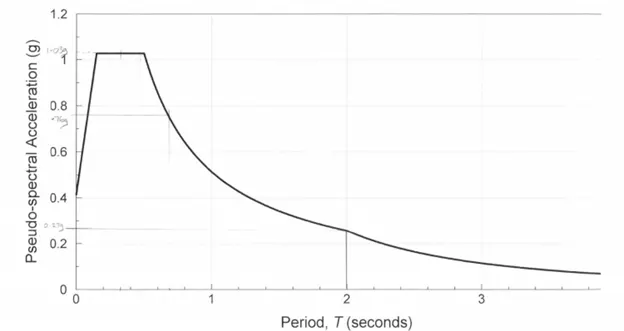
From the pseudo Acceleration dessign spectrum graph Acceleration for each
Modes are:-
- For T1 =2 Seconds, A 1= 0.279
- For T2= 0.6852 Second, A2 = 0.769
- For T3=0.4346 Second, A3 = 1.039
- For T4=0.3383 Second, A4= 1.039
- For T5=0.2966 Second, A5= 1.039
For mode1,
- Vb1 = A1 * M1*
Vb1 = (0.279)*(0.279m)
Vb1 = 1.227m
For mode2,
- Vb2 = A2 * M2*
Vb2 = (0.769)*(0.435m)
Vb2 = 0.334m
For mode3,
- Vb3 = A3 * M3*
Vb3 = (1.039)*(0.121m)
Vb3 = 0.126m
For mode4,
- Vb4 = A4 * M4*
Vb4 = (1.039)*(0.037m)
Vb4 = 0.038m
For mode5,
- Vb5 = A5 * M5*
For T5 = 2 Seconds, A5 = 0.27g
Vb5 = (1.039)*(0.008m)
Vb5 = 0.008m
7. Calculation of Combined Base Shear as per SRSS rule :-
- `V^2B` = `V^2b1+V^2b2+V^2b3+V^2b4+V^2b5`
`V^2B` = `(1.227m)^2+(0.334m)^2+(0.126m)^2+(0.038m)^2+(0.008m)^2`
VB = `sqrt 1.634m`
Result:- VB = 1.278m